Thank you for visiting SNEWPapers!
Sign up free
Editorial
April 17, 1934
The Daily Worker
Chicago, Cook County, Illinois
What is this article about?
An editorial criticizes sectarianism among veteran Communist Party members in New Hampshire, who reject suggestions from native-born workers and fail to integrate them into leadership. It calls for rooting out old cliques, promoting new members, and expanding activities to reach broader proletarian masses.
Clipping
OCR Quality
98%
Excellent
Full Text
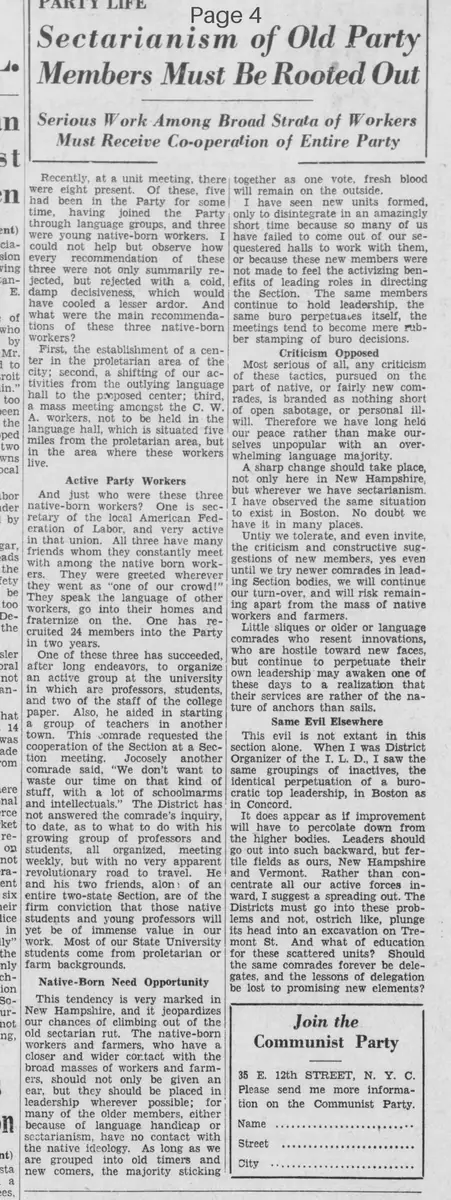
Sectarianism of Old Party Members Must Be Rooted Out
Serious Work Among Broad Strata of Workers Must Receive Co-operation of Entire Party
Recently, at a unit meeting, there were eight present. Of these, five had been in the Party for some time, having joined the Party through language groups, and three were young native-born workers. I could not help but observe how every recommendation of these three were not only summarily rejected, but rejected with a cold, damp decisiveness, which would have cooled a lesser ardor. And what were the main recommendations of these three native-born workers?
First, the establishment of a center in the proletarian area of the city; second, a shifting of our activities from the outlying language hall to the proposed center; third, a mass meeting amongst the C. W. A. workers, not to be held in the language hall, which is situated five miles from the proletarian area, but in the area where these workers live.
Active Party Workers
And just who were these three native-born workers? One is secretary of the local American Federation of Labor, and very active in that union. All three have many friends whom they constantly meet with among the native born workers. They were greeted wherever they went as 'one of our crowd!' They speak the language of other workers, go into their homes and fraternize on the. One has recruited 24 members into the Party in two years.
One of these three has succeeded, after long endeavors, to organize an active group at the university in which are professors, students, and two of the staff of the college paper. Also, he aided in starting a group of teachers in another town. This comrade requested the cooperation of the Section at a Section meeting. Jocosely another comrade said, 'We don't want to waste our time on that kind of stuff, with a lot of schoolmarms and intellectuals.' The District has not answered the comrade's inquiry, to date, as to what to do with his growing group of professors and students, all organized, meeting weekly, but with no very apparent revolutionary road to travel. He and his two friends, alone of an entire two-state Section, are of the firm conviction that those native students and young professors will yet be of immense value in our work. Most of our State University students come from proletarian or farm backgrounds.
Native-Born Need Opportunity
This tendency is very marked in New Hampshire, and it jeopardizes our chances of climbing out of the old sectarian rut. The native-born workers and farmers, who have a closer and wider contact with the broad masses of workers and farmers, should not only be given an ear, but they should be placed in leadership wherever possible; for many of the older members, either because of language handicap or sectarianism, have no contact with the native ideology. As long as we are grouped into old timers and new comers, the majority sticking will remain on the outside.
I have seen new units formed only to disintegrate in an amazingly short time because so many of us have failed to come out of our sequestered halls to work with them, or because these new members were not made to feel the activizing benefits of leading roles in directing the Section. The same members continue to hold leadership, the same buro perpetuates itself, the meetings tend to become mere rubber stamping of buro decisions.
Criticism Opposed
Most serious of all, any criticism of these tactics, pursued on the part of native, or fairly new comrades, is branded as nothing short of open sabotage, or personal ill will. Therefore we have long held our peace rather than make ourselves unpopular with an overwhelming language majority.
A sharp change should take place, not only here in New Hampshire, but wherever we have sectarianism. I have observed the same situation to exist in Boston. No doubt we have it in many places.
Until we tolerate, and even invite, the criticism and constructive suggestions of new members, yes even until we try newer comrades in leading Section bodies, we will continue our turn-over, and will risk remaining apart from the mass of native workers and farmers.
Little cliques or older or language comrades who resent innovations, who are hostile toward new faces, but continue to perpetuate their own leadership may awaken one of these days to a realization that their services are rather of the nature of anchors than sails.
Same Evil Elsewhere
This evil is not extant in this section alone. When I was District Organizer of the I. L. D., I saw the same groupings of inactives, the identical perpetuation of a bureaucratic top leadership, in Boston as in Concord.
It does appear as if improvement will have to percolate down from the higher bodies. Leaders should go out into such backward, but fertile fields as ours, New Hampshire and Vermont. Rather than concentrate all our active forces inward, I suggest a spreading out. The Districts must go into these problems and not, ostrich like, plunge its head into an excavation on Tremont St. And what of education for these scattered units? Should the same comrades forever be delegates, and the lessons of delegation be lost to promising new elements?
Serious Work Among Broad Strata of Workers Must Receive Co-operation of Entire Party
Recently, at a unit meeting, there were eight present. Of these, five had been in the Party for some time, having joined the Party through language groups, and three were young native-born workers. I could not help but observe how every recommendation of these three were not only summarily rejected, but rejected with a cold, damp decisiveness, which would have cooled a lesser ardor. And what were the main recommendations of these three native-born workers?
First, the establishment of a center in the proletarian area of the city; second, a shifting of our activities from the outlying language hall to the proposed center; third, a mass meeting amongst the C. W. A. workers, not to be held in the language hall, which is situated five miles from the proletarian area, but in the area where these workers live.
Active Party Workers
And just who were these three native-born workers? One is secretary of the local American Federation of Labor, and very active in that union. All three have many friends whom they constantly meet with among the native born workers. They were greeted wherever they went as 'one of our crowd!' They speak the language of other workers, go into their homes and fraternize on the. One has recruited 24 members into the Party in two years.
One of these three has succeeded, after long endeavors, to organize an active group at the university in which are professors, students, and two of the staff of the college paper. Also, he aided in starting a group of teachers in another town. This comrade requested the cooperation of the Section at a Section meeting. Jocosely another comrade said, 'We don't want to waste our time on that kind of stuff, with a lot of schoolmarms and intellectuals.' The District has not answered the comrade's inquiry, to date, as to what to do with his growing group of professors and students, all organized, meeting weekly, but with no very apparent revolutionary road to travel. He and his two friends, alone of an entire two-state Section, are of the firm conviction that those native students and young professors will yet be of immense value in our work. Most of our State University students come from proletarian or farm backgrounds.
Native-Born Need Opportunity
This tendency is very marked in New Hampshire, and it jeopardizes our chances of climbing out of the old sectarian rut. The native-born workers and farmers, who have a closer and wider contact with the broad masses of workers and farmers, should not only be given an ear, but they should be placed in leadership wherever possible; for many of the older members, either because of language handicap or sectarianism, have no contact with the native ideology. As long as we are grouped into old timers and new comers, the majority sticking will remain on the outside.
I have seen new units formed only to disintegrate in an amazingly short time because so many of us have failed to come out of our sequestered halls to work with them, or because these new members were not made to feel the activizing benefits of leading roles in directing the Section. The same members continue to hold leadership, the same buro perpetuates itself, the meetings tend to become mere rubber stamping of buro decisions.
Criticism Opposed
Most serious of all, any criticism of these tactics, pursued on the part of native, or fairly new comrades, is branded as nothing short of open sabotage, or personal ill will. Therefore we have long held our peace rather than make ourselves unpopular with an overwhelming language majority.
A sharp change should take place, not only here in New Hampshire, but wherever we have sectarianism. I have observed the same situation to exist in Boston. No doubt we have it in many places.
Until we tolerate, and even invite, the criticism and constructive suggestions of new members, yes even until we try newer comrades in leading Section bodies, we will continue our turn-over, and will risk remaining apart from the mass of native workers and farmers.
Little cliques or older or language comrades who resent innovations, who are hostile toward new faces, but continue to perpetuate their own leadership may awaken one of these days to a realization that their services are rather of the nature of anchors than sails.
Same Evil Elsewhere
This evil is not extant in this section alone. When I was District Organizer of the I. L. D., I saw the same groupings of inactives, the identical perpetuation of a bureaucratic top leadership, in Boston as in Concord.
It does appear as if improvement will have to percolate down from the higher bodies. Leaders should go out into such backward, but fertile fields as ours, New Hampshire and Vermont. Rather than concentrate all our active forces inward, I suggest a spreading out. The Districts must go into these problems and not, ostrich like, plunge its head into an excavation on Tremont St. And what of education for these scattered units? Should the same comrades forever be delegates, and the lessons of delegation be lost to promising new elements?
What sub-type of article is it?
Partisan Politics
Labor
What keywords are associated?
Sectarianism
Party Members
Native Born Workers
Leadership Roles
Proletarian Areas
Party Criticism
Bureaucracy
Organizing Workers
What entities or persons were involved?
Native Born Workers
Old Party Members
Language Groups
American Federation Of Labor
University Professors And Students
I. L. D.
Party Section
Party District
Editorial Details
Primary Topic
Rooting Out Sectarianism In The Party To Integrate Native Born Workers
Stance / Tone
Strongly Critical Of Old Party Sectarianism And Advocacy For Leadership Opportunities For New Native Born Members
Key Figures
Native Born Workers
Old Party Members
Language Groups
American Federation Of Labor
University Professors And Students
I. L. D.
Party Section
Party District
Key Arguments
Old Party Members Reject Recommendations From Native Born Workers
Native Born Workers Have Better Contacts With Masses And Should Be Given Leadership
Criticism From New Members Is Branded As Sabotage
Sectarianism Leads To High Turnover And Isolation From Native Workers
Party Activities Should Shift To Proletarian Areas
Need For Cooperation From Higher Bodies To Address Issues In Places Like New Hampshire And Vermont