Thank you for visiting SNEWPapers!
Sign up free
Alexandria Gazette, Commercial And Political
Alexandria, Virginia
What is this article about?
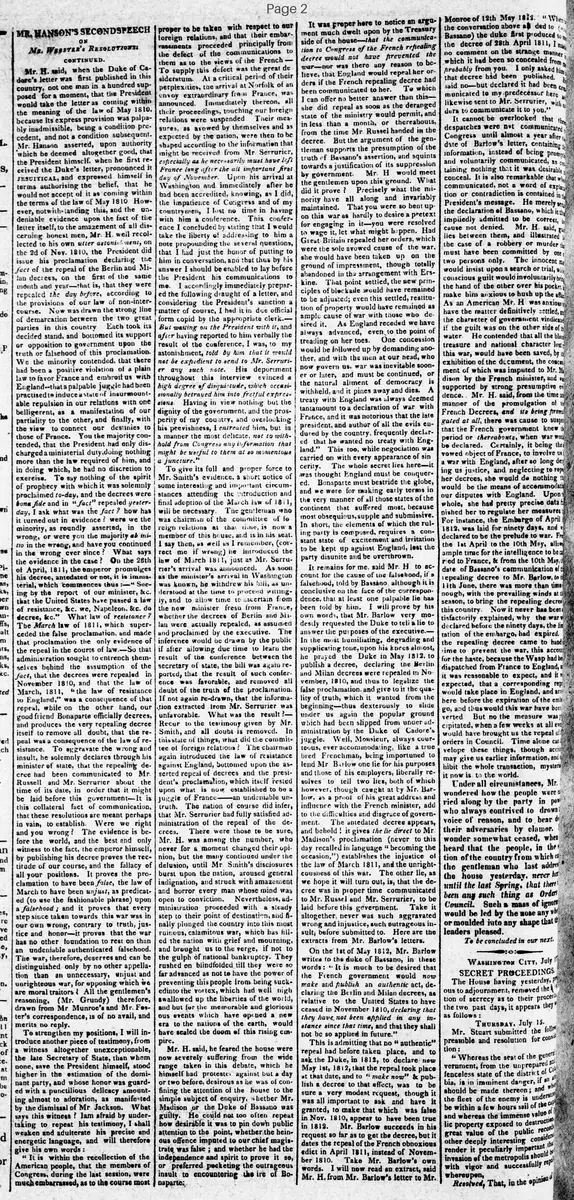
Transcript of Mr. Hanson's speech in the U.S. House criticizing President Madison's 1810 proclamation on the French repeal of Berlin and Milan decrees as false, arguing it led to an unjust War of 1812 with England, and referencing communications with French ministers like Serrurier and Barlow.
Clipping
OCR Quality
Full Text
Mr. H. said, when the Duke of Cadore's letter was first published in this country, not one man in a hundred supposed for a moment, that the President would take the letter as coming within the meaning of the law of May 1810.
because its express provision was palpably inadmissible, being a condition precedent, and not a condition subsequent.
Mr. Hanson asserted, upon authority which he deemed altogether good, that the President himself, when he first received the Duke's letter, pronounced it JESUITICAL, and expressed himself in terms authorising the belief, that he would not accept of it as coming within the terms of the law of May 1810. However, notwithstanding this, and the undeniable evidence upon the fact of the letter itself, to the amazement of all discerning honest men, Mr. H. well recollected to his own utter astonishment, on the 2d of Nov. 1810, the President did issue his proclamation declaring the fact of the repeal of the Berlin and Milan decrees, on the first of the same month and year-that is, that they were repealed the day before, according to the provisions of our law of non-intercourse. Now was drawn the strong line of demarcation between the two great parties in this country. Each took its decided stand, and bottomed its support or opposition to government upon the truth or falsehood of this proclamation.
We the minority contended, that there had been a positive violation of a plain law to favor France and embroil us with England--that a palpable juggle had been practised to induce a state of insurmountable repulsion in our relations with one belligerent, as a manifestation of our partiality to the other, and finally, with the view to connect our destinies to those of France. You the majority contended, that the President had only discharged a ministerial duty, doing nothing more than the law required of him, and in doing which, he had no discretion to exercise. To say nothing of the spirit of prophecy with which it was solemnly proclaimed to-day, and the decrees were bona fide and in "fact" repealed yesterday, I ask what was the fact? how has it turned out in evidence? were we the minority, as roundly asserted, in the wrong, or were you the majority ab initio in the wrong, and have you continued in the wrong ever since? What says the evidence in the case? On the 28th of April, 1811, the emperor promulgates his decree, antedated or not, it is immaterial, which commences thus:--"Seeing by the report of our minister, &c. that the United States have passed a law of resistance, &c. we, Napoleon, &c. do decree, &c." What law of resistance? The March law of 1811, which superceded the false proclamation, and made that proclamation the only evidence of the repeal in the courts of law.--So that administration sought to entrench themselves behind the assumption of the fact, that the decrees were repealed in November 1810, and that the law of March, 1811, "the law of resistance to England," was a consequence of that repeal, while on the other hand, our good friend Bonaparte officially decrees, and produces the very repealing decree itself to remove all doubt, that the repeal was a consequence of the law of resistance. To aggravate the wrong and insult, he solemnly declares through his minister of state, that the repealing decree had been communicated to Mr. Russell and Mr. Serrurier about the time of its date, in order that it might be laid before this government-It is this collateral fact of communication, that these resolutions are meant perhaps in vain, to establish. Were we right and you wrong? The evidence is before the world, and the best and only witness to the fact, the emperor himself, by publishing his decree proves the rectitude of our course, and the fallacy of all your positions. It proves the proclamation to have been false, the law of March to have been unjust, as predicated (to use the fashionable phrase) upon a falsehood; and it proves that every step since taken towards this war was in our own wrong, contrary to truth, justice and honor-it proves that the war has no other foundation to rest on than an undeniable authenticated falsehood.
The war, therefore, deserves and can be distinguished only by no other appellation than an unnecessary, unjust and unrighteous war, for opposing which we are moral traitors! All the gentlemen's reasoning, (Mr. Grundy) therefore, drawn from Mr Monroe's and Mr. Foster's correspondence, is of no avail, and merits no reply.
To strengthen my positions, I will introduce another piece of testimony, from a witness altogether unexceptionable, the late Secretary of State, than whom none, save the President himself, stood higher in the estimation of the dominant party, and whose honor was guarded with a punctilious delicacy amounting almost to adoration, as manifested by the dismissal of Mr Jackson. What says this witness? I am afraid by undertaking to repeat his testimony, I shall weaken and adulterate his precise and energetic language, and will therefore give his own words:
"It is within the recollection of the American people, that the members of Congress, during the last session, were much embarrassed, as to the course most proper to be taken with respect to our foreign relations, and that their embarrassments proceeded principally from the defect of the communications to them as to the views of the French -
To supply this defect was the great desideratum. At a critical period of their perplexities, the arrival at Norfolk of an envoy extraordinary from France, was announced. Immediately thereon, all their proceedings, touching our foreign relations were suspended Their measures, as avowed by themselves and as expected by the nation, were then to be shaped according to the information that might be received from Mr Serrurier, especially as he necessarily must have left France long after the all important first day of November. Upon his arrival at Washington and immediately after he had been accredited, knowing, as I did, the impatience of Congress and of my countrymen, I lost no time in having with him a conference. This conference I concluded by stating that I would take the liberty of addressing to him a note propounding the several questions, that I had just the honor of putting to him in conversation, and that thus by his answer I should be enabled to lay before the President his communications to me. I accordingly immediately prepared the following draught of a letter, and considering the President's sanction a matter of course, I had it in due official form copied by the appropriate clerk.-- But waiting on the President with it, and after having reported to him verbally the result of the conference, I was, to my astonishment, told by him that it would not be expedient to send to Mr. Serrurier any such note. His deportment throughout this interview evinced a high degree of disquietude, which occasionally betrayed him into fretful expressions. Having in view nothing but the dignity of the government, and the prosperity of my country, and overlooking his peevishness, I entreated him, but in a manner the most delicate, not to withhold from Congress any information that might be useful to them at so momentous a juncture.
To give its full and proper force to Mr. Smith's evidence, a short notice of some interesting and important circumstances attending the introduction and final adoption of the March law of 1811, will be necessary. The gentleman who was chairman of the committee of foreign relations at that time, is now a member of this house, and is in his seat. I say then, as well as I remember, (correct me if wrong) he introduced the law of March 1811, just as Mr. Serrurier's arrival was announced. As soon as the minister's arrival in Washington was known, he withdrew his bill, as understood at the time to proceed willingly, and to allow time to ascertain from the new minister fresh from France, whether the decrees of Berlin and Milan were actually repealed, as assumed and proclaimed by the executive. The inference would be drawn by the public if after allowing due time to learn the result of the conference between the secretary of state, the bill was again reported, that the result of such conference was favorable, and removed all doubt of the truth of the proclamation. If not again re-drawn, that the information extracted from Mr. Serrurier was unfavorable. What was the result?- Recur to the testimony given by Mr. Smith, and all doubt is removed. In this state of things, what did the committee of foreign relations? The chairman again introduced the law of resistance against England, bottomed upon the asserted repeal of decrees and the president's proclamation, which itself rested upon what is now established to be a juggle of France--an undeniable untruth. The nation of course did infer, that Mr. Serrurier had fully satisfied administration of the repeal of the decrees.
There were those to be sure, Mr. H. was among the number, who never for a moment changed their opinion, but the many continued under the delusion, until Mr Smith's disclosures burst upon the nation, aroused general indignation, and struck with amazement and horror every man whose mind was open to conviction. Nevertheless, administration proceeded with a steady step to their point of destination, and finally plunged the country into this most ruinous, calamitous war, which has filled the nation with grief and mourning, and brought us to the verge, if not to the gulph of national bankruptcy. They rushed on blindfolded till they were so far advanced as not to have the power of preventing this people from being sucked into the vortex, which had wellnigh swallowed up the liberties of the world, and but for the memorable and glorious events which have opened a new era to the nations of the earth, would have sealed the doom of this rising empire.
Mr. H. said, he feared the house were now severely suffering from the wide range taken in this debate, which he himself had protested against but a day or two before, desirous as he was of confining the attention of the house to the simple subject of enquiry, whether Mr. Madison or the Duke of Bassano was guilty. He could not too often repeat how desirable it was to pin down public attention to the point, whether the heinous offence imputed to our chief magistrate was false; and whether he had the independence and spirit to prove it so, or preferred pocketing the outrageous insult to encountering the ire of Bonaparte.
It was proper here to notice an argument much dwelt upon by the Treasury side of the house--that the communication to Congress of the French repealing decree would not have prevented the war-nor was there any reason to believe, that England would repeal her orders if the French repealing decree had been communicated to her. To which I can offer no better answer than this- she did repeal as soon as the deranged state of the ministry would permit, and in less than a month, or thereabouts, from the time Mr. Russel handed in the decree. But the argument of the gentleman supports the presumption of the truth of Bassano's assertion, and squints towards a justification of its suppression by government.
Mr. H would meet the gentlemen upon this ground. What did it prove? Precisely what the minority have all along and invariably maintained. That you were so bent up on this war as hardly to desire a pretext for engaging in it-you were resolved to wage it, let what might happen. Had Great Britain repealed her orders, which were the sole avowed cause of the war, she would have been taken up on the ground of impressment, though totally abandoned in the arrangement with Erskine. That point settled, the new principles of blockade would have remained to be adjusted; even this settled, restitution of property would have remained as ample cause of war with those who desired it. As England receded we have always advanced, even to the point of treading on her toes. One concession would be followed up by demanding another. and with the men at our head, who now govern us, war was inevitable sooner or later, and must be continued, or the natural aliment of democracy is withheld. and it pines away and dies. A treaty with England was always deemed tantamount to a declaration of war with France, and it was notorious that the late president, and author of all the evils endured by the country, frequently declared that he wanted no treaty with England." This too, while negociation was carried on with every appearance of sincerity. The whole secret lies here-it was thought England must be conquered. Bonaparte must bestride the globe, and we were for making early terms in the very manner of all those states of the continent that suffered most, because most obsequious, supple and submissive. In short, the elements of which the ruling party is composed, requires a constant state of excitement and irritation to be kept up against England, lost the party disunite and be overthrown.
It remains for me, said Mr. H to account for the cause of the falsehood, if a falsehood, told by Bassano, although it is conclusive on the face of the correspondence, that at least one palpable lie has been told by him. I will prove by his own words, that Mr. Barlow very modestly requested the Duke to tell a lie to answer the purposes of the executive.-- In the most humiliating, degrading and supplicating tone, upon his knees almost, he prayed the Duke in May 1812, to publish a decree, declaring the Berlin and Milan decrees were repealed in November, 1810, and thus to legalize the false proclamation. and give to it the quality of truth, which it wanted from the beginning-thus dexterously to slide under us again the popular ground which had been slipped from under administration by the Duke of Cadore's juggle: Well, Monsieur, always courteous, ever accommodating, like a true bred Frenchman, being importuned to lend Mr Barlow one lie for his purposes and those of his employers, liberally resolves to tell two lies, both of which however, though caught at by Mr. Barlow, as a proof of his great address and influence with the French minister, add to the difficulties and disgrace of government. The antedated decree appears, and behold! it gives the lie direct to Mr Madison's proclamation (never to this day recalled in language "becoming the occasion,"), establishes the injustice of the law of March 1811, and the unrighteousness of this war. The other lie, as we hope it will turn out, is, that the decree was in proper time communicated to Mr. Russell and Mr. Serrurier, to be laid before this government. Take it altogether, never was such aggravated wrong and injustice, such outrageous insult, before submitted to. Here are the extracts from Mr. Barlow's letters.
On the 1st of May 1812, Mr. Barlow writes to the duke of Bassano, in these words: "It is much to be desired that the French government would now make and publish an authentic act, declaring the Berlin and Milan decrees, as relative to the United States to have ceased in November 1810, declaring that they have not been applied in any instance since that time, and that they shall not be so applied in future."
This is admitting that no "authentic" repeal had before taken place, and to ask the Duke, in 1812, to declare now May 1st, 1812, that the repeal took place at that date, and to "make now" & publish a decree to that effect, was to be sure a very modest request, though it was all important to ask and have it granted, to make that which was false in Nov. 1810, appear to have been true in 1812. Mr. Barlow succeeds in his request so far as to get the decree, but it dates the repeal of the French obnoxious edict in April 1811, instead of November 1810. Take Mr. Barlow's own words. I will now read an extract, said Mr. H. from Mr. Barlow's letter to Mr. Monroe of 12th May 1812. "When the conversation above alluded to (" with Bassano) the duke first produced to me the decree of 28th April 1811, I made no comment on the strange manner which it had been so concealed from the world, probably from you. I only asked him if that decree had been published. He said no-but declared it had been communicated to my predecessor here likewise sent to Mr. Serrurier, with orders to communicate it to you."
It cannot be overlooked that these despatches were not communicated to Congress until almost a year after date of Barlow's letter, containing the information, instead of being promptly and voluntarily communicated, as containing nothing that it was desirable to conceal. It is also remarkable that when communicated, not a word of explanation or contradiction is contained in the President's message. He merely sends the declaration of Bassano, which it implicitly admitted to be correct, because not denied.
Mr. H. said, guilt lies between them, and illustrated the case of a robbery or murder that must have been committed by one of two persons only. The innocent man would insist upon a search or trial, while conscious guilt would involuntarily bring the hand of the other over his pocket and make him anxious to hush up the affair. As an American Mr. H was anxious to have the matter definitively settled, and the character of government vindicated if the guilt was on the other side of the water. He contended that all the blood and treasure and national character lost in this war, would have been saved, by the exhibition of the document, the concealment of which was imputed to Mr. Madison by the French minister, and so supported by strong presumptive evidence. Mr. H. said, from the time and manner of the promulgation of the French Decrees, and its being from the first negatived at all, there was cause to suspect that the French government knew the period or thereabouts, when war would be declared. Certainly, it being the avowed object of France, to involve us in a war with England, after so long denying us justice, and neglecting to repeal her decrees, she would do nothing that would be the means of accommodation of our disputes with England. Upon the whole, she had pretty precise data furnished her to regulate her measures. For instance, the Embargo of April 1812, was laid for ninety days, and it was declared to be the prelude to war. From the 1st April to the 10th May, allow ample time for the intelligence to be carried to France, & from the 10th May, date of Bassano's communication of the repealing decree to Mr. Barlow, to the 14th June, there was more than time enough, with the prevailing winds at the season, to bring the repealing decree to this country. Now it never has been satisfactorily explained, why the war was declared before the ninety days, though limitation of the embargo, had expired. If the repealing decree came too late to prevent the war, this accounts for the haste, because the Wasp had been dispatched from France to England, that it was reasonable to expect, and it was expected, that a corresponding repeal would take place in England, and arrive here before the expiration of the embargo, and thus would this war have been averted But no the measure was precipitated, when a few weeks at all events would have brought us the repeal of orders in Council. Time alone can develope these things, though accident may give us earlier information, and exhibit the whole transaction, mysterious as it now is. to the world.
Under all circumstances, Mr. H. wondered how the people were dragged along by the party in power who always contrived to drown the voice of reason, and to bear down their adversaries by clamor. His wonder somewhat ceased. when he heard that the people, in the section of the country from which the gentleman who last addressed the house yesterday, never heard until the last Spring. that there had been any such thing as Orders in Council. Such a mass of ignorance would be led by the nose any where or moulded into any shape that the leaders pleased.
To be concluded in our next.
Washington City, July
What sub-type of article is it?
What keywords are associated?
What entities or persons were involved?
Where did it happen?
Domestic News Details
Primary Location
Washington City
Event Date
July
Key Persons
Outcome
criticism of the war as unnecessary, unjust, and unrighteous; call for investigation into suppression of french decree communications.
Event Details
Mr. Hanson delivers a speech in the House of Representatives denouncing the President's 1810 proclamation on French decrees as false, arguing it violated law, favored France, and precipitated an unjust war with England; references testimonies, letters, and historical events to support claims of deception by administration.