Thank you for visiting SNEWPapers!
Sign up free
The Augusta Courier
Augusta, Richmond County, Georgia
What is this article about?
Georgia Attorney General Eugene Cook delivers a defiant speech at Yale Law School's Conservative Society, defending racial segregation in schools against the 1954 Brown v. Board of Education decision, arguing it betrays the Constitution and outlining Georgia's plans to resist integration.
Merged-components note: Merged continuations of the Eugene Cook speech story across pages 1-4; changed label from editorial to story for continuations as they are part of the narrative reporting the full speech.
Clippings
1 of 4
OCR Quality
Full Text
Defending Racial Segregation
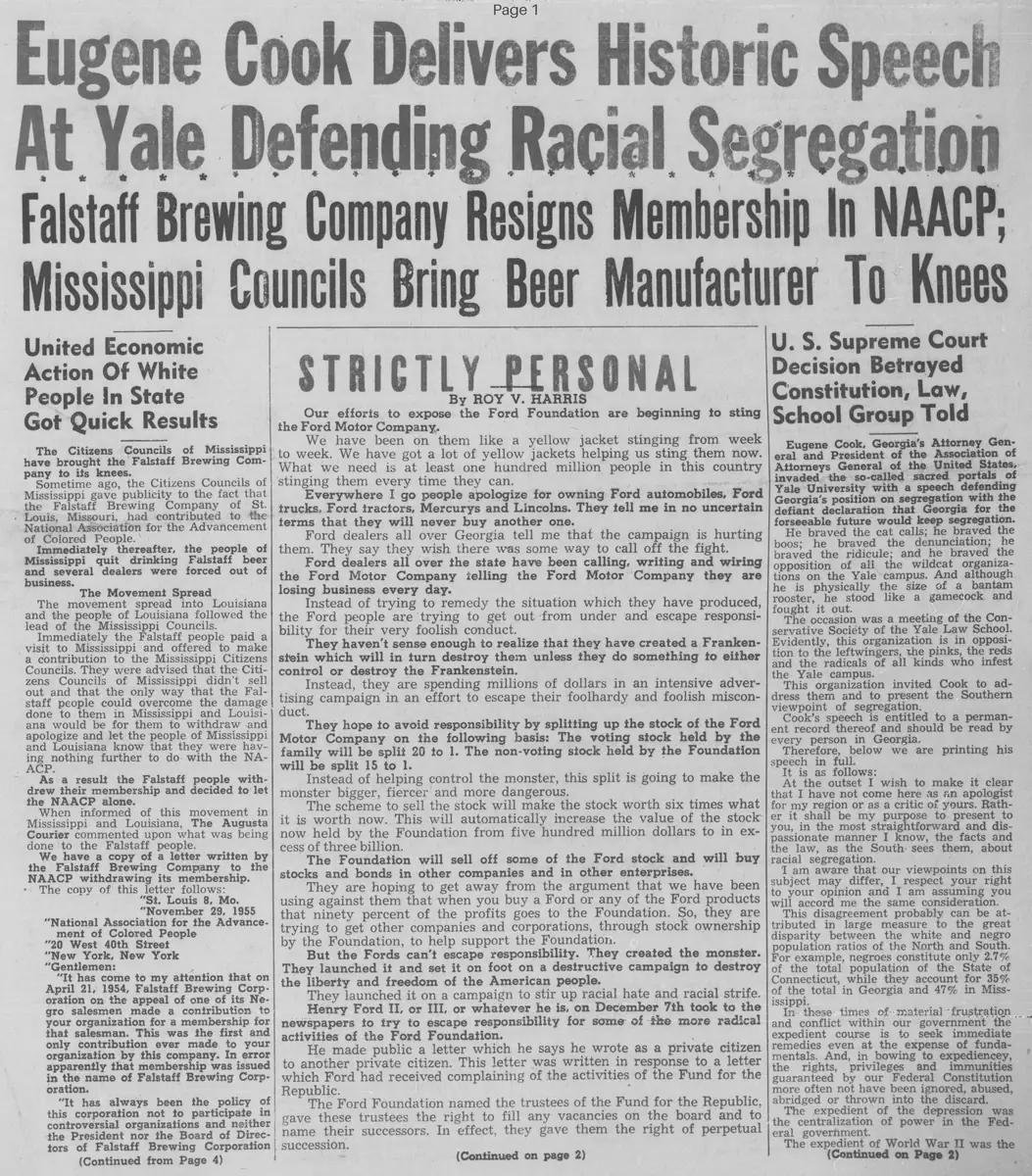
U. S. Supreme Court Decision Betrayed Constitution, Law School Group Told
Eugene Cook, Georgia's Attorney General and President of the Association of Attorneys General of the United States, invaded the so-called sacred portals of Yale University with a speech defending Georgia's position on segregation with the defiant declaration that Georgia for the foreseeable future would keep segregation.
He braved the cat calls; he braved the boos; he braved the denunciation; he braved the ridicule; and he braved the opposition of all the wildcat organizations on the Yale campus. And although he is physically the size of a bantam rooster, he stood like a gamecock and fought it out.
The occasion was a meeting of the Conservative Society of the Yale Law School.
Evidently, this organization is in opposition to the leftwingers, the pinks, the reds and the radicals of all kinds who infest the Yale campus.
This organization invited Cook to address them and to present the Southern viewpoint of segregation.
Cook's speech is entitled to a permanent record thereof and should be read by every person in Georgia.
Therefore, below we are printing his speech in full.
It is as follows:
At the outset I wish to make it clear that I have not come here as an apologist for my region or as a critic of yours. Rather it shall be my purpose to present to you, in the most straightforward and dispassionate manner I know, the facts and the law, as the South sees them, about racial segregation.
I am aware that our viewpoints on this subject may differ, I respect your right to your opinion and I am assuming you will accord me the same consideration.
This disagreement probably can be attributed in large measure to the great disparity between the white and negro population ratios of the North and South.
For example, negroes constitute only 2.7% of the total population of the State of Connecticut, while they account for 35% of the total in Georgia and 47% in Mississippi.
In these times of material frustration and conflict within our government the expedient course is to seek immediate remedies even at the expense of fundamentals. And, in bowing to expediency, the rights, privileges and immunities guaranteed by our Federal Constitution more often than not have been ignored, abused, abridged or thrown into the discard.
The expedient of the depression was the centralization of power in the Federal government.
The expedient of World War II was the regimentation of our people and resources.
The expedient of postwar reconstruction, readjustment and resulting tensions was the entrenchment of bureaucracy on the national level.
Each step taken along this road to expediency has carried this Nation farther away from the fundamental concept upon which it was founded—that the source of power rests with the people as expressed through their duly-elected officials and representatives.
Now that this drama is reaching its climax, we can see belatedly how much it has cost us in terms of circumscribing the lives and liberties of individual citizens and reducing the status of State and local governments. We can see now the dangers posed for the future if the present trend becomes policy and that policy becomes the law of the land.
We have allowed the concentration of more and more power in the hands of fewer and fewer men.
We have permitted the development of an ever expanding Executive Department and an unbridled judiciary.
We have sanctioned the substitution of executive fiat and judicial decree for legislature enactment.
We have waived the rights of individuals and the jurisdiction of local government in favor of regulation from the Nation's capital.
The net result has been the usurpation of legislative power by the executive and judicial branches of our government and the delicate system of checks and balances so studiously contrived by our founding forefathers has been thrown out of kilter.
There is no more flagrant example of this judicial usurpation of legislative power and abridgement of the rights of the States and individual citizens than in the recent cases overruling segregation in the public schools of the so-called "Southern states" and the District of Columbia. And perhaps even more dangerous for the future of our country is the fact that the justices based their decision not upon any premise or tenet of law but solely upon sociological and psychological theories.
The ruling ignored 105 years of judicial precedent, as well as the social customs of the regions affected. It read into the United States Constitution meaning not intended by the most liberal of its framers and, in effect, sought to amend the Constitution to give the Federal government jurisdiction over the education of all the children of this country.
The Brown, et al decision is held in utter contempt by most Georgians and it will not be respected or enforced in my State within the foreseeable future.
Why this attitude on the part of Georgians?
The first point the Court had to resolve in the Brown, et al case was whether the framers and ratifiers of the Fourteenth Amendment intended for the equal protection clause to abolish segregation in the public schools. To this question the Supreme Court pleaded ignorance by saying that the intent of the framers and ratifiers "cannot be determined with any degree of certainty."
The Court said this, even though the briefs show that the same 39th Congress that promulgated the Fourteenth Amendment passed two bills dealing with separate schools for white and colored children in the District of Columbia. In addition, the briefs show that of the 37 States in existence at that time, only five abolished segregation contemporaneously with ratification of the Fourteenth Amendment, and three of these restored segregation after the removal of Federal troops.
The overwhelming majority either established or continued segregation in their public schools contemporaneously with ratification of the Fourteenth Amendment. Georgia's first public school segregation laws were enacted at the same session at which the Fourteenth Amendment was ratified. They were enacted by a Republican Legislature which had 33 negro members and were signed by a Republican Governor.
In a recent article Alexander M. Bickel, who was one of the law clerks to Mr. Justice Frankfurter during the segregation arguments, had this to say:
(1) The legislative history of the 14th Amendment makes clear that it was not intended to abolish segregation immediately,
(2) But that it did not foreclose to a court the authority to find a different application under different circumstances years later.
We agree with his first proposition, but the latter, if correct, rules out precedent entirely and leaves the Constitution as unstable as the wind. It suggests that all constitutional amendments should include express provisions as to what they mean at different periods of time and under different circumstances. To attempt any such constitutional mechanism would be an absurdity. Why have a written constitution if the Court will not be bound by the intent of the framers and ratifiers?
In rendering its decision, the Supreme Court rejected the traditional rule of constitutional construction and substituted the intent of the Court for the intent of the people.
In its article entitled The Supreme Court 1953 Term the Harvard Law Review (68 Harv. L. Rev. 96) said:
"In dealing with prior cases, especially Plessy v. Ferguson, the Chief Justice did not seek to demonstrate that the court had once blundered. His point, rather, was that these prior decisions were simply outmoded in present day society."
Thus, it is seen that a new rule of testing the constitutionality of a State's public policy as expressed in its statutes and as authorized by the Tenth Amendment has been formulated. No longer is there a question of whether there exists a conflict with precedent or whether precedent is wrong but rather whether the decision is, in the opinion of the Judges, "outmoded".
The purpose of all sincere investigations is the discovery of truth. Basic truth is discoverable in the midst of external realities. It may not be manufactured by the mind. It is a tangible reality and is never new. Once found, we may seize and hold fast to it. Now let us seek and follow the truth wherever it may lead, as applied to the Brown, et al cases.
In its decision, the Supreme Court did not hold that the old "separate but equal" doctrine, laid down in Plessy v. Ferguson (163 U. S. 537) was bad law. It held that it was bad sociology. It did not hold that the facts (or truths) disclosed by the records in the cases before the court, justified a departure from the separate but equal doctrine. It held that "psychological knowledge", apart from these records, was of more validity than factual truths.
The Court conceded that the records in the cases before it demonstrated equality of white and colored schools in respect to all "tangible factors". The decision could not "turn on" such "tangible factors", said the court:
"We must look instead" (not also) "to the effect of segregation itself on public education."
The Court then asked:
"Does segregation (alone) deprive the children of the minority group of equal educational opportunities?"
The answer was: "We believe that it does."
Why? Because, the Court said:
"Whatever may have been the psychological knowledge at the time of Plessy v. Ferguson, this finding is amply supported by modern authority. Any language in Plessy v. Ferguson contrary to this finding is rejected."
How did such "intangibles" find their way into the cases? They were not authenticated as "authority" by any method known to Anglo-Saxon jurisprudence or rules of evidence. If not in evidence, the universal rule is that it was harmful error, prejudicial to the parties defendant for them to be considered by the court.
We have scanned legal literature since May 1954 in an effort to find a respectable vindication of the Supreme Court's conduct, but have found none that appeals to reason.
Under elementary and elemental law, a court may not consider treatises in a field other than law, unless the treatises themselves are the very subject of inquiry. The doctrine of judicial notice extends only to those things of common knowledge that lie without the realm of science, or to that one science in which judges are presumed to be learned or experts themselves—the science of law.
In Pinkus v. Reilly (338 U. S. 269), decided November 14, 1949, Justice Black held that the use of nonlegal materials in a case was illegal, illogical and unfair. If it was illegal, illogical and unfair in 1949, what has happened since to confirm such procedure to the sense of justice of the same judges?
In the Pinkus case the parties at least had an opportunity to rebut, to disprove and to impeach by means other than cross-examination. In the integration cases, no such opportunity was afforded to parties. The intangible consideration first appeared in the secrecy of the Judge's chambers. Notice of it was given to the defendants in the judgment itself. No precedent short of Star Chamber and High Commission cases of the Stuart kings, 300 years ago, may be found for like judicial deportment.
In National Council of American Soviet Friendship, Inc. v. McGrath (341 U. S. 123), the Supreme Court held that non-legal materials could not be used by the Attorney General as a basis for listing an organization as communistic.
Justice Black shamed the Attorney General, calling such conduct "unfair". He said it was "abhorrent to free men". He should not now complain that we agree with him.
In Ohio Bell Telephone Co. v. Public Utilities Commission of Ohio (301 U. S. 292), the court said that the use of such material was a denial of "the rudiments of fair play", and that "to wander afield and fix . . . the evidence upon proofs drawn from the clouds . . . is not the fair hearing essential to due process" but is . . . "condemnation without trial".
Justice Brandeis said in U. S. v. Abilene & Southern Railway Company (265 U. S. 374):
"Nothing can be treated as evidence which was not introduced as such."
That rule was universal until the Supreme Court found it standing as a barrier to a decision that would defy constitutional law and facts. That rule vanished as the court founded its judgment on pseudo-socio-science, not made a part of the record either as evidence or as law.
The findings of social science are sometimes regarded as elaborate statements of what everybody knows in the language that nobody can understand.
While little harm can come from such an undertaking, great harm will result when a social scientist takes his deductions and generalizations into the field of judicial interpretation and treats them as the equivalent of "law".
U. S. Circuit Judge Jerome Frank recently wrote that these generalizations and the "inferences derived therefrom are almost certain to be importantly false. For the consequences of the operation of certain customs or group attitudes are often cancelled out by the consequences of other conflicting customs and attitudes."
Even the latest book cited in footnote 11 of the Brown, et al cases (Whitmer and Kotinsky) states:
"Unfortunately for scientific accuracy and adequacy, thoroughly satisfactory methods of determining the effects of prejudice and discrimination on health or personality have not yet been devised, nor has a sufficient number of studies dealing with the various minority groups been made."
A recent writer, Edmond Cohan, who agrees with the result of the Brown, et al Case nevertheless criticizes the use of sociological authority and shows its danger by saying:
"The word 'danger' is used advisedly, because I would not have the constitutional rights of negroes or of other Americans rest on such flimsy foundations as some of the scientific demonstrations in these records."
Since these behavioral sciences are so very young, imprecise and changeful, their findings have an uncertain expectancy of life. Today's observations may be cancelled by tomorrow's new revelation—or new technical fad.
Should our fundamental rights rise, fall or change along with the latest fashions of psychological literature? How are we to know that in the future social scientists may present us with a collection of notions similar to Adolf Hitler and label them as modern science. If Mr. Justice Holmes was correct when he insisted that the Constitution should not be tied to the wheels of any economic system whatsoever, shouldn't it be similarly uncommitted in relation to other social sciences?
What of this modern authority upon which the Court based its decision?
Two of the six principal authorities listed by the Court, Theodore Brameld and E. Franklin Frazier have between them been members of or identified with 28 organizations declared to be Communist, Communist-fronts or Communist-dominated, by the Attorney General of the United States or the Committee on Un-American Activities of the United States House of Representatives. A third of the six, K. B. Clark was, at the time of the arguments before the Court, on the payroll of the National Association For The Advancement of Colored People as a so-called "social-science expert"—a highly irregular procedure in view of the fact that the NAACP was the principal plaintiff in these cases.
The book, "An American Dilemma", written by Swedish Socialist Gunnar Myrdal on the grant from the Carnegie Foundation was cited in its entirety by the Supreme Court as an authority for its ruling. Sixteen of the contributors to this work have lengthy records of pro-Communist activity in the files of the "Un-American Activities Committee. One of them, Negro educator W. E. B. DuBois, who contributed to 82 portions of the book, has been cited no less than 72 times by the Committee. He filed briefs on behalf of since-executed Communist spies Julius and Ethel Rosenberg and sent a message of condolence upon the death of Joseph Stalin.
It was in this book that Myrdal declared the United States Constitution to be "impractical and unsuited to modern conditions" and its adoption to be "nearly a plot against the common people". Furthermore, he openly avowed that liberty must be forsaken for the benefit of what he called "social equality".
We in Georgia intend to circumvent this decision and Congress and the people have furnished many precedents for our action. The 14th Amendment, upon which the Court's decision rested, was itself designed to circumvent the decision of the Supreme Court in the Dred Scott case which held a negro could not be a citizen.
At this point it is in order for me to tell you in part how we in Georgia propose to do this.
Our General Appropriations Act contains a provision requiring the withholding of State funds from any city or county school system in which the races are mixed and, since the State supplies 75 to 90 per cent of all public school funds, it is obvious that no system could continue to operate without State aid. In addition, last January the General Assembly enacted a law making it a felony for any public or school official to permit the spending of State or local funds for mixed schools and holding such officials personally liable for any sums so spent.
Because of the operation of these statutes, local school authorities in Georgia are helpless to effect classroom integration, even should they desire to do so.
Therefore, should integration ever be ordered in Georgia we would not be confronted with a choice between segregated and integrated public schools, but rather between segregated public schools and private schools.
This was made certain in November 1954 when the voters of Georgia overwhelmingly ratified the so-called "private school" amendment to the State Constitution. This Amendment authorizes the General Assembly to make grants to individuals for educational purposes.
Next month the following implementation measures will be enacted by the General Assembly:
1. Empowering the Governor to close by Executive Order any city, county or independent school system when "the public interest shall so require" and provide for the payment of yearly educational grants to be used as tuition in attending private schools to children of school age residing within the affected district or districts.
2. Authorizing the Attorney General, upon direction of the Governor, to enjoin any city, county or independent school system from any actual or threatened step, action or practice which would result in violation of the state law requiring separation of the races in Georgia schools.
3. Permitting city, county and independent boards of education to lease school buildings and property to private individuals, groups or corporations which are "bona fide engaged in the operation of a private school in a manner which they think will best serve the interest of children of school age within their respective school districts."
4. Permitting city, county and independent boards of education to sublease school buildings and property owned by the State School Building Authority and lease them to private individuals, groups or corporations which are "bona fide engaged in the operation of a private school in a manner which they think will best serve the interest of children of school age within their respective school districts."
5. Bringing teachers employed by such private schools under the State Teachers Retirement System.
We of Georgia are joining hands with those who share our views in an effort to accomplish one major objective on the national level which we believe is necessary to stop the present trend of the U. S. Supreme Court to usurp those prerogatives which are peculiarly the States'. This objective is congressional enactment designed to withdraw jurisdiction from the Federal courts in cases involving the administration by the States of their respective public school systems.
Such a bill drafted by my staff and me was introduced in Congress February 8, 1955, by Congressman E. L. Forrester of Georgia.
Of course, we have little hopes of the passage of such a bill under present circumstances, but we are prayerfully hopeful of these circumstances assuming a more healthy atmosphere in the future.
Segregation in the South is viewed by whites and negroes alike as a matter of instinct and personal choice. The United States Supreme Court and the National Association for the Advancement of Colored People to the contrary notwithstanding, it is neither predicted upon hatred of either race for the other nor considered as a badge of superiority or inferiority by either.
In a society where from one-third to one-half of the citizens belong to a different race, the overwhelming majority of both white and colored citizens agree that segregation serves the best interests of both races and desire that it can be continued. The truth of the matter is that, in the wake of the decisions of the Supreme Court respecting segregation our municipal problem is not how to make mixed schools, playgrounds and public places, but how not to have them forced upon us against our will.
To be sure there are those who are championing the cause of integration in the South, but they comprise less than five per cent of the total population. This discredited minority is composed in the main of paid agitators and known subversives using naive do-gooders and fuzzy-minded intellectuals as their pawns. It is egged on by the NAACP and radical newspapers and is financed by the left-wing Fund for the Republic of the Ford Foundation through grants to organizations whose officials and motives will not stand up under investigation.
The real enemies of racial progress in the South are two extremist organizations -- the NAACP and the Ku Klux Klan. I believe as does Federal District Judge Ashton H. Williams of Charleston, S. C., that "no progress can be made unless and until both the Klan and the NAACP are wholly eliminated from the picture."
The Klan, I am happy to report, long has been in disrepute among the thinking and leading citizens of the South, and the NAACP rapidly is falling into the same category. The decline of the NAACP can be attributed to two facts: (1) its uncompromising insistence upon complete amalgamation of the races, including intermarriage; and (2) the mounting proof that it is being used as a tool and front by subversive elements seeking to overthrow our republican form of government.
To combat these radical organizations, the solid citizens of the South are joining together in a new type of organization -- organizations like the States' Rights Council in Georgia, the Citizens' Councils in Mississippi and the States' Rights and Grass Roots Leagues in other States. These organizations have pledged themselves to the preservation of the South's traditional pattern of segregation through use of all lawful means. All have repudiated the use of intimidation, force and violence, recognizing that their greatest weapon lies in aroused public opinion, a force with which not even a political-minded Supreme Court can cope.
Our sensitivity respecting the matter of amalgamation of the races is a basically inborn characteristic from which we can never divorce ourselves. It needs no explanation or apology.
That amalgamation or intermarriage of the races is the ultimate goal of NAACP is no product of my own imagination. Many responsible officials of the NAACP are on record with declarations which make it quite clear that racial intermarriage is the ultimate goal of that group. Perhaps the best example of that is the statement made by Albert A. Kennedy, South Carolina State Counselor for the NAACP, in an interview with the Orangeburg, South Carolina, Times and Democrat, on August 30th of this year.
Kennedy told the Times and Democrat -- and I quote "Once the two races are integrated, intermarriage is the natural consequence. Intermingling can't be regulated by the State and if the State tried to regulate it you will find the same thing in every particular in the dark, behind closed doors and in automobiles. Psychologists say that a girl's chances of getting married are governed by the number of her male associates. Integration will result in white girls being associated with negro boys and naturally intermarriage will result. We (the NAACP) have committed ourselves to a program of full integration" -- end quote.
Kennedy's statement was carried throughout the nation by the Associated Press and was printed in the New York Post's issue of September 1st.
The late Walter White, who was executive secretary of the NAACP, had something to say on this subject in an interview with the magazine, U. S. News and World Report, following the May 17, 1954, decision of the United States Supreme Court regarding school segregation.
At that time White advocated an end to laws prohibiting racial intermarriage and stated that the school decree would -- and these are his exact words -- "lead to an increase in intermarriage between the races."
Among other statements, White told U. S. News and World Report -- and I quote -- "When human beings get to know each other and to respect each other, friendships develop, and some of those friendships develop into love and marriage. The NAACP has always opposed laws barring intermarriages, because they do great harm to both races. They deny the women of a so-called minority group protection of their person and it also is an improper and immoral thing to do. It really places a premium on extramarital relationships on both sides of the racial fence. If two people wish to live together, it is most unchristian to say they must live together in sin instead of holy wedlock." end quote.
Need I say more? There it is for everyone to see.
The South, until recent years, was hampered in dealing with its problems by its lack of economic resources. Hamstrung by the economic shackles forged upon it following the War Between the States and by the fact that a large segment of its citizenry was unproductive taxwise, the region found itself unable to provide the way, even though it had the will.
In 1929 the per capita income in my State was $350. Last year it was $1,237, which is $533 less than the national average and it is continuing to climb. The economic, social and cultural lot of the Negro population has improved in direct proportion to that of the white population. We propose to do even more for the negro in the future than we are now doing.
To my mind, it is to the everlasting credit of the sound leadership of the South that once its economy had recovered to the point where it could support programs of improvement the benefits were shared equally between the races.
In my own State of Georgia where the colored population is approximately 35% of the total more than 50% of the funds being spent on education are going to negro schools.
We have equalized the salaries of white and negro teachers and we have more than 8,500 negro educators on the State payroll. We are spending 53 cents out of every tax dollar for education -- a percentage unmatched by any other State. Our total education budget last year was more than $120,000,000 on the State level and just this summer we increased our tax load by $40,000,000 a year, the major portion of which will go to schools.
We are rapidly completing a $200,000,000 school-building program which will provide absolutely equal facilities for white and negro children throughout the State. Indeed, in many communities the negro schools will be superior to the white schools because they are more modern and better equipped. Yet, despite this disparity, there have been no complaints from the white taxpayers who are footing approximately 90% of the bill. Neither has anyone so much as suggested that white children might get an inferiority complex as the result of the superiority of negro school facilities.
At this point you may well challenge our treatment of qualified negro applicants who seek professional and graduate training which is available in the institutions in the University System for white students but is not offered in the negro institutions of the University System. The fact that we have had only one negro who has persisted in his efforts to enter our State Law School should be persuasive of the fact that we have been and will continue to respond to the applications of those negroes who in good faith seek graduate and professional training.
These are facts little known among Georgians:
In 1943 the Board of Regents of the University System activated a scholarship aid program for Negroes designed to meet this very problem. Since its inception in October 1943 the State has paid $1,115,815 for differentials in tuition and transportation costs and in room and board supplements for Negroes in this category to attend out-of-State graduate and professional colleges and universities of their choice. 2,290 applications were approved for 1954-55 at a cost of $208,217. These students are now attending 71 different colleges throughout the United States and the Atlanta University. Actually in many of these cases they are obtaining at State expense a quality of education superior to that obtainable by the white students in our University System, because many of the out-of-State colleges and universities are better equipped for such training in some respects.
If our Negro population is happy over this method of the State meeting their needs, it comes with poor grace for NAACP to criticize it.
I point out these facts to show that we in Georgia and the South were well on our way toward solving what few racial problems we had when the Supreme Court on May 17, 1954, disrupted our orderly procedure with its psycho-political decision that segregation of the races in the public schools violates the "equal protection" clause of the 14th Amendment.
The South has had no serious racial problems for several decades past. Its racial problems were solved by segregation. We do not intend to turn back to the horrors of a day that is dead, to please alien sociologists.
The American Negro never had a more effective and highly respected friend than the late statesman and publisher, Henry W. Grady of Georgia.
Unlike Lincoln, Everett, Clay and Webster who favored colonization of the Negro race after emancipation, Grady persisted in his efforts to prove that the two races could and would live together in peace and prosperity under a pattern of segregation then well established.
I should like to quote from Grady's masterpiece address "The New South" delivered at the Eighty-First Anniversary Celebration of the New England Society held in New York City in 1886.
"The attempt to force commingling of the races, where the habits and instincts of both races object, would produce irritation and lead to hopeless conflict.
"It must not be imagined that the Negro is outlawed in the South. He has ten avenues of employment in this section to where he has one in the North. White and black carpenters and masons work together on the same buildings. White and black shoemakers and mechanics in the same shops. White and black hackmen drive on the same streets. White and black farmers work in the same field. Whatever the Negro is fitted to do, he has abundant chance to do. All this too in the South where the Negro is in such numbers that he seriously competes for work and lowers wages. All this is done too without protest or without friction. But the white and black carpenters, working together on the same building, go to separate homes at night, to separate churches on Sunday. White and black mechanics in the same shop send their children to separate schools. White and black farmers in the same field ride to market in separate cars. This distinction may seem trifling, but it is natural. It responds to an instinct planted by the Almighty in the two races. It is the wisest and the best course.
"The South has moved rapidly towards the solution of the race problem. If left alone it can solve it. Interference simply irritates, and outside opinion simply misjudges. The Negroes are prospering and are contented. Malignant agitators who seek office from the government, or notoriety, or bribes, inveigh against the status, and magnify the occasional disorders. Happily the records show that the Negro is prospering. In every Southern State he owns farms and city property. His children have good schools. He has his churches, his societies, and his sports. And he is prospering faster than the same number of people, just released from a century of slavery, without property or education, could prosper in any community on this earth. The American Republic has achieved great things, but it will have nothing better to render into the keeping of universal history than the progress made by the two races in the South in the past twenty-five years towards the adjustment of their relations and the solution of the problem that is theirs."
What Grady said in 1886 may well be multiplied an hundred fold.
Whether you happen to approve or disapprove of segregation as a personal matter is of no concern.
Those whose honest beliefs may be against segregation have lost just as much by the Court's decision as those who favor it.
The preservation of liberty through an honest and conscientious interpretation of the Constitution by the Court transcends all other considerations of personal likes or dislikes.
If the Court interprets the Constitution according to its own notion of what the law ought to be, rather than what the law is, we no longer have a government of laws, but of men.
If the Court can disregard the Constitution today to accomplish a result of which you approve, it likewise can ignore it tomorrow to reach a result of which you disapprove.
Constitutional government as we heretofore have known it and the philosophy upon which this decision was based are incompatible and so long as it stands, the liberties and heritage of freedom which we so zealously cherish in both the North and South are in great jeopardy.
What sub-type of article is it?
What themes does it cover?
What keywords are associated?
What entities or persons were involved?
Where did it happen?
Story Details
Key Persons
Location
Yale University, Connecticut
Event Date
1955
Story Details
Eugene Cook speaks at Yale defending segregation, criticizes Brown v. Board as unconstitutional, details Georgia's resistance plans including private schools and funding cuts, quotes historical figures, and warns of federal overreach.