Thank you for visiting SNEWPapers!
Sign up free
Letter to Editor
September 9, 1826
Northern Star, And Warren And Bristol Gazette
Warren, Bristol County, Rhode Island
What is this article about?
Editorial insertion of a letter correcting a prior report on the mourning celebration for John Adams and Thomas Jefferson in Bristol, clarifying no public dinner occurred but a coincidental gathering of twelve men from Bristol and Warren, emphasizing the solemnity of the event.
Clipping
OCR Quality
95%
Excellent
Full Text
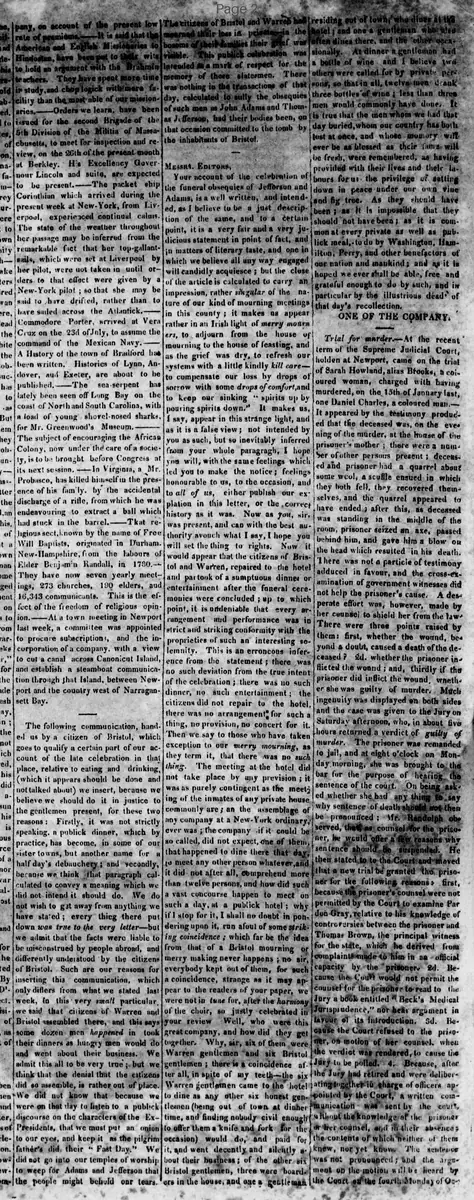
The following communication, handed us by a citizen of Bristol, which goes to qualify a certain part of our account of the late celebration in that place, relative to eating and drinking (which it appears should be done and not talked about) we insert, because we believe we should do it in justice to the gentlemen present, for these two reasons: Firstly, it was not strictly speaking, a publick dinner, which by practice, has become, in some of our sister towns, but another name for a half day's debauchery; and secondly, because we think that paragraph calculated to convey a meaning which we did not intend it should do. We do not wish to get away from anything we have stated; everything there put down was true to the very letter—but we admit that the facts were liable to be misconstrued by people abroad, and differently understood by the citizens of Bristol. Such are our reasons for inserting this communication, which only differs from what we stated last week, in this very small particular—we said that citizens of Warren and Bristol assembled there, and (this says some) dozen men happened in took their dinners as hungry men would do and went about their business. We admit this all to be very true; but we think that the denial that the citizens did so assemble, is rather out of place. We did not know that because we were on that day to listen to a publick discourse on the characters of the Ex-Presidents, that we must put an onion to our eyes, and keep it as the pilgrim fathers did, their "Fast Day." We did not go into our temples of worship to weep for Adams and Jefferson that the people might behold our tears.
The citizens of Bristol and Warren had mourned their loss in private in the bosoms of their families their grief was visible. This publick celebration was intended a mark of respect for the memory of those statesmen. There was nothing in the transactions of that day, calculated to sully the obsequies of such men as John Adams and Thomas Jefferson, had their bodies been, on that occasion committed to the tomb by the inhabitants of Bristol.
Messrs. Editors,
Your account of the celebration of the funeral obsequies of Jefferson and Adams, is a well written, and intended, as I believe to be a just description of the same, and to a certain point, it is a very fair and a very judicious statement in point of fact, and in matters of literary taste, and one in which we believe all any way engaged will candidly acquiesce; but the close of the article is calculated to carry an impression, rather singular of the nature of our kind of mourning meetings in this county; it makes us appear rather in an Irish light of merry mourners, to adjourn from the house of mourning to the house of feasting, and as the grief was dry, to refresh our systems with a little kindly kill care—to compensate our loss by drops of sorrow with some drops of comfort, and to keep our sinking "spirits up by pouring spirits down." It makes us, I say, appear in this strange light, and as it is a false view; not intended by you as such, but so inevitably inferred from your whole paragraph, I hope you will, with the same feelings which led you to make the notice; feelings honourable to us, to the occasion, and to all of us, either publish our explanation in this letter, or the correct history as it was. Now as you, sir, was present, and can with the best authority avouch what I say, I hope you will set the thing to rights. Now it would appear that the citizens of Bristol and Warren, repaired to the hotel and partook of a sumptuous dinner or entertainment after the funeral ceremonies were concluded; up to which point, it is undeniable that every arrangement and performance was in strict and striking conformity with the proprieties of such an interesting solemnity. This is an erroneous inference from the statement; there was no such deviation from the true intent of the celebration; there was no such dinner, no such entertainment; the citizens did not repair to the hotel, there was no arrangement for such a thing, no provision, no concert or it. Then we say to those who have taken exception to our merry mourning, as they term it, that there was no such thing. The meeting at the hotel did not take place by any prevision; it was as purely contingent as the meeting of the inmates of any private house commonly are; and the assemblage of any company at a New-York ordinary—ever was; the company if it could be so called, did not expect, one of them, that happened to dine there that day, to meet any other person whatever, and it did not after all, comprehend more than twelve persons, and how did such a vast concourse happen to meet on such a day, at a publick hotel; why if I stop for it, I shall no doubt in pondering upon it, run foul of some striking coincidence; which far be the idea from that of a Bristol mourning or merry making never happens; no sir, everybody kept out of them, for such a coincidence, strange as it may appear to the readers of your paper, we were not in tune for, after the harmony of the choir, so justly celebrated in your review "Well, who were this great company, and how did they get together. Why, sir, six of them were Warren gentlemen and six Bristol gentlemen; there is a coincidence after all, in spite of my teeth—the six Warren gentlemen came to the hotel to dine as any other six honest gentlemen (being out of town at dinner time, and finding nobody civil enough to offer them a knife and fork for the occasion) would do, and paid for it, and went decently and silently about their business; of the other six Bristol gentlemen, three were boarders in the house, and one a gentleman residing out of town who dines in the hotel and one a gentleman who also often dines there, and the other occasionally, At dinner a gentleman had a bottle of wine and I believe two others were called for by private persons, so that in all, twelve men drank three bottles of wine: less than three men would commonly have done,. It is true that the men whom we had that day buried, whom our country had both lost at once, and whose memory will ever be as blessed as their fame will be fresh, were remembered, as having provided with their lives and their labours for us the privilege of sitting down in peace under our own vine and fig tree. As they should have been; as it is impossible that they should not have been; as it is common at every private as well as publick meal to do by Washington, Hamilton, Perry, and other benefactors of our nation and mankind; and as it is hoped we ever shall be able, free and grateful enough to do by such, and in particular by the illustrious dead of that day's recollection.
ONE OF THE COMPANY
The citizens of Bristol and Warren had mourned their loss in private in the bosoms of their families their grief was visible. This publick celebration was intended a mark of respect for the memory of those statesmen. There was nothing in the transactions of that day, calculated to sully the obsequies of such men as John Adams and Thomas Jefferson, had their bodies been, on that occasion committed to the tomb by the inhabitants of Bristol.
Messrs. Editors,
Your account of the celebration of the funeral obsequies of Jefferson and Adams, is a well written, and intended, as I believe to be a just description of the same, and to a certain point, it is a very fair and a very judicious statement in point of fact, and in matters of literary taste, and one in which we believe all any way engaged will candidly acquiesce; but the close of the article is calculated to carry an impression, rather singular of the nature of our kind of mourning meetings in this county; it makes us appear rather in an Irish light of merry mourners, to adjourn from the house of mourning to the house of feasting, and as the grief was dry, to refresh our systems with a little kindly kill care—to compensate our loss by drops of sorrow with some drops of comfort, and to keep our sinking "spirits up by pouring spirits down." It makes us, I say, appear in this strange light, and as it is a false view; not intended by you as such, but so inevitably inferred from your whole paragraph, I hope you will, with the same feelings which led you to make the notice; feelings honourable to us, to the occasion, and to all of us, either publish our explanation in this letter, or the correct history as it was. Now as you, sir, was present, and can with the best authority avouch what I say, I hope you will set the thing to rights. Now it would appear that the citizens of Bristol and Warren, repaired to the hotel and partook of a sumptuous dinner or entertainment after the funeral ceremonies were concluded; up to which point, it is undeniable that every arrangement and performance was in strict and striking conformity with the proprieties of such an interesting solemnity. This is an erroneous inference from the statement; there was no such deviation from the true intent of the celebration; there was no such dinner, no such entertainment; the citizens did not repair to the hotel, there was no arrangement for such a thing, no provision, no concert or it. Then we say to those who have taken exception to our merry mourning, as they term it, that there was no such thing. The meeting at the hotel did not take place by any prevision; it was as purely contingent as the meeting of the inmates of any private house commonly are; and the assemblage of any company at a New-York ordinary—ever was; the company if it could be so called, did not expect, one of them, that happened to dine there that day, to meet any other person whatever, and it did not after all, comprehend more than twelve persons, and how did such a vast concourse happen to meet on such a day, at a publick hotel; why if I stop for it, I shall no doubt in pondering upon it, run foul of some striking coincidence; which far be the idea from that of a Bristol mourning or merry making never happens; no sir, everybody kept out of them, for such a coincidence, strange as it may appear to the readers of your paper, we were not in tune for, after the harmony of the choir, so justly celebrated in your review "Well, who were this great company, and how did they get together. Why, sir, six of them were Warren gentlemen and six Bristol gentlemen; there is a coincidence after all, in spite of my teeth—the six Warren gentlemen came to the hotel to dine as any other six honest gentlemen (being out of town at dinner time, and finding nobody civil enough to offer them a knife and fork for the occasion) would do, and paid for it, and went decently and silently about their business; of the other six Bristol gentlemen, three were boarders in the house, and one a gentleman residing out of town who dines in the hotel and one a gentleman who also often dines there, and the other occasionally, At dinner a gentleman had a bottle of wine and I believe two others were called for by private persons, so that in all, twelve men drank three bottles of wine: less than three men would commonly have done,. It is true that the men whom we had that day buried, whom our country had both lost at once, and whose memory will ever be as blessed as their fame will be fresh, were remembered, as having provided with their lives and their labours for us the privilege of sitting down in peace under our own vine and fig tree. As they should have been; as it is impossible that they should not have been; as it is common at every private as well as publick meal to do by Washington, Hamilton, Perry, and other benefactors of our nation and mankind; and as it is hoped we ever shall be able, free and grateful enough to do by such, and in particular by the illustrious dead of that day's recollection.
ONE OF THE COMPANY
What sub-type of article is it?
Informative
Persuasive
Reflective
What themes does it cover?
Politics
Morality
What keywords are associated?
Adams Jefferson Mourning
Bristol Warren Celebration
Correction To Report
Solemn Obsequies
Coincidental Gathering
What entities or persons were involved?
One Of The Company
Messrs. Editors
Letter to Editor Details
Author
One Of The Company
Recipient
Messrs. Editors
Main Argument
the newspaper's report inadvertently suggested a public dinner followed the solemn mourning for adams and jefferson, implying irreverent 'merry mourning'; in reality, no such arranged event occurred, only a coincidental gathering of twelve men who dined separately and modestly.
Notable Details
Comparison To 'Irish Merry Mourners'
Reference To Biblical 'Vine And Fig Tree'
Toasts To Adams, Jefferson, Washington, Hamilton, Perry