Thank you for visiting SNEWPapers!
Sign up free
Story
May 21, 1857
Oroville Daily Butte Record
Oroville, Butte County, California
What is this article about?
Professor Sontag of the Grinnell Expedition speculates on scientific opportunities and challenges at the North Pole, including terrain unknowns, navigation difficulties in open water, and the lack of apparent time due to converging meridians.
Clipping
OCR Quality
95%
Excellent
Full Text
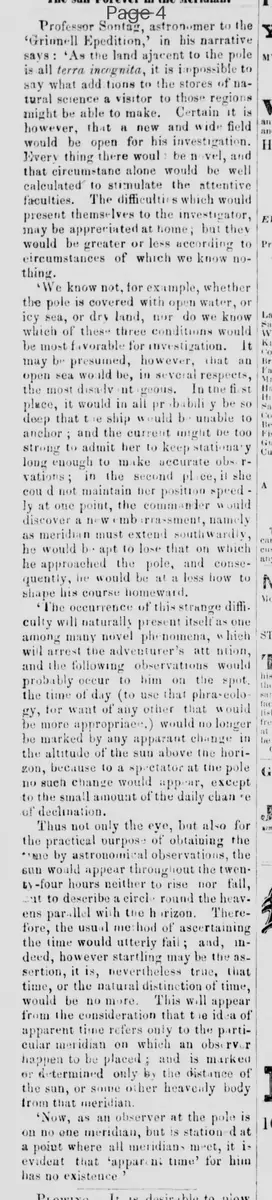
Professor Sontag, astronomer to the 'Grinnell Expedition,' in his narrative says: 'As the land adjacent to the pole is all terra incognita, it is impossible to say what additions to the stores of natural science a visitor to those regions might be able to make. Certain it is however, that a new and wider field would be open for his investigation. Everything there would be novel, and that circumstance alone would be well calculated to stimulate the attentive faculties. The difficulties which would present themselves to the investigator, may be appreciated at home; but they would be greater or less according to circumstances of which we know nothing.
We know not, for example, whether the pole is covered with open water, or icy sea, or dry land, nor do we know which of these three conditions would be most favorable for investigation. It may be presumed, however, that an open sea would be, in several respects, the most disadvantageous. In the first place, it would in all probability be so deep that the ship would be unable to anchor; and the current might be too strong to admit her to keep stationary long enough to make accurate observations; in the second place, if she could not maintain her position speedily at one point, the commander would discover a new embarrassment, namely as meridian must extend southwardly. He would be apt to lose that on which he approached the pole, and consequently, he would be at a loss how to shape his course homeward.
'The occurrence of this strange difficulty will naturally present itself as one among many novel phenomena, which will arrest the adventurer's attention, and the following observations would probably occur to him on the spot. The time of day (to use that phraseology, for want of any other that would be more appropriate.) would no longer be marked by any apparent change in the altitude of the sun above the horizon, because to a spectator at the pole no such change would appear, except to the small amount of the daily change of declination. Thus not only the eye, but also for the practical purpose of obtaining the time by astronomical observations, the sun would appear throughout the twenty-four hours neither to rise nor fall. It would appear to describe a circle round the heavens parallel with the horizon. Therefore, the usual method of ascertaining the time would utterly fail; and, indeed, however startling may be the assertion, it is, nevertheless true, that time, or the natural distinction of time, would be no more. This will appear from the consideration that the idea of apparent time refers only to the particular meridian on which an observer happen to be placed: and is marked or determined only by the distance of the sun, or some other heavenly body from that meridian.
'Now, as an observer at the pole is on no one meridian, but is stationed at a point where all meridians meet, it is evident that 'apparent time' for him has no existence
We know not, for example, whether the pole is covered with open water, or icy sea, or dry land, nor do we know which of these three conditions would be most favorable for investigation. It may be presumed, however, that an open sea would be, in several respects, the most disadvantageous. In the first place, it would in all probability be so deep that the ship would be unable to anchor; and the current might be too strong to admit her to keep stationary long enough to make accurate observations; in the second place, if she could not maintain her position speedily at one point, the commander would discover a new embarrassment, namely as meridian must extend southwardly. He would be apt to lose that on which he approached the pole, and consequently, he would be at a loss how to shape his course homeward.
'The occurrence of this strange difficulty will naturally present itself as one among many novel phenomena, which will arrest the adventurer's attention, and the following observations would probably occur to him on the spot. The time of day (to use that phraseology, for want of any other that would be more appropriate.) would no longer be marked by any apparent change in the altitude of the sun above the horizon, because to a spectator at the pole no such change would appear, except to the small amount of the daily change of declination. Thus not only the eye, but also for the practical purpose of obtaining the time by astronomical observations, the sun would appear throughout the twenty-four hours neither to rise nor fall. It would appear to describe a circle round the heavens parallel with the horizon. Therefore, the usual method of ascertaining the time would utterly fail; and, indeed, however startling may be the assertion, it is, nevertheless true, that time, or the natural distinction of time, would be no more. This will appear from the consideration that the idea of apparent time refers only to the particular meridian on which an observer happen to be placed: and is marked or determined only by the distance of the sun, or some other heavenly body from that meridian.
'Now, as an observer at the pole is on no one meridian, but is stationed at a point where all meridians meet, it is evident that 'apparent time' for him has no existence
What sub-type of article is it?
Curiosity
Extraordinary Event
Journey
What themes does it cover?
Exploration
What keywords are associated?
North Pole Exploration
Astronomical Observations
Meridians Convergence
Apparent Time Absence
Grinnell Expedition
What entities or persons were involved?
Professor Sontag
Where did it happen?
North Pole
Story Details
Key Persons
Professor Sontag
Location
North Pole
Story Details
Professor Sontag discusses potential scientific discoveries at the North Pole, unknowns about its terrain, challenges of investigation in open sea or ice, and the absence of apparent time due to all meridians converging there.