Thank you for visiting SNEWPapers!
Sign up free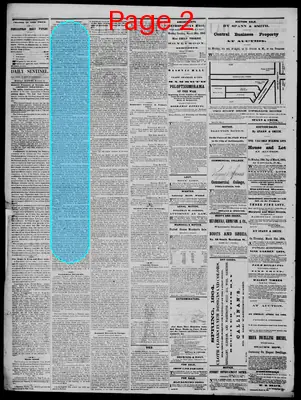
Editorial
March 28, 1864
Daily State Sentinel
Indianapolis, Marion County, Indiana
What is this article about?
An editorial lambasts the Lincoln administration for prioritizing the 1864 presidential election over effectively prosecuting the Civil War, alleging military expeditions in Florida, Mississippi, and Mobile were electioneering efforts to secure Southern electoral votes, resulting in wasteful losses of life and treasure.
Clipping

OCR Quality
98%
Excellent
Full Text
The spring campaign now opening, and already considerably advanced, ought to be a final and effective one. But there does not seem to be any prospect of such a result. Thus far it has been attended with great loss and almost uniform failure, and the reason seems to be manifest. Instead of a campaign against the rebels, it has, apparently, been a campaign for the Presidency. The lives that have been sacrificed, the millions of treasure that have been expended, seem to have been devoted, not to crushing the rebellion, not to re-establishing the Union, but to securing votes for the coming convention and the Presidential election. Soldiers, who ought to be in the field, have been pouring home by thousands, carefully selected and pledged to vote the Administration ticket. Other thousands will soon be picked and sent home to other elections, and so the spring campaign will go on.
The horrible waste of life in Florida is virtually confessed to have been on an electioneering expedition. No partisan of the Administration has yet had the boldness to attempt an explanation of any military benefits to be derived from the expedition. The campaign of Sherman into Mississippi is a great failure, with vast expense and loss, and no one can explain what was its object, unless it was also designed to establish a base for electioneering operations. The latest news from New Orleans indicates that the attack on Mobile failed because Gen. Banks was too busy about that farce, which has been styled an election in New Orleans. It was thought more important to secure the arrangements for the electoral vote of Louisiana this fall, than to co-operate with the navy in the attack on a rebel city. Hence another great waste of expense. It seems that the Administration will succeed this fall in producing several electoral votes from the Southern States. It will only require a few men to cast the great electoral vote of Virginia. It would not be surprising to see the Presidential election claimed on the votes of these bogus elections, held at Southern military posts. New Orleans is little else than a military post. Of course each vote in the electoral college thus obtained will cost the country, on an average, several millions of dollars and several hundred lives. This is solemn truth. It is indeed a somewhat expensive style of winning an election, but a style at which the radical mind does not feel any compunctions of conscience.
In view of what has occurred, we may judge of what is likely to occur. It is more than probable that the entire spring and summer campaign will be directed toward the perpetuation of the Republican dynasty, instead of toward the crushing of the rebellion. Everything indicates that this has been the object, thus far, of the various military movements or failures to move. It may be reckoned as certain that whenever soldiers can be effectually used for voting they will not be employed in fighting. Whenever and wherever a State election occurs, there will be a sudden coincidence of several thousand furloughs, regiments going home to recruit, etc., etc.
The radical party is counting daily upon the effect of military operations upon the nominations and elections. Some of the radical papers already express views against Mr. Lincoln, and we have lying before us several such papers, in which we find printed, in plain language, the regret of the writers that the Republican Convention has been appointed at so early a day, because these writers say that they expect defeats in the field and want the advantage of these defeats against Mr. Lincoln. We give an example.
A correspondent of the Anti-Slavery Standard thus writes:
"The radicals say that a bad spring campaign will finish Mr. Lincoln's chances for the nomination, but they seem to forget that it is next to impossible that the spring campaign will come to an end by the 7th of June, and by that time the Republican Convention will have met at Baltimore. It would, perhaps, have been better if the day for the Convention had been fixed in August or September, but the day is fixed in June, and the military fortunes of the summer can have no effect upon the Convention, though they may decide the election. During the last few days and weeks the Government has made very little progress in the work of subduing the enemy. General Sherman has got back to the place from which he started. General Smith has accomplished nothing in his attempted cavalry raid, and Kilpatrick has only succeeded in losing three good Colonels and one hundred and fifty men."
The Florida failure is in everybody's mouth. This is what some men call a bad beginning, but very likely it is the prelude to a good ending.
Writers of this class, of course, belong to the Chase and Fremont factions. They are not "copperheads"—for they deserve no such honorable name. They are the same men who said in 1863, "a victory by McClellan in Maryland will set us back six months;" and who are now coining every form of falsehood against that General.
The question becomes a serious one, how far the year 1864 is likely to contribute to the safety of the American Republic. The war now entering on its fourth year is not likely to make any great advance until the succession to power is determined. We have had a spring of terrible waste and awful disregard of public trust. Who can have confidence in a summer introduced by such a spring? Florida, Mobile, Mississippi, Charleston—all the expeditions are abandoned as failures, and who can assign a reason except it be because of the desire to control electoral votes this fall? What will be the next waste, what the next expense of blood and treasure in the political campaign before the country? Let it be plainly understood that the charges against Mr. Lincoln are not made by the opposition party. The New York Times some time since stated frankly and boldly that "Mr. Lincoln made use of his Cabinet to dispose of his rivals for the Presidency," pronounced him "utterly incompetent to the great task devolved on him," and added, "hitherto Mr. Lincoln has given us no constitutional administration."
The truth of these charges no one in the ranks of the radical party has seen fit to deny; and the accusation that he is using the army as he used his Cabinet, is freely made by men of his own party.—[N. Y. Jour of Com.
The horrible waste of life in Florida is virtually confessed to have been on an electioneering expedition. No partisan of the Administration has yet had the boldness to attempt an explanation of any military benefits to be derived from the expedition. The campaign of Sherman into Mississippi is a great failure, with vast expense and loss, and no one can explain what was its object, unless it was also designed to establish a base for electioneering operations. The latest news from New Orleans indicates that the attack on Mobile failed because Gen. Banks was too busy about that farce, which has been styled an election in New Orleans. It was thought more important to secure the arrangements for the electoral vote of Louisiana this fall, than to co-operate with the navy in the attack on a rebel city. Hence another great waste of expense. It seems that the Administration will succeed this fall in producing several electoral votes from the Southern States. It will only require a few men to cast the great electoral vote of Virginia. It would not be surprising to see the Presidential election claimed on the votes of these bogus elections, held at Southern military posts. New Orleans is little else than a military post. Of course each vote in the electoral college thus obtained will cost the country, on an average, several millions of dollars and several hundred lives. This is solemn truth. It is indeed a somewhat expensive style of winning an election, but a style at which the radical mind does not feel any compunctions of conscience.
In view of what has occurred, we may judge of what is likely to occur. It is more than probable that the entire spring and summer campaign will be directed toward the perpetuation of the Republican dynasty, instead of toward the crushing of the rebellion. Everything indicates that this has been the object, thus far, of the various military movements or failures to move. It may be reckoned as certain that whenever soldiers can be effectually used for voting they will not be employed in fighting. Whenever and wherever a State election occurs, there will be a sudden coincidence of several thousand furloughs, regiments going home to recruit, etc., etc.
The radical party is counting daily upon the effect of military operations upon the nominations and elections. Some of the radical papers already express views against Mr. Lincoln, and we have lying before us several such papers, in which we find printed, in plain language, the regret of the writers that the Republican Convention has been appointed at so early a day, because these writers say that they expect defeats in the field and want the advantage of these defeats against Mr. Lincoln. We give an example.
A correspondent of the Anti-Slavery Standard thus writes:
"The radicals say that a bad spring campaign will finish Mr. Lincoln's chances for the nomination, but they seem to forget that it is next to impossible that the spring campaign will come to an end by the 7th of June, and by that time the Republican Convention will have met at Baltimore. It would, perhaps, have been better if the day for the Convention had been fixed in August or September, but the day is fixed in June, and the military fortunes of the summer can have no effect upon the Convention, though they may decide the election. During the last few days and weeks the Government has made very little progress in the work of subduing the enemy. General Sherman has got back to the place from which he started. General Smith has accomplished nothing in his attempted cavalry raid, and Kilpatrick has only succeeded in losing three good Colonels and one hundred and fifty men."
The Florida failure is in everybody's mouth. This is what some men call a bad beginning, but very likely it is the prelude to a good ending.
Writers of this class, of course, belong to the Chase and Fremont factions. They are not "copperheads"—for they deserve no such honorable name. They are the same men who said in 1863, "a victory by McClellan in Maryland will set us back six months;" and who are now coining every form of falsehood against that General.
The question becomes a serious one, how far the year 1864 is likely to contribute to the safety of the American Republic. The war now entering on its fourth year is not likely to make any great advance until the succession to power is determined. We have had a spring of terrible waste and awful disregard of public trust. Who can have confidence in a summer introduced by such a spring? Florida, Mobile, Mississippi, Charleston—all the expeditions are abandoned as failures, and who can assign a reason except it be because of the desire to control electoral votes this fall? What will be the next waste, what the next expense of blood and treasure in the political campaign before the country? Let it be plainly understood that the charges against Mr. Lincoln are not made by the opposition party. The New York Times some time since stated frankly and boldly that "Mr. Lincoln made use of his Cabinet to dispose of his rivals for the Presidency," pronounced him "utterly incompetent to the great task devolved on him," and added, "hitherto Mr. Lincoln has given us no constitutional administration."
The truth of these charges no one in the ranks of the radical party has seen fit to deny; and the accusation that he is using the army as he used his Cabinet, is freely made by men of his own party.—[N. Y. Jour of Com.
What sub-type of article is it?
Partisan Politics
War Or Peace
Military Affairs
What keywords are associated?
Spring Campaign
Presidential Election
Electioneering
Military Failures
Lincoln Administration
Radical Party
Electoral Votes
Southern Elections
Civil War Waste
What entities or persons were involved?
Mr. Lincoln
Gen. Banks
Sherman
Chase
Fremont
Mcclellan
Radical Party
Republican Convention
Anti Slavery Standard
New York Times
Editorial Details
Primary Topic
Administration's Use Of War Efforts For 1864 Presidential Election
Stance / Tone
Strongly Critical Of Lincoln And Radical Republicans
Key Figures
Mr. Lincoln
Gen. Banks
Sherman
Chase
Fremont
Mcclellan
Radical Party
Republican Convention
Anti Slavery Standard
New York Times
Key Arguments
Spring Campaign Prioritizes Presidency Over Crushing Rebellion
Soldiers Furloughed For Voting Rather Than Fighting
Florida Expedition Was Electioneering, Not Military
Sherman's Mississippi Campaign Failed Due To Electioneering Objectives
Mobile Attack Failed Because Of New Orleans Election Focus
Bogus Southern Elections To Secure Electoral Votes At High Cost
Summer Campaign Will Perpetuate Republican Power, Not End War
Radical Papers Regret Early Convention Due To Expected Military Defeats
Lincoln Incompetent And Using Army For Political Rivals
Expeditions In Florida, Mobile, Mississippi, Charleston Abandoned For Electoral Control