Thank you for visiting SNEWPapers!
Sign up free
Martinsburg Gazette And Public Advertiser
Martinsburg, Berkeley County, West Virginia
What is this article about?
Account of the Battle of Blue Licks in 1782, where Kentucky militia pursued Native American forces after Bryan's Station siege, leading to a disastrous ambush. Colonels Todd and Trigg killed; Boone's warnings ignored by McGary's rash charge. 61 of 176 whites slain.
Merged-components note: These components form a continuous historical narrative about the Battle of the Blue Licks, with sequential reading orders and coherent topic.
Clipping
OCR Quality
Full Text
From the Kentucky Gazette
NOTES ON KENTUCKY-SECTION 14.
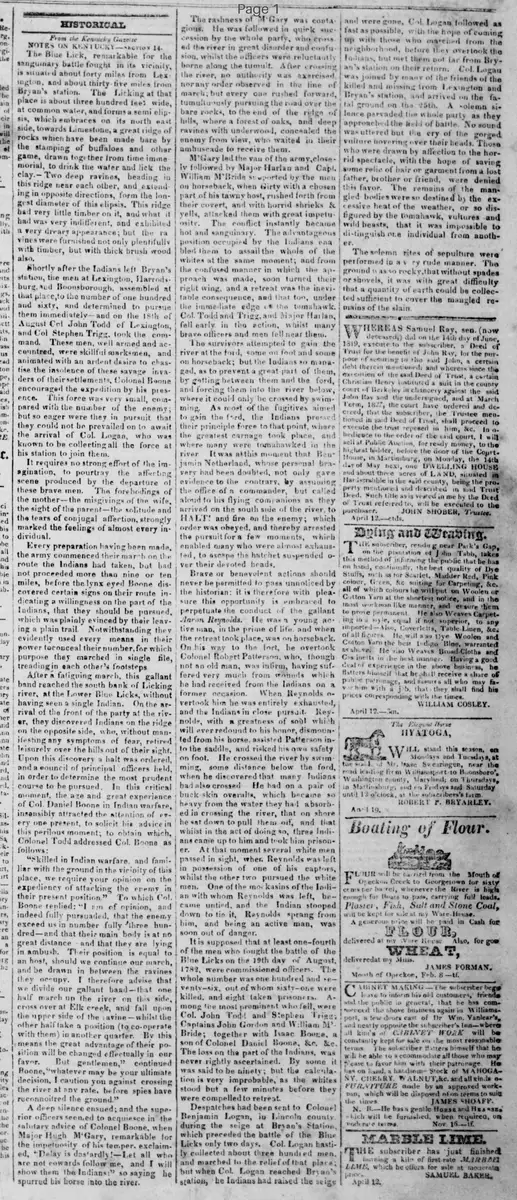
The Blue Lick, remarkable for the sanguinary battle fought in its vicinity, is situated about forty miles from Lexington, and about thirty-five miles from Bryan's station. The Licking at that place is about three hundred feet wide, at common water, and forms a semi ellipsis, which embraces on its north east side, towards Limestone, a great ridge of rocks which have been made bare by the stamping of buffaloes and other game, drawn together from time immemorial, to drink the water and lick the clay. Two deep ravines, heading in this ridge near each other, and extending in opposite directions, form the longest diameter of this ellipsis. This ridge had very little timber on it, and what it had was very indifferent, and exhibited a very dreary appearance; but the ravines were furnished not only plentifully with timber, but with thick brush wood also.
Shortly after the Indians left Bryan's station, the men at Lexington, Harrodsburg, and Boonsborough, assembled at that place, to the number of one hundred and sixty, and determined to pursue them immediately-and on the 18th of August Col John Todd of Lexington, and Col Stephen Trigg, took the command. These men, well armed and accoutred, were skillful marksmen, and animated with an ardent desire to chastise the insolence of these savage invaders of their settlements, Colonel Boone encouraged the expedition by his presence. This force was very small, compared with the number of the enemy; but so eager were they in pursuit that they could not be prevailed on to await the arrival of Col. Logan, who was known to be collecting all the force at his station to join them.
It requires no strong effort of the imagination, to pourtray the affecting scene produced by the departure of these brave men. The forebodings of the mother-the misgivings of the wife, the sight of the parent-the solitude and the tears of conjugal affection, strongly marked the feelings of almost every individual.
Every preparation having been made, the army commenced their march on the route the Indians had taken, but had not proceeded more than nine or ten miles, before the lynx eyed Boone discovered certain signs on their route indicating a willingness on the part of the Indians, that they should be pursued, which was plainly evinced by their leaving a plain trail. Notwithstanding they evidently used every means in their power to conceal their number, for which purpose they marched in single file, treading in each other's footsteps.
After a fatiguing march, this gallant band reached the south bank of Licking river, at the Lower Blue Licks, without having seen a single Indian. On the arrival of the front of the party at the river, they discovered Indians on the ridge on the opposite side, who, without manifesting any symptoms of fear, retired leisurely over the hills out of their sight. Upon this discovery a halt was ordered, and a council of principal officers held, in order to determine the most prudent course to be pursued. In this critical moment, the age and great experience of Col. Daniel Boone in Indian warfare, insensibly attracted the attention of every one present, to solicit his advice in this perilous moment; to obtain which, Colonel Todd addressed Col. Boone as follows:
"Skilled in Indian warfare, and familiar with the ground in the vicinity of this place, we require your opinion on the expediency of attacking the enemy in their present position." To which Col. Boone replied: "I am of opinion, and indeed fully persuaded, that the enemy exceed us in number fully three hundred-and that their main body is at no great distance -and that they are lying in ambush. Their position is equal to an host, should we continue our march, and be drawn in between the ravines they occupy. I therefore advise that we divide our gallant band-that one half march up the river on this side, cross over at Elk creek, and fall upon the upper side of the ravine-whilst the other half take a position (to co-operate with them) in another quarter. By this means the great advantage of their position will be changed effectually in our favor. But gentlemen," continued Boone, "whatever may be your ultimate decision, I caution you against crossing the river at any rate, before spies have reconnoitred the ground."
A deep silence ensued; and the superior officers seemed to acquiesce in the salutary advice of Colonel Boone, when Major Hugh McGary, remarkable for the impetuosity of his temper, exclaimed, -Delay is dastardly!-Let all who are not cowards follow me, and I will show them the Indians:" so saying he spurred his horse into the river.
The rashness of McGary was contagious. He was followed in quick succession by the whole party, who crossed the river in great disorder and confusion, whilst the officers were reluctantly borne along the tumult. After crossing the river, no authority was exercised, nor any order observed in the line of march; but every one rushed forward, tumultuously pursuing the road over the bare rocks, to the end of the ridge of hills, where a forest of oaks, and deep ravines with underwood, concealed the enemy from view, who waited in their ambuscade to receive them.
McGary led the van of the army, closely followed by Major Harlan and Capt. William McBride supported by the men on horseback, when Girty with a chosen part of his tawny host, rushed forth from their covert, and with horrid shrieks & yells, attacked them with great impetuosity. The conflict instantly became hot and sanguinary. The advantageous position occupied by the Indians enabled them to assail the whole of the whites at the same moment; and from the confused manner in which the approach was made, soon turned their right wing, and a retreat was the inevitable consequence, and that too, under the immediate edge of the tomahawk.
Col. Todd and Trigg, and Major Harlan, fall early in the action, whilst many brave officers and men fell near them. The survivors attempted to gain the river at the ford, some on foot and some on horseback; but the Indians so managed, as to prevent a great part of them, by getting between them and the ford, and forcing them into the river below, where it could only be crossed by swimming. As most of the fugitives aimed to gain the ford, the Indians pressed their principle force to that point, where the greatest carnage took place, and where many were tomahawked in the river. It was at this moment that Benjamin Netherland, whose personal bravery had been doubted, not only gave evidence to the contrary, by assuming the office of a commander, but called aloud to his flying companions as they arrived on the south side of the river, to HALT: and fire on the enemy; which order was obeyed, and thereby arrested the pursuit for a few moments, which enabled many who were almost exhausted, to escape the hatchet suspended over their devoted heads.
Brave or benevolent actions should never be permitted to pass unnoticed by the historian: it is therefore with pleasure this opportunity is embraced to perpetuate the conduct of the gallant Jaron Reynolds. He was a young active man, in the prime of life, and when the retreat took place, was on horseback. On his way to the fort, he overtook Colonel Robert Patterson, who, though not an old man, was infirm, having suffered very much from wounds which he had received from the Indians on a former occasion. When Reynolds overtook him he was entirely exhausted, and the Indians in close pursuit. Reynolds, with a greatness of soul which will ever redound to his honor, dismounted from his horse, assisted Patterson into the saddle, and risked his own safety on foot. He crossed the river by swimming, some distance below the ford, when he discovered that many Indians had also crossed. He had on a pair of buck-skin overalls, which became so heavy from the water they had absorbed in crossing the river, that on shore he sat down to pull them off, and that whilst in the act of doing so, three Indians came up to him and took him prisoner. At that moment several white men passed in sight, where Reynolds was left in possession of one of his captors, whilst the other two pursued the white men. One of the moccasins of the Indian with whom Reynolds was left, became untied, and the Indian stooped down to tie it. Reynolds sprang from him, and being an active man, was soon out of danger.
It is supposed that at least one-fourth of the men who fought the battle of the Blue Licks on the 19th day of August, 1782, were commissioned officers. The whole number was one hundred and seventy-six, out of whom sixty-one were killed, and eight taken prisoners. Among the most prominent who fell, were Col. John Todd and Stephen Trigg: Captains John Gordon and William McBride: together with Isaac Boone, a son of Colonel Daniel Boone, &c. &c.
The loss on the part of the Indians, was never rightly ascertained. By some it was said to be ninety; but the calculation is very improbable, as the whites stood but a few minutes before they were compelled to retreat.
Despatches had been sent to Colonel Benjamin Logan, in Lincoln county during the siege at Bryan's Station, which preceded the battle of the Blue Licks only two days. Col. Logan hastily collected about three hundred men, and marched to the relief of that place; but when Col. Logan reached Bryan's station, the Indians had raised the siege and were gone. Col. Logan followed as fast as possible, with the hope of coming up with those who marched from the neighborhood, before they overtook the Indians, but met them not far from Bryan's station on their return. Col. Logan was joined by many of the friends of the killed and missing from Lexington and Bryan's station, and arrived on the fatal ground on the 25th. A solemn silence pervaded the whole party as they approached the field of battle. No sound was uttered but the cry of the gorged vulture hovering over their heads. Those who were drawn by affection to the horrid spectacle, with the hope of saving some relic of hair or garment from a lost father, brother or friend, were denied this favor. The remains of the mangled bodies were so destined by the excessive heat of the weather, or so disfigured by the tomahawk, vultures -and wild beasts, that it was impossible to distinguish one individual from another.
The solemn rites of sepulture were performed in a very rude manner. The ground was so rocky, that without spades or shovels, it was with great difficulty that a quantity of earth could be collected sufficient to cover the mangled remains of the slain.
What sub-type of article is it?
What themes does it cover?
What keywords are associated?
What entities or persons were involved?
Where did it happen?
Story Details
Key Persons
Location
Blue Licks, Near Lexington And Bryan's Station, Kentucky
Event Date
19th Day Of August, 1782
Story Details
Kentucky militia of 176 men, led by Colonels Todd and Trigg with Boone present, pursued Native Americans after Bryan's Station siege. Ignoring Boone's ambush warning, Major McGary rashly charged across Licking River into an Indian trap at Blue Licks. Ambushed in ravines, 61 whites killed including leaders; survivors fled with heroic acts by Netherland and Reynolds. Logan arrived later for burial.