Thank you for visiting SNEWPapers!
Sign up free
Norfolk Gazette And Publick Ledger
Norfolk, Virginia
What is this article about?
Electors of Westminster hold a dinner at the Crown and Anchor Tavern to celebrate Sir Francis Burdett's release from the Tower. In his speech, Burdett criticizes the Whig Party, defends reform efforts, and calls for restoring liberties and aiding Ireland. (248 characters)
Merged-components note: The editorial component is an introductory paragraph to the foreign news article on Sir Francis Burdett's speech from a London paper; merging into a single coherent foreign news story.
Clipping
OCR Quality
Full Text
From A London Paper.
Sir Francis Burdett's Liberation.
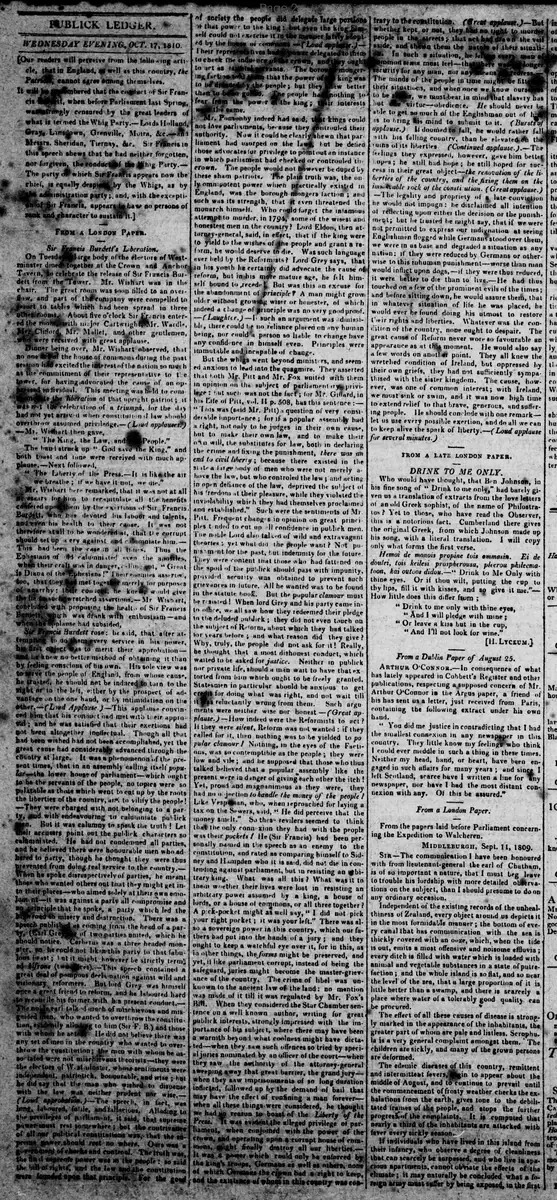
On Tuesday a large body of the electors of Westminster dined together at the Crown and Anchor Tavern, to celebrate the release of Sir Francis Burdett from the Tower. Mr. Wishart was in the chair. The great room was soon filled to an overflow, and part of the company were compelled to sit at tables which had been spread in three other rooms. About five o'clock Sir Francis entered the room with Major Cartwright, Mr. Wardle, Clifford, Mr. Mallet, and other gentlemen, who were received with great applause.
Dinner being over, Mr. Wishart observed, that no one in the house of commons during the past session had excited the interest of the nation so much as the commitment of their representative to the Tower, or having advocated the cause of an oppressed individual. This meeting was held to congratulate the liberation of that upright patriot; it was not yet the celebration of a triumph, for the day had not yet arrived when constitution and law should overthrow assumed privilege. (Loud applauses.)
Mr. Wishart then gave, "The King, the Law, and the People."
The band struck up "God save the King," and both toast and tune were received with much applause.—Next followed,
The Liberty of the Press.—It is like the air we breathe; if we have it not, we die.
Mr. Wishart here remarked, that it was not at all necessary for him to recapitulate all the benefits conferred upon them by the exertions of Sir Francis Burdett, who had devoted his labour and talents, and even his health to their cause. It was not therefore at all to be wondered at, that the corrupt should set up a cry against, and calumniate him.—This had been the case in all times. Thus the Ephesians did calumniate even the apostles, when their craft was in danger, crying out, "Great Diana of the Ephesians!" Their enemies asserted, too, that they met together merely for purposes of anarchy: their conduct, he knew would give the lie to such wretched assertions.—Mr. Wishart, concluded with proposing the health of Sir Francis Burdett, which was drank with enthusiasm—and when the applause had subsided,
Sir Francis Burdett rose: he said, that after attempting to do them every service in his power, his first object was to merit their approbation—and he knew no better method of obtaining it than by feeling conscious of his own. His sole view was to serve the people of England, from whose cause, he trusted, he should not be induced to turn to the right or to the left, either by the prospect of advantage on the one hand, or by intimidation on the other. (Loud Applause.)—This applause convinced him that his conduct had met with their approbation; and he was satisfied that their exertions had not been altogether ineffectual. Though all that had been wished had not been accomplished, yet the great cause had considerably advanced through the country at large. It was a phenomenon of the present times, that in an assembly calling itself popular—the lower house of parliament—which ought to be the servants of the people, no topics were so palatable as those which went to cut up by the roots the liberties of the country, and to vilify the people! They were charged with not belonging to a party, and with endeavouring to calumniate public men. But it was calumny to speak the truth! Let their accusers point out the public characters so calumniated. He had not condemned all parties, and he believed there were honourable men who adhered to party, though he thought they were thus prevented from doing real service to the country.—When he spoke disrespectfully of parties, he meant those who wanted others out that they might get into their places—who aimed solely at their own emolument. It was against a party all compromise and no principle that he spoke, a party which led the way to misery and destruction. There was a speech published as coming from the head of a party (lord Grey) of two parties united, which he should notice. Cerberus was a three headed monster so he could not liken this party to that fabulous beast; but it might however be strictly termed by-ros (two faces).—This speech contained a great deal of pompous declamation against wild and visionary reformers. But lord Grey was himself once a fervent friend to reform, and he laboured hard to reconcile his former with his present conduct.—The noble earl talked much of mischievous and mis-guided men, who wanted to overthrow the constitution, evidently alluding to him (Sir F. B.) and those with whom he acted.
He did not believe there was any set of men in the country who wanted to overthrow the constitution; the men with whom he associated were not mischievous theorists—they were the electors of Westminster, whose sentiments were independent, patriotick, honourable, and wise; but he did say that the man who wished to dispense with the law, was neither prudent nor wise. (Loud approbation.)—The speech, in fact, was long, laboured, futile, and fallacious. Alluding to the privileges of parliament it said that supreme power must rest somewhere; but the contrivance of all our political constitutions was that the supreme power should rest nowhere. Our government of checks and controul. The truth the independent power was in the people it said The bill of rights, and the laws and the constitution founded upon that principle, for he of society the people did delegate large portion of that power to the king: but even the king who self could not exercise it in the manner safely adopted by the house of commons. Loud applause Their representatives power delegated to them to check the influence of the crown and they ought to act as faithful guardians. The borough monger iny faction knew full well that the power of king was to be divided by the people; but they knew better than to be gone the people have nothing to fear from the power of the king; their interests te came. Mr. Ponsonby indeed had said, that kings could not love parliaments, because they controlled their authority. Now it could be clearly shewn that parliament had usurped on the law but he defied those advocates for privilege to point out an instance in which parliament had checked or controlled the crown. The people would not however be duped by these sham patriots. The plain truth was, the only omnipotent power which practically existed in England, was the borough mongers faction; and such was its strength, that it even threatened the monarch himself. Who could forget the infamous attempt to murder, in 1794, some of the wisest and honestest men in the country? Lord Eldon, then attorney-general, said, in effect, that if the king were to yield to the wishes of the people and grant a reform, he would deserve to die. Was such language ever held by the Reformists? Lord Grey says, that in his youth he certainly did advocate the cause of reform, but in his more mature age, he felt himself bound to recede! But was this an excuse for the abandonment of principle? A man might grow older without growing wiser or honester, of which indeed a change of principle was no very good proof. —(Laughter.)—If such an argument was admissible, there could be no reliance placed on any human being, nor could a person so liable to change have any confidence in himself even. Principles were immutable and incapable of change. But the whigs went beyond ministers, and seemed anxious to lead into the quagmire. They asserted that both Mr. Pitt and Mr. Fox united with them in opinion on the subject of parliamentary privilege: but such was not the fact; for Mr. Gifford, in his Life of Pitt, vol. II p. 508, has this sentence :—"This was (said Mr. Pitt) a question of very considerable importance; for if a popular assembly had a right, not only to be judges in their own cause, but to make their own law, and to make their own will, the substitutes for law, both in declaring the crime and fixing the punishment, there was an end to civil liberty; because there existed in the state a large body of men who were not merely above the law, but who controlled the law; and acting in open defiance of the law, deprived the subject of his freedom at their pleasure, while they violated the inviolability which they had themselves proclaimed and established." Such were the sentiments of Mr. Pitt. Frequent changes in opinion on great principles tended to cut up all confidence in public men. The noble Lord also talked of wild and extravagant theories: yet what did the people want? Not punishment for the past, but indemnity for the future. They were content that those who had fattened on the spoil of the public should pass with impunity, provided security was obtained to prevent such grievances in future. All he wanted was to be found in the statute book. But the popular clamour must be resisted! When lord Grey and his party came into office; we all saw how they redeemed their pledge to the deluded public; they did not even touch on the subject of Reform, about which they had talked for years before; and what reason did they give? Why, truly, the people did not ask for it! Really, he thought that a most dishonest conduct, which waited to be asked for justice. Neither in public nor private life, should a man wait to have that extorted from him which ought to be freely granted. Statesmen in particular should be anxious to get credit for doing what was right, and not wait till it was reluctantly wrung from them. Such arguments were neither wise nor honest.—(Great applause.)—How indeed were the Reformists to act? If they were silent, Reform was not wanted: if they called for it, then nothing was to be yielded to popular clamour. Nothing, in the eyes of the Factious, was so contemptible as the people; they were low and vile; and he supposed that those who thus talked believed that a popular assembly like the present were in danger of giving each other the itch! Yet, proud and magnanimous as they were, they had no objection to handle the money of the people! Like Vespasian, who, when reproached for laying a tax on the Sewers, said, "He did perceive that the money smelt." So these revilers seemed to think that the only connexion they had with the people was their pockets. He (Sir Francis) had been personally named in the speech as an enemy to the constitution, and rated as comparing himself to Sidney and Hampden who it is said, did not die in contending against parliament, but in resisting an arbitrary king. What was all this? What was it to them whether their lives were lost in resisting an arbitrary power assumed by a king, a house of lords, or a house of commons, or all three together? A pick-pocket might as well say, "I did not pick your right pocket; it was your left." There was also a sovereign power in this country, which our fathers had put into the hands of a jury; and they ought to keep a watchful eye over it, for in this, as in other things, the forms might be preserved, and yet, if like parliament corrupt, instead of being the safeguard, juries might become the master-grievance of the country. The crime of libel was unknown to the ancient law of the land: no mention was made of it till it was regulated by Mr. Fox's Bill. When they considered the Star Chamber sentence on a well known author, writing on great public interests, strongly impressed with the importance of his subject, where there may have been a warmth beyond what coolness might have dictated—when they saw such offences so tried by special juries nominated by an officer of the court when they saw the authority of the attorney-general sweeping away that great barrier, the grand jury—when they saw imprisonments of so long duration inflicted, followed up by the demand of bail that may have the effect of confining a man forever—when all these things were considered, he thought we had no reason to boast of the Liberty of the Press. It was evident the alleged privilege of parliament when conjoined with the power of the crown and operating upon corrupt house of commons might finally destroy all our liberties. It was a power which could only be enforced by the king's troops Germans as well as others none of which persons the crown had right to keep. and the existence of whom in this country was contrary to the constitution. (Great applause.)—But whether kept or not, they had no right to murder people in the streets: that act had drawn the veil aside, and shewn them the picture of their situation. In such situation he felt every man of common sense must feel—there was no security for any man, not any means rights. The minds of the people in one might be tried their situations, and when once we know ours to be such, we must bear in mind that slavery has but one virtue—obedience. He should never be able to get so much of the Englishman out of him as to bring his mind to submit to it. (Bursts of applause.) If doomed to fall, he would rather fall with his falling country, than be elevated on the ruins of its liberties. (Continued applause.)—The feelings they expressed, however, gave him better hopes; he still had hope; he still hoped for success in their great object—the renovation of the liberties of the country, and the fixing them on the immutable rock of the constitution. (Great applause.)
—The legality and propriety of a late conviction he would not impugn: he disclaimed all intention of reflecting upon either the decision or the punishment; but he trusted he might say, that if we were not permitted to express our indignation at seeing Englishmen flogged while Germans stood over them, we were in as base and degraded a situation as any nation: if they were reduced by Germans or otherwise to this inhuman punishment—worse than man would inflict upon dogs,—if they were thus reduced, it were better to die than to live.—He had thus touched on a few of the prominent evils of the times; and before sitting down, he would assure them, that in whatever situation of life he was placed, he would ever be found doing his utmost to restore our rights and liberties. Whatever was the condition of the country, none ought to despair. The great cause of Reform never wore so favourable an appearance as at this moment. He would also say a few words on another point. They all knew the wretched condition of Ireland, but oppressed by their own griefs, they had not sufficiently sympathised with the sister kingdom. The cause, however, was one of common interest; with Ireland, we must sink or swim, and it was now high time to extend relief to that brave, generous, and suffering people. He should conclude with one remark—let us use every possible exertion, and do all we can to keep alive the spark of liberty.—(Loud applause for several minutes.)
What sub-type of article is it?
What keywords are associated?
What entities or persons were involved?
Where did it happen?
Foreign News Details
Primary Location
Westminster, London
Event Date
On Tuesday
Key Persons
Outcome
celebration of burdett's release; advocacy for reform and liberties advanced but not fully achieved; call for sympathy with ireland.
Event Details
Electors of Westminster dine at Crown and Anchor Tavern to celebrate Sir Francis Burdett's release from the Tower. Toasts given to the King, Law, People, and Liberty of the Press. Burdett speaks criticizing Whig Party, parliamentary privilege, borough-mongers, and advocating constitutional reform, press freedom, and aid to Ireland.