Thank you for visiting SNEWPapers!
Sign up free
Editorial
May 6, 1829
Daily Richmond Whig
Richmond, Virginia
What is this article about?
Editorial republishes extract from London Evening Mail attacking Pharisaic hypocrisy in Christianity, praises Mr. Harness' sermons on schism targeting Evangelicals, and advocates moderate enjoyment of innocent pleasures as aligned with Gospel teachings.
Clipping
OCR Quality
98%
Excellent
Full Text
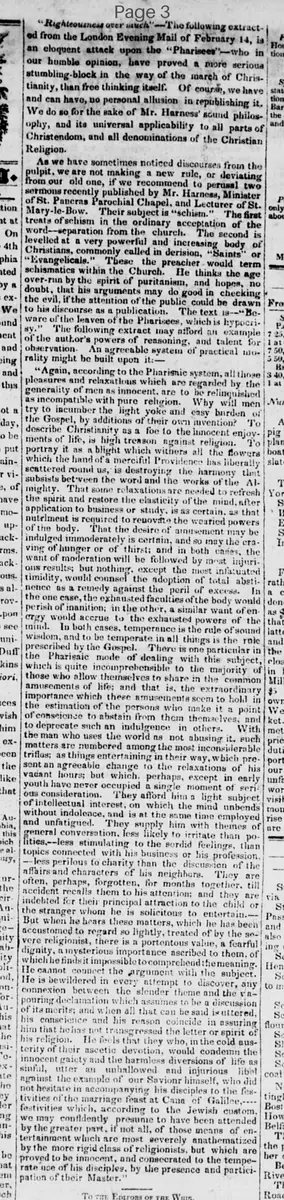
"Righteousness over much"--The following extract from the London Evening Mail of February 14, is an eloquent attack upon the "Pharisees"--who in our humble opinion, have proved a more serious stumbling-block in the way of the march of Christianity, than free thinking itself. Of course, we have and can have, no personal allusion in republishing it. We do so for the sake of Mr. Harness' sound philosophy, and its universal applicability to all parts of Christendom, and all denominations of the Christian Religion.
As we have sometimes noticed discourses from the pulpit, we are not making a new rule, or deviating from our old one, if we recommend to perusal two sermons recently published by Mr. Harness, Minister of St. Pancras Parochial Chapel, and Lecturer of St. Mary-le-Bow. Their subject is "schism." The first treats of schism in the ordinary acceptation of the word--separation from the church. The second is levelled at a very powerful and increasing body of Christians, commonly called in derision, "Saints" or "Evangelicals." These the preacher would term schismatics within the Church. He thinks the age over-run by the spirit of puritanism, and hopes, no doubt, that his arguments may do good in checking the evil, if the attention of the public could be drawn to his discourse as a publication. The text is--"Beware of the leaven of the Pharisees, which is hypocrisy."
The following extract may afford an example of the author's powers of reasoning, and talent for observation. An agreeable system of practical morality might be built upon it:-
"Again, according to the Pharisaic system, all those pleasures and relaxations which are regarded by the generality of men as innocent, are to be relinquished as incompatible with pure religion. Why will men try to incumber the light yoke and easy burden of the Gospel, by additions of their own invention? To describe Christianity as a foe to the innocent enjoyments of life, is high treason against religion. To portray it as a blight which withers all the flowers which the hand of a merciful Providence has liberally scattered round us, is destroying the harmony that subsists between the word and the works of the Almighty. That some relaxations are needed to refresh the spirit and restore the elasticity of the mind, after application to business or study, is as certain, as that nutriment is required to renovate the wearied powers of the body. That the desire of amusement may be indulged immoderately is certain, and so may the craving of hunger or of thirst; and in both cases, the want of moderation will be followed by most injurious results; but nothing, except the most infatuated timidity, would counsel the adoption of total abstinence as a remedy against the peril of excess. In the one case, the exhausted faculties of the body would perish of inanition; in the other, a similar want of energy would accrue to the exhausted powers of the mind. In both cases, temperance is the rule of sound wisdom, and to be temperate in all things is the rule prescribed by the Gospel. There is one particular in the Pharisaic mode of dealing with this subject, which is quite incomprehensible to the majority of those who allow themselves to share in the common amusements of life; and that is, the extraordinary importance which these amusements seem to hold in the estimation of the persons who make it a point of conscience to abstain from them themselves, and to deprecate such an indulgence in others. With the man who uses the world as not abusing it, such matters are numbered among the most inconsiderable trifles; as things entertaining in their way, which present an agreeable change to the relaxations of his vacant hours; but which, perhaps, except in early youth have never occupied a single moment of serious consideration. They afford him a light subject of intellectual interest, on which the mind unbends without indolence, and is at the same time employed and unfatigued. They supply him with themes of general conversation, less likely to irritate than politics.--less stimulating to the sordid feelings, than topics connected with his business or his profession.--less perilous to charity than the discussion of the affairs and characters of his neighbors. They are often, perhaps, forgotten, for months together, till accident recalls them to his attention; and they are indebted for their principal attraction to the child or the stranger whom he is solicitous to entertain.-- But when he hears these matters, which he has been accustomed to regard so lightly, treated of by the severe religionist, there is a portentous value, a fearful dignity, a mysterious importance ascribed to them, of which he finds it impossible to comprehend the meaning. He cannot connect the argument with the subject. He is bewildered in every attempt to discover, any connexion between the slender theme and the vaunting declamation which assumes to be a discussion of its merits; and when all that can be said is uttered, his conscience and his reason coincide in assuring him that he has not transgressed the letter or spirit of his religion. He feels that they who, in the cold austerity of their ascetic devotion, would condemn the innocent gaiety and the harmless diversions of life as sinful, utter an unhallowed and injurious libel against the example of our Saviour himself, who did not hesitate in accompanying his disciples to the festivities of the marriage feast at Cana of Galilee,... festivities which, according to the Jewish custom, we may confidently presume to have been attended by the greater part, if not all, of those means of entertainment which are most severely anathematized by the more rigid class of religionists, but which are proved to be innocent, and consecrated to the temperate use of his disciples, by the presence and participation of their Master.'
As we have sometimes noticed discourses from the pulpit, we are not making a new rule, or deviating from our old one, if we recommend to perusal two sermons recently published by Mr. Harness, Minister of St. Pancras Parochial Chapel, and Lecturer of St. Mary-le-Bow. Their subject is "schism." The first treats of schism in the ordinary acceptation of the word--separation from the church. The second is levelled at a very powerful and increasing body of Christians, commonly called in derision, "Saints" or "Evangelicals." These the preacher would term schismatics within the Church. He thinks the age over-run by the spirit of puritanism, and hopes, no doubt, that his arguments may do good in checking the evil, if the attention of the public could be drawn to his discourse as a publication. The text is--"Beware of the leaven of the Pharisees, which is hypocrisy."
The following extract may afford an example of the author's powers of reasoning, and talent for observation. An agreeable system of practical morality might be built upon it:-
"Again, according to the Pharisaic system, all those pleasures and relaxations which are regarded by the generality of men as innocent, are to be relinquished as incompatible with pure religion. Why will men try to incumber the light yoke and easy burden of the Gospel, by additions of their own invention? To describe Christianity as a foe to the innocent enjoyments of life, is high treason against religion. To portray it as a blight which withers all the flowers which the hand of a merciful Providence has liberally scattered round us, is destroying the harmony that subsists between the word and the works of the Almighty. That some relaxations are needed to refresh the spirit and restore the elasticity of the mind, after application to business or study, is as certain, as that nutriment is required to renovate the wearied powers of the body. That the desire of amusement may be indulged immoderately is certain, and so may the craving of hunger or of thirst; and in both cases, the want of moderation will be followed by most injurious results; but nothing, except the most infatuated timidity, would counsel the adoption of total abstinence as a remedy against the peril of excess. In the one case, the exhausted faculties of the body would perish of inanition; in the other, a similar want of energy would accrue to the exhausted powers of the mind. In both cases, temperance is the rule of sound wisdom, and to be temperate in all things is the rule prescribed by the Gospel. There is one particular in the Pharisaic mode of dealing with this subject, which is quite incomprehensible to the majority of those who allow themselves to share in the common amusements of life; and that is, the extraordinary importance which these amusements seem to hold in the estimation of the persons who make it a point of conscience to abstain from them themselves, and to deprecate such an indulgence in others. With the man who uses the world as not abusing it, such matters are numbered among the most inconsiderable trifles; as things entertaining in their way, which present an agreeable change to the relaxations of his vacant hours; but which, perhaps, except in early youth have never occupied a single moment of serious consideration. They afford him a light subject of intellectual interest, on which the mind unbends without indolence, and is at the same time employed and unfatigued. They supply him with themes of general conversation, less likely to irritate than politics.--less stimulating to the sordid feelings, than topics connected with his business or his profession.--less perilous to charity than the discussion of the affairs and characters of his neighbors. They are often, perhaps, forgotten, for months together, till accident recalls them to his attention; and they are indebted for their principal attraction to the child or the stranger whom he is solicitous to entertain.-- But when he hears these matters, which he has been accustomed to regard so lightly, treated of by the severe religionist, there is a portentous value, a fearful dignity, a mysterious importance ascribed to them, of which he finds it impossible to comprehend the meaning. He cannot connect the argument with the subject. He is bewildered in every attempt to discover, any connexion between the slender theme and the vaunting declamation which assumes to be a discussion of its merits; and when all that can be said is uttered, his conscience and his reason coincide in assuring him that he has not transgressed the letter or spirit of his religion. He feels that they who, in the cold austerity of their ascetic devotion, would condemn the innocent gaiety and the harmless diversions of life as sinful, utter an unhallowed and injurious libel against the example of our Saviour himself, who did not hesitate in accompanying his disciples to the festivities of the marriage feast at Cana of Galilee,... festivities which, according to the Jewish custom, we may confidently presume to have been attended by the greater part, if not all, of those means of entertainment which are most severely anathematized by the more rigid class of religionists, but which are proved to be innocent, and consecrated to the temperate use of his disciples, by the presence and participation of their Master.'
What sub-type of article is it?
Moral Or Religious
What keywords are associated?
Pharisees
Schism
Evangelicals
Puritanism
Christian Moderation
Innocent Pleasures
Temperance
What entities or persons were involved?
Mr. Harness
Pharisees
Saints Or Evangelicals
St. Pancras Parochial Chapel
St. Mary Le Bow
Editorial Details
Primary Topic
Critique Of Pharisaic Hypocrisy And Schism In Christianity
Stance / Tone
Advocacy For Moderate Religion Against Puritanical Excess
Key Figures
Mr. Harness
Pharisees
Saints Or Evangelicals
St. Pancras Parochial Chapel
St. Mary Le Bow
Key Arguments
Pharisees Hinder Christianity More Than Free Thinking
Schism By Evangelicals Within The Church
Christianity Permits Innocent Pleasures And Relaxations
Total Abstinence From Amusements Is Unwise; Temperance Is Prescribed
Rigid Religionists Overemphasize Trivial Amusements
Jesus Participated In Festivities At Cana