Thank you for visiting SNEWPapers!
Sign up free
Literary
November 5, 1900
Freeland Tribune
Freeland, Luzerne County, Pennsylvania
What is this article about?
Science notes covering: low density of the sun indicating gaseous mass; bats' value in destroying insects including mosquitoes and codling moths; optimal shutter design for instantaneous photography per M. Sigriste; disappearance of a common hummingbird species from St. Vincent after 1898 hurricane; theory of sun's photosphere as a shell of condensed clouds illustrated by steam from a kettle.
Clipping
OCR Quality
98%
Excellent
Full Text
SCIENCE NOTES
The mean density of the sun is only about one-fourth that of the earth. This low density is one of the several reasons for believing that the sun's mass is gaseous throughout.
As destroyers of many of our most pestiferous night-flying insects, like mosquitoes, the bat is almost our sole dependence, and, as he is known to hunt insects afoot as well as on the wing, he is also of some value for larvae that do not fly. So says one of the scientists, who also credits the bat with destroying codling moths.
According to M. Sigriste of the French Academy of Sciences, the only thoroughly scientific shutter for instantaneous photography consists of a slit moving rapidly across the sensitive plate. But to obtain good results, the space between the plate and the shutter should not exceed one-tenth of a millimetre, and the edges of the slit must be sharp and carefully beveled to exclude reflection.
A remarkable effect of the great hurricane of 1898 in the West India Islands was the complete disappearance from the island of St. Vincent of a species of humming-bird, which, previous to the storm, had been one of the commonest and tamest birds that inhabited the island. Other species of humming-birds, of a larger size, survived the tempest, and are yet to be seen in St. Vincent, but the little bronze-green birds with erected crests which formerly attracted much admiration, are all gone.
The brilliant "photosphere" of the sun is now held to be a shell of clouds, within the sun's gaseous mass, but at an altitude—or distance from the centre—such that the temperature is low enough for the partial condensation of those substances which are the most intractable to heat. This theory is well illustrated by steam issuing from the nozzle of a tea kettle. Steam is an invisible gas; but as soon as it becomes cooled below a certain point from contact with the outer air it condenses into a visible vapor, forming clouds. The droplets which form the solar clouds are probably mainly of carbon, although condensed to the liquid, or possibly the solid form, they are still hot enough to be intensely incandescent.
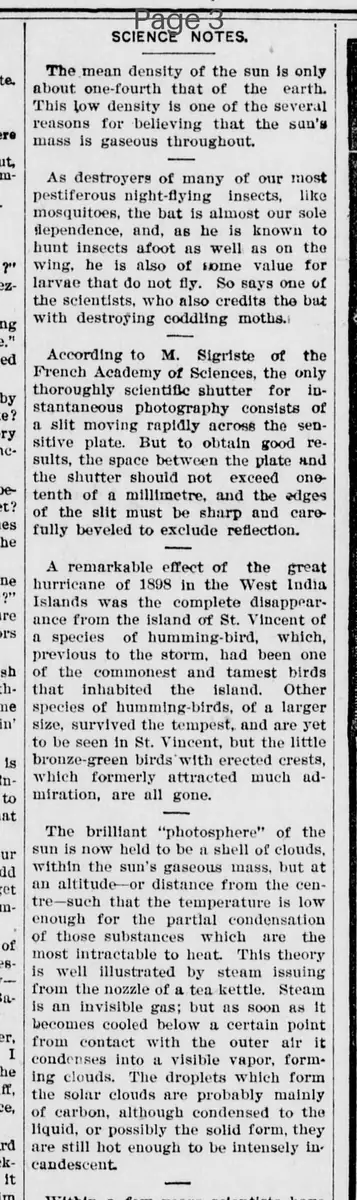
The mean density of the sun is only about one-fourth that of the earth. This low density is one of the several reasons for believing that the sun's mass is gaseous throughout.
As destroyers of many of our most pestiferous night-flying insects, like mosquitoes, the bat is almost our sole dependence, and, as he is known to hunt insects afoot as well as on the wing, he is also of some value for larvae that do not fly. So says one of the scientists, who also credits the bat with destroying codling moths.
According to M. Sigriste of the French Academy of Sciences, the only thoroughly scientific shutter for instantaneous photography consists of a slit moving rapidly across the sensitive plate. But to obtain good results, the space between the plate and the shutter should not exceed one-tenth of a millimetre, and the edges of the slit must be sharp and carefully beveled to exclude reflection.
A remarkable effect of the great hurricane of 1898 in the West India Islands was the complete disappearance from the island of St. Vincent of a species of humming-bird, which, previous to the storm, had been one of the commonest and tamest birds that inhabited the island. Other species of humming-birds, of a larger size, survived the tempest, and are yet to be seen in St. Vincent, but the little bronze-green birds with erected crests which formerly attracted much admiration, are all gone.
The brilliant "photosphere" of the sun is now held to be a shell of clouds, within the sun's gaseous mass, but at an altitude—or distance from the centre—such that the temperature is low enough for the partial condensation of those substances which are the most intractable to heat. This theory is well illustrated by steam issuing from the nozzle of a tea kettle. Steam is an invisible gas; but as soon as it becomes cooled below a certain point from contact with the outer air it condenses into a visible vapor, forming clouds. The droplets which form the solar clouds are probably mainly of carbon, although condensed to the liquid, or possibly the solid form, they are still hot enough to be intensely incandescent.
What sub-type of article is it?
Science Notes
What keywords are associated?
Sun Density
Gaseous Sun
Bats Insects
Codling Moths
Instantaneous Photography
Shutter Slit
Hurricane 1898
St Vincent Hummingbird
Solar Photosphere
Steam Condensation
Literary Details
Title
Science Notes
Key Lines
The Mean Density Of The Sun Is Only About One Fourth That Of The Earth.
As Destroyers Of Many Of Our Most Pestiferous Night Flying Insects, Like Mosquitoes, The Bat Is Almost Our Sole Dependence.
According To M. Sigriste Of The French Academy Of Sciences, The Only Thoroughly Scientific Shutter For Instantaneous Photography Consists Of A Slit Moving Rapidly Across The Sensitive Plate.
A Remarkable Effect Of The Great Hurricane Of 1898 In The West India Islands Was The Complete Disappearance From The Island Of St. Vincent Of A Species Of Humming Bird.
The Brilliant "Photosphere" Of The Sun Is Now Held To Be A Shell Of Clouds, Within The Sun's Gaseous Mass.