Thank you for visiting SNEWPapers!
Sign up free
The Virginia Gazette
Richmond, Williamsburg, Richmond County, Virginia
What is this article about?
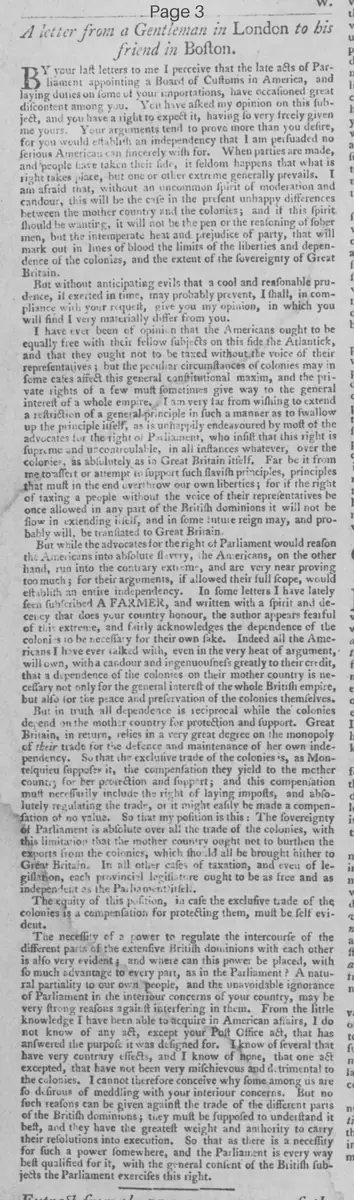
A gentleman in London responds to his friend in Boston's concerns over British parliamentary acts imposing duties on American imports. He argues for equal freedoms for colonists but acknowledges Parliament's absolute sovereignty over colonial trade as compensation for protection, while provincial legislatures should handle internal taxation and legislation.
Clipping
OCR Quality
Full Text
friend in Boston.
By the late act of Parliament appointing a Board of Customs in America, and your last letters to me I perceive that the late acts of Parliament laying duties on some of your importations, have occasioned great discontent among you. You have asked my opinion on this subject, and you have a right to expect it, having so very freely given me yours. Your arguments tend to prove more than you desire, for you would establish an independency that I am persuaded no serious American sincerely wishes for. When parties are made, and people take their side, it seldom happens that what is right takes place, but one or other extreme generally prevails. I am afraid that, without an uncommon spirit of moderation and candour, this will be the case in the present unhappy differences between the mother country and the colonies; and if this spirit should be wanting, it will not be the pen or the reasoning of sober men, but the intemperate heat and prejudice of party, that will mark out in lines of blood the limits of the liberties and dependence of the colonies, and the extent of the sovereignty of Great Britain.
But without anticipating evils that a cool and reasonable prudence, if exerted in time, may probably prevent, I shall, in compliance with your request, give you my opinion, in which you will find I very materially differ from you.
I have ever been of opinion that the Americans ought to be equally free with their fellow subjects on this side the Atlantic, and that they ought not to be taxed without the voice of their representatives; but the peculiar circumstances of colonies may in some cases affect this general constitutional maxim, and the private rights of a few must sometimes give way to the general interest of a whole empire. I am very far from wishing to extend a restriction of a general principle in such a manner as to swallow up the principle itself, as is unhappily endeavoured by most of the advocates for the right of Parliament, who insist that this right is supreme and uncontrollable, in all instances whatever, over the colonies, as absolutely as in Great Britain itself. Far be it from me to assert or attempt to support such slavish principles, principles that must in the end overthrow our own liberties; for if the right of taxing a people without the voice of their representatives be once allowed in any part of the British dominions it will not be slow in extending itself, and in some future reign may, and probably will, be translated to Great Britain.
But while the advocates for the right of Parliament would reason the Americans into absolute slavery, the Americans, on the other hand, run into the contrary extreme, and are very near proving too much; for their arguments, if allowed their full scope, would establish an entire independency. In some letters I have lately seen subscribed A FARMER, and written with a spirit and decency that does your country honour, the author appears fearful of this extreme, and fairly acknowledges the dependence of the colonies to be necessary for their own sake. Indeed all the Americans I have ever talked with, even in the very heat of argument, will own, with a candour and ingenuousness greatly to their credit, that a dependence of the colonies on their mother country is necessary not only for the general interest of the whole British empire, but also for the peace and preservation of the colonies themselves.
But in truth all dependence is reciprocal while the colonies depend on the mother country for protection and support. Great Britain, in return, relies in a very great degree on the monopoly of their trade for the defence and maintenance of her own independency. So that the exclusive trade of the colonies is, as Montesquieu supposes it, the compensation they yield to the mother country; for her protection and support; and this compensation must necessarily include the right of laying imposts, and absolutely regulating the trade, or it might easily be made a compensation of no value. So that my position is this: The sovereignty of Parliament is absolute over all the trade of the colonies, with this limitation that the mother country ought not to burthen the exports from the colonies, which should all be brought hither to Great Britain. In all other cases of taxation, and even of legislation, each provincial legislature ought to be as free and as independent as the Parliament itself.
The equity of this position, in case the exclusive trade of the colonies is a compensation for protecting them, must be self-evident.
The necessity of a power to regulate the intercourse of the different parts of the extensive British dominions with each other is also very evident; and where can this power be placed, with so much advantage to every part, as in the Parliament? A natural partiality to our own people, and the unavoidable ignorance of Parliament in the interior concerns of your country, may be very strong reasons against interfering in them. From the little knowledge I have been able to acquire in American affairs, I do not know of any act, except your Post Office act, that has answered the purpose it was designed for. I know of several that have very contrary effects, and I know of none, that one act excepted, that have not been very mischievous and detrimental to the colonies. I cannot therefore conceive why some among us are so desirous of meddling with your interior concerns. But no such reasons can be given against the trade of the different parts of the British dominions; they must be supposed to understand it best, and they have the greatest weight and authority to carry their resolutions into execution. So that as there is a necessity for such a power somewhere, and the Parliament is every way best qualified for it, with the general consent of the British subjects the Parliament exercises this right.
What sub-type of article is it?
What themes does it cover?
What keywords are associated?
What entities or persons were involved?
Letter to Editor Details
Author
A Gentleman In London
Recipient
His Friend In Boston
Main Argument
parliament holds absolute sovereignty over colonial trade and imposts as compensation for protection, but should not tax exports or interfere in internal legislation, where provincial assemblies should be as free as parliament itself.
Notable Details