Thank you for visiting SNEWPapers!
Sign up free
Literary
November 22, 1827
The Litchfield County Post
Litchfield, Litchfield County, Connecticut
What is this article about?
Descriptive account of the common fox's habitat, behavior, prudence, hunting habits, maternal instincts, and historical fox-chasing pursuits, drawn from Griffith's translation of Cuvier's work.
Clipping
OCR Quality
98%
Excellent
Full Text
From Griffith's translation of Cuvier's animal kingdom
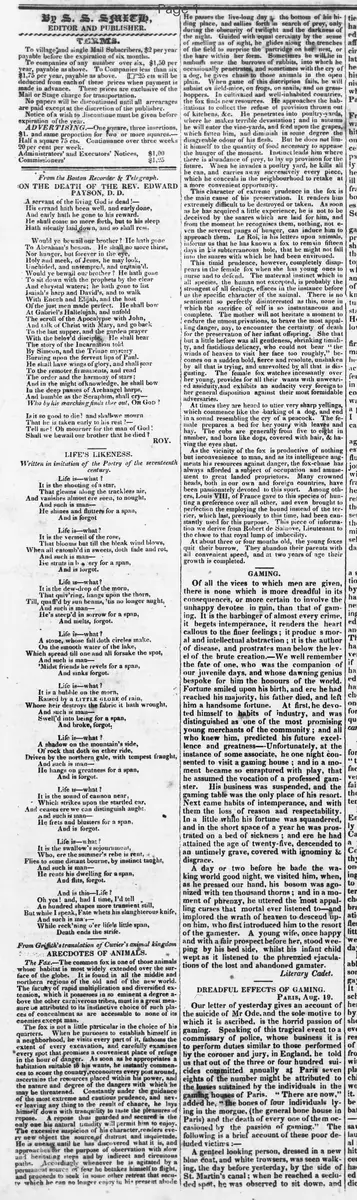
ANECDOTES OF ANIMALS.
The Fox.—The common fox is one of those animals whose habitat is most widely extended over the surface of the globe. It is found in all the middle and northern regions of the old and of the new world.
The faculty of rapid multiplication and diversified extension, which it possesses in so eminent a degree above the other carnivorous tribes, must in a great measure be attributed to its instinctive choice of such places of concealment as are accessible to none of its enemies except man.
The fox is not a little particular in the choice of his quarters. When he purposes to establish himself in a neighborhood, he visits every part of it, fathoms the extent of every excavation, and carefully examines every spot that promises a convenient place of refuge in the hour of danger. As soon as he appropriates a habitation suitable to his wants, he instantly commences to scour the country, reconnoitres every post around, ascertains the resources placed within his power, and the nature and degree of the dangers with which he may be threatened. Constantly under the guidance of the most extreme and cautious prudence, and never leaving any thing to the result of chance, he lays himself down with tranquility to taste the pleasures of repose. A repose thus guarded and secured is the only one his natural timidity will permit him to enjoy.
The excessive suspicion of his character, renders every new object the source of distrust and inquietude. He is uneasy until he has discovered what it is, and approaches for the purpose of observation with slow and hesitating steps and by indirect and circuitous paths. Accordingly whenever he is agitated by a permanent source of fear he betakes himself to flight, and proceeds to seek in some other retreat that security which he can no longer enjoy in his present abode
He passes the live-long day at the bottom of his hiding place, and sallies forth in search of prey, only during the obscurity of twilight and the darkness of the night. Guided with equal certainty by the sense of smelling as of sight, he glides along the trenches of the field to surprise the partridge on her nest, or the hare within her form. Sometimes he will lie in ambush near the burrows of rabbits, into which he occasionally penetrates, and sometimes with the cry of a dog, he gives chase to those animals in the open plain. When game of this description fails, he will subsist on field-mice, on frogs, on snails, and on grass-hoppers. In cultivated and well-inhabited countries, the fox finds new resources. He approaches the habitations to collect the refuse of provision thrown out of kitchens, &c. He penetrates into poultry-yards, where he makes terrible devastation; and in autumn he will enter the vine-yards, and feed upon the grapes, which fatten him, and diminish in some degree the disagreeable odour of his flesh. But he does not limit himself to the quantity of food necessary to appease the hunger of the moment. Instinct leads him where there is abundance of prey, to lay up provision for the future. When he invades a poultry yard, he kills all he can, and carries away successively every piece which he conceals in the neighbourhood to retake at a more convenient opportunity.
This character of extreme prudence in the fox is the main cause of his preservation. It renders him extremely difficult to be destroyed or taken. As soon as he has acquired a little experience, he is not to be deceived by the snares which are laid for him, and from the moment he recognises them, nothing, not even the severest pangs of hunger, can induce him to approach them. Le Roi, in his letters upon animals, informs us that he has known a fox to remain fifteen days in his subterraneous hole, that he might not fall into the snares with which he had been environed.
This timid prudence, however, completely disappears in the female fox when she has young ones to nurse and to defend. The maternal instinct which in all species, the human not excepted, is probably the strongest of all feelings, effaces in the instance before us the specific character of the animal. There is no sentiment so perfectly disinterested as this, none in which the sacrifice of self is so instantaneous and complete. The mother will not hesitate a moment to endure the utmost privations, to brave the most appalling danger, nay, to encounter the certainty of death for the preservation of her infant offspring. She that but a little before was all gentleness, shrinking timidity, and fastidious delicacy, who could not bear "the winds of heaven to visit her face too roughly," becomes on a sudden bold, fierce and resolute, unshaken by all that is trying, and unrevolted by all that is disgusting. The female fox watches incessantly over her young, provides for all their wants with unwearied assiduity, and exhibits an audacity very foreign to her general disposition against their most formidable adversaries.
At times they are heard to utter very sharp yellings, which commence like the barking of a dog, and end in a sound resembling the cry of a peacock. The female prepares a bed for her young with leaves and hay. The cubs are generally from five to eight in number, and born like dogs, covered with hair, & having the eyes shut.
As the vicinity of the fox is productive of nothing but inconvenience to man, and as its intelligence augments his resources against danger, the fox-chase has always afforded a subject of occupation and amusement to great landed proprietors. Many crowned heads, both in our own and foreign countries, have been passionately devoted to this sport. Among others, Louis XIV. of France gave to this species of hunting a preference over all other, and even brought to perfection the employing the hound instead of the terrier, which last, previously to this time, had been constantly used for this purpose. This piece of information we derive from Robert de Salnove, Lieutenant to the chase to that royal lump of imbecility.
At about three or four months old, the young foxes quit their burrow. They abandon their parents with all convenient speed, and at two years of age their growth is completed.
ANECDOTES OF ANIMALS.
The Fox.—The common fox is one of those animals whose habitat is most widely extended over the surface of the globe. It is found in all the middle and northern regions of the old and of the new world.
The faculty of rapid multiplication and diversified extension, which it possesses in so eminent a degree above the other carnivorous tribes, must in a great measure be attributed to its instinctive choice of such places of concealment as are accessible to none of its enemies except man.
The fox is not a little particular in the choice of his quarters. When he purposes to establish himself in a neighborhood, he visits every part of it, fathoms the extent of every excavation, and carefully examines every spot that promises a convenient place of refuge in the hour of danger. As soon as he appropriates a habitation suitable to his wants, he instantly commences to scour the country, reconnoitres every post around, ascertains the resources placed within his power, and the nature and degree of the dangers with which he may be threatened. Constantly under the guidance of the most extreme and cautious prudence, and never leaving any thing to the result of chance, he lays himself down with tranquility to taste the pleasures of repose. A repose thus guarded and secured is the only one his natural timidity will permit him to enjoy.
The excessive suspicion of his character, renders every new object the source of distrust and inquietude. He is uneasy until he has discovered what it is, and approaches for the purpose of observation with slow and hesitating steps and by indirect and circuitous paths. Accordingly whenever he is agitated by a permanent source of fear he betakes himself to flight, and proceeds to seek in some other retreat that security which he can no longer enjoy in his present abode
He passes the live-long day at the bottom of his hiding place, and sallies forth in search of prey, only during the obscurity of twilight and the darkness of the night. Guided with equal certainty by the sense of smelling as of sight, he glides along the trenches of the field to surprise the partridge on her nest, or the hare within her form. Sometimes he will lie in ambush near the burrows of rabbits, into which he occasionally penetrates, and sometimes with the cry of a dog, he gives chase to those animals in the open plain. When game of this description fails, he will subsist on field-mice, on frogs, on snails, and on grass-hoppers. In cultivated and well-inhabited countries, the fox finds new resources. He approaches the habitations to collect the refuse of provision thrown out of kitchens, &c. He penetrates into poultry-yards, where he makes terrible devastation; and in autumn he will enter the vine-yards, and feed upon the grapes, which fatten him, and diminish in some degree the disagreeable odour of his flesh. But he does not limit himself to the quantity of food necessary to appease the hunger of the moment. Instinct leads him where there is abundance of prey, to lay up provision for the future. When he invades a poultry yard, he kills all he can, and carries away successively every piece which he conceals in the neighbourhood to retake at a more convenient opportunity.
This character of extreme prudence in the fox is the main cause of his preservation. It renders him extremely difficult to be destroyed or taken. As soon as he has acquired a little experience, he is not to be deceived by the snares which are laid for him, and from the moment he recognises them, nothing, not even the severest pangs of hunger, can induce him to approach them. Le Roi, in his letters upon animals, informs us that he has known a fox to remain fifteen days in his subterraneous hole, that he might not fall into the snares with which he had been environed.
This timid prudence, however, completely disappears in the female fox when she has young ones to nurse and to defend. The maternal instinct which in all species, the human not excepted, is probably the strongest of all feelings, effaces in the instance before us the specific character of the animal. There is no sentiment so perfectly disinterested as this, none in which the sacrifice of self is so instantaneous and complete. The mother will not hesitate a moment to endure the utmost privations, to brave the most appalling danger, nay, to encounter the certainty of death for the preservation of her infant offspring. She that but a little before was all gentleness, shrinking timidity, and fastidious delicacy, who could not bear "the winds of heaven to visit her face too roughly," becomes on a sudden bold, fierce and resolute, unshaken by all that is trying, and unrevolted by all that is disgusting. The female fox watches incessantly over her young, provides for all their wants with unwearied assiduity, and exhibits an audacity very foreign to her general disposition against their most formidable adversaries.
At times they are heard to utter very sharp yellings, which commence like the barking of a dog, and end in a sound resembling the cry of a peacock. The female prepares a bed for her young with leaves and hay. The cubs are generally from five to eight in number, and born like dogs, covered with hair, & having the eyes shut.
As the vicinity of the fox is productive of nothing but inconvenience to man, and as its intelligence augments his resources against danger, the fox-chase has always afforded a subject of occupation and amusement to great landed proprietors. Many crowned heads, both in our own and foreign countries, have been passionately devoted to this sport. Among others, Louis XIV. of France gave to this species of hunting a preference over all other, and even brought to perfection the employing the hound instead of the terrier, which last, previously to this time, had been constantly used for this purpose. This piece of information we derive from Robert de Salnove, Lieutenant to the chase to that royal lump of imbecility.
At about three or four months old, the young foxes quit their burrow. They abandon their parents with all convenient speed, and at two years of age their growth is completed.
What sub-type of article is it?
Essay
What themes does it cover?
Nature
Moral Virtue
What keywords are associated?
Fox
Animal Behavior
Prudence
Maternal Instinct
Fox Chase
Natural History
What entities or persons were involved?
From Griffith's Translation Of Cuvier's Animal Kingdom
Literary Details
Title
Anecdotes Of Animals. The Fox.
Author
From Griffith's Translation Of Cuvier's Animal Kingdom
Key Lines
The Faculty Of Rapid Multiplication And Diversified Extension, Which It Possesses In So Eminent A Degree Above The Other Carnivorous Tribes, Must In A Great Measure Be Attributed To Its Instinctive Choice Of Such Places Of Concealment As Are Accessible To None Of Its Enemies Except Man.
This Character Of Extreme Prudence In The Fox Is The Main Cause Of His Preservation.
The Maternal Instinct Which In All Species, The Human Not Excepted, Is Probably The Strongest Of All Feelings, Effaces In The Instance Before Us The Specific Character Of The Animal.
She That But A Little Before Was All Gentleness, Shrinking Timidity, And Fastidious Delicacy, Who Could Not Bear "The Winds Of Heaven To Visit Her Face Too Roughly," Becomes On A Sudden Bold, Fierce And Resolute, Unshaken By All That Is Trying, And Unrevolted By All That Is Disgusting.