Thank you for visiting SNEWPapers!
Sign up free
The Coconino Sun
Flagstaff, Coconino County, Arizona
What is this article about?
The Park-to-Park caravan visits Flagstaff, promoting a national highway connecting parks to boost tourism. Local leaders agree it's key to growth, pledging support for the project and upcoming Denver convention in November 1920.
Merged-components note: Continuation of Park-to-Park tourist traffic story from page 1 to page 5; merged based on explicit 'Continued on Page 5' and coherent narrative.
Clippings
1 of 2
OCR Quality
Full Text
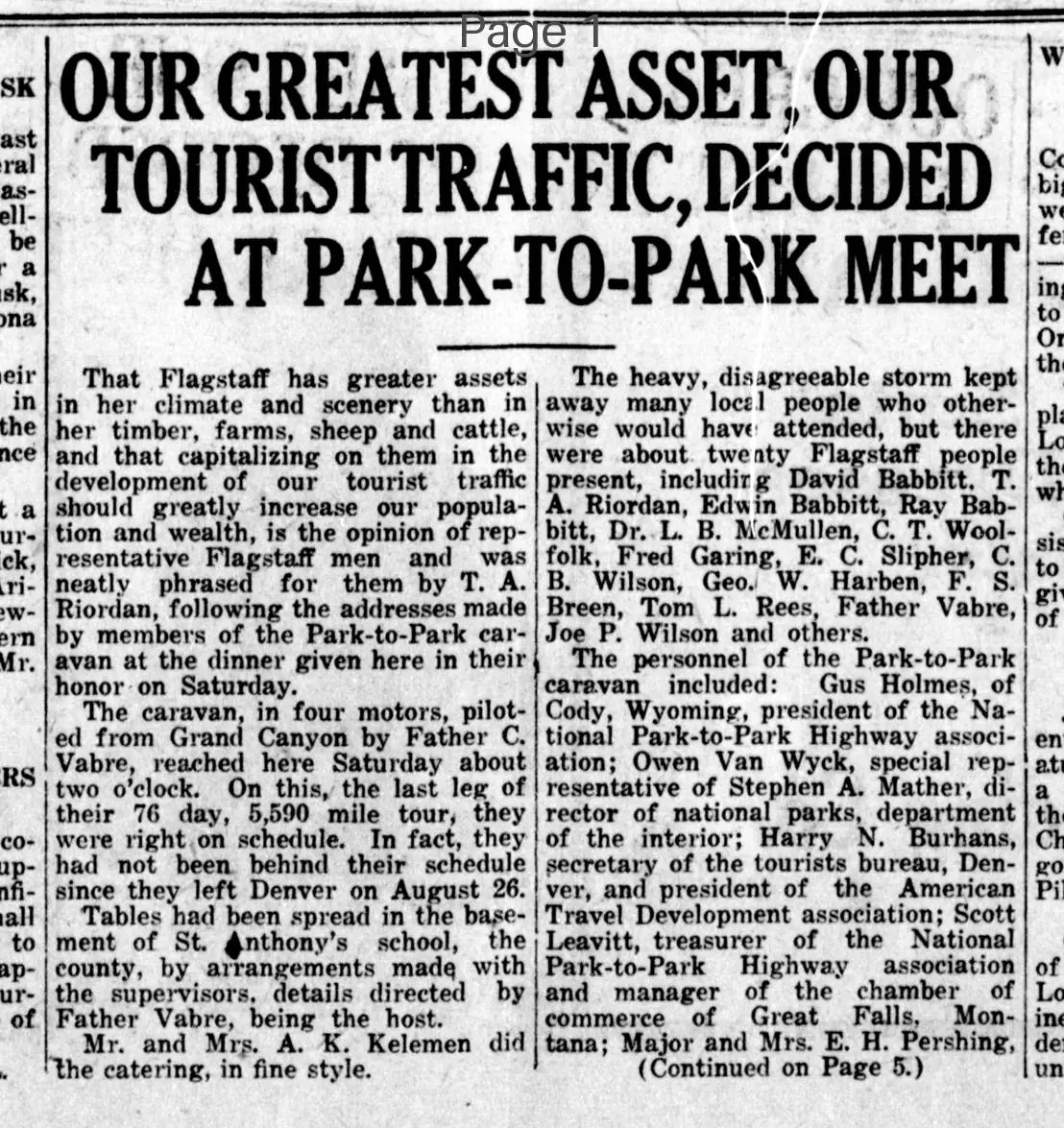
That Flagstaff has greater assets in her climate and scenery than in her timber, farms, sheep and cattle, and that capitalizing on them in the development of our tourist traffic should greatly increase our population and wealth, is the opinion of representative Flagstaff men and was neatly phrased for them by T. A. Riordan, following the addresses made by members of the Park-to-Park caravan at the dinner given here in their honor-on Saturday.
The caravan, in four motors, piloted from Grand Canyon by Father C. Vabre, reached here Saturday about two o'clock. On this. the last leg of their 76 day, 5,590 mile tour, they were right on schedule. In fact. they had not been behind their schedule since they left Denver on August 26.
Tables had been spread in the basement of St. Anthony's school, the county, by arrangements made with the supervisors, details directed by Father Vabre, being the host.
Mr. and Mrs. A. K. Kelemen did the catering, in fine style.
The heavy, disagreeable storm kept away many local people who otherwise would have attended, but there were about. twenty Flagstaff people present, including David Babbitt. T. A. Riordan. Edwin Babbitt. Ray Babbitt. Dr.. L. B. McMullen, C. T. Woolfolk, Fred Garing. E. C. Slipher, C. B. Wilson, Geo. W. Harben, F. S. Breen, Tom L. Rees, Father Vabre, Joe P. Wilson and others.
The personnel of the Park-to-Park caravan included: Gus Holmes, of Cody, Wyoming, president of the National Park-to-Park Highway association; Owen Van Wyck, special representative of Stephen A. Mather, director of national parks, department of the interior; Harry N. Burhans, secretary of the tourists bureau, Denver, and president of the American Travel Development association: Scott Leavitt. treasurer of the National Park-to-Park Highway association and manager of the chamber of commerce of Great Falls, Montana; Major and Mrs. E. H. Pershing,
(Continued on Page 5)
OUR GREATEST ASSET OUR
TOURIST TRAFFIC DECIDED
AT PARK-TO-PARK MEET
(Continued from Page 1.)
of New York; R. M. Davis, of Denver;
L. A. Shawer, of Shoshonie, Wyoming;
M. W. Lusk, representing the
White Motor Truck Co., Cleveland,
Ohio; and A. G. Lucier, of the Inter-
national Film service.
Father Vabre was toastmaster. He
introduced Mr. Leavitt. The latter
told how the caravan had left Denver
on August 26, taking in the Rocky
Mountain, Yellowstone, Glacier, Mt.
Rainier, Crater Lake and Grand
Canyon national parks, besides four
other national parks in California.
They will visit the Mesa Verde na-
tional park on their way to Denver,
which they expect to reach on the
76th day of the tour, in time to attend
the convention of the National Park-
to-Park Highways association, to be
held in Denver, November 11th to
13th.
Mr. Leavitt explained that the pur-
pose of the tour is to acquaint the
people all along the big loop of the
project to get the government to ap-
propriate $100,000,000 to hard sur-
face the entire route. He dwelt on
the advantages that would accrue to
every community on the loop, the
stimulation of tourist traffic, the in-
crease in populations, the fuller de-
velopment of resources. He called at-
tention to the fact that this project
does not conflict with, but really co-
operates with all the great transcon-
continental highways. He spoke of the
great national parks as a group of
magnets to draw tourists from all
over the world, and showed how much
more powerful in their attraction
those magnets will be when chained
together by the proposed highway.
Mr. Burhans related startling facts
regarding the influence that tourist
traffic has on the growth in wealth
and population of communities. He
said that of the 600,000 tourists who
now go to Denver from the east every
year, only ten per cent go farther
west. He said the tourist travel into
the eleven western scenic states be-
gan really to increase only five years
ago. Now the number of tourists
visiting each of the great national
parks each year is from three to five
times greater than then.
To illustrate the benefits to the
west of this great and increasing tour-
ist traffic he cited Los Angeles, the
city that more than any other has
made an endeavor to capitalize on
that traffic. A few years ago Denver
was larger than Los Angeles. But
the increase in three years in Los An-
geles' population has amounted to
more than Denver's entire present
population. In the recent homecom-
ing week at Los Angeles, 101,000 of
the inhabitants of that city register-
ed as being originally from the one
state of Iowa. This proved that a big
proportion of the tourists settle in the
west.
He ascribed the fact that Arizona
has shown a greater increase in pop-
ulation in the last ten years than any
other state in the Union as largely
due to tourist traffic. The two states
showing next largest increases are
also western scenic states.
The time will come, he declared,
when the real playground for the
whole world will be our own west.
The least exploited asset we have is
our tourist traffic. Before the war a
half billion dollars a year was car-
ried abroad by Americans to Euro-
pean playgrounds. European coun-
tries are again maintaining travel bu-
reaus in our large cities in an attempt
to rebuild this tourist traffic.
In Denver, three years ago, an inves-
tigation was made to learn the aver-
age stay in that city of automobile
tourists. They found it was from two
to four hours. They got busy, build-
ing Overland park for auto tourists.
Now the average stay is four to five
days. This year, 60,000 cars have
spent an average of $10 a day in
Denver, a total of at least $2,400,000.
The night before the caravan left on
the big loop trip there were 6,000 cars
parked at Overland Park.
Canon City, after checking up to
find what auto travel meant there, at
once provided two magnificent auto
parks.
He showed the parallel between
railroad and highway conditions, how
the railroads built depots for the ac-
commodation and comfort of patrons;
and declared that communities on
tourist highways must provide depots
in the form of auto parks for the con-
venience and comfort of tourists, to
attract them to stop and to make them
stay longer, declaring that the more
any town provides in this respect the
greater will be its income from tour-
ist travel.
Mr. Van Wyck assured the gather-
ing that his chief, Stephen A. Math-
er, director of national parks, is
heartily for the park-to-park high-
way. He said that this is an excellent
time to get the matter before con-
gress, as good roads problems will
be more largely considered by the next
congress than ever before.
An appeal was made by the visitors
for a delegation to be sent from Flag-
staff to the convention in Denver next
month.
C. T. Woolfolk for the county sup-
ervisors, said that he thought this one
of the most important movements
ever brought to the attention of our
citizens. He said he personally would
do all he could to see that the county
sends a delegate to the convention.
E. C. Slipher, for the city council,
pledged himself to take an active in-
terest in getting the city to send a
deleate to the convention.
Edwin Babbitt said that in the last
few years the increase in tourist auto
traffic here has been wonderful. He
believes that the success of the Park-
to-Park highway project and general
improvement of road conditions will
vastly increase this traffic and our in-
come from it.
T. A. Riordan, representing the bus-
iness interests of Flagstaff, said that
he would do all he could to have a del-
egate at the convention, representing
the business interests of the city.
"The information given us today,"
he said, "is startling. It shows us
plainly where we are and what we are
coming to." He said that he had
thought we had reached our full
growth, but now believes that our
greatest assets have not been tapped
yet, namely our climate and our won-
derful scenery. "We have been asleep
and not awake to our possibilities,"
he declared.
He spoke of his several trips to
Italy, where thousands go every year,
drawn there by the climate, which, he
said, is no better than ours. Then he
called attention to our tremendous ad-
vantages in scenery, the most mag-
nificent in the world, and to the fact
that in this county are countless
places of scenic interest, ruins, caves
and picture rocks, that not even our
own people know about. He said we
have not reached our limit in popula-
tion and wealth by any means, for,
though our timber and farms, sheep
and cattle, have been developed pret-
ty well up to the limit, we have not as
yet even begun to capitalize on our
possibilities for growth in population
and wealth furnished by our wonder-
ful climate and glorious scenery.
The caravan left for Winslow
shortly after four o'clock, then will
go to St. Johns, the Zuni villages, Hol-
brook, Gallup, and then strike for
Mesa Verde, Charlie Woolfolk pilot-
ed them to Winslow, returning next
morning by train.
The Park-to-Park Highways con-
vention in Denver next month is high-
ly important, for it is meant as a
demonstration to congress of the en-
thusiasm and earnestness with which
the people of the western states desire
the building by the government of this
great 5,590 mile hard-surfaced loop
connecting all the great national parks
of the west. It is to be hoped that
Flagstaff manages in some way to
have at least three delegates to that
convention.
"America's Master Highway"
has been officially approved by the Na-
tional Park Service of the department
of the interior, the American Auto-
mobile association and the National
Park-to-Park Highway associ-
ations.
The first annual convention of The
National Park-to-Park Highway asso-
ciation, November 11, 12, 13, 1920, in
senate chamber, state capitol, Denver
Colorado.
The following is the program for
the big meeting:
Thursday, November 11th.
9:00 a. m.-Registration of Delegates.
9:30 a. m.--Convention called to order
by President Gus Holmes, of
Cody, Wyo.
Invocation.
Armistice Day Salutation.
Addresses of Welcome:
Hon. Oliver H. Shoup, Gover-
nor of Colorado.
Hon. Dewey C. Bailey, Mayor
of Denver.
Response:
Scott Leavitt, Great Falls,
Mont., Treasurer National
Park-to-Park Highway asso-
ciation; President Montana
Highway Improvement asso-
ciation and President Y-G
Bee Line Highway associa-
tion.
Address:
Hon. Stephen T. Mather, Di-
rector National Park Service,
Department of the Interior,
Washington, D. C.
Appointment of Committees.
Afternoon Session.
L. L. Newton, Cody, Wyo., Presi-
dent Wyoming State Good Roads
association and Secretary of the
National Park-to-Park Highway
association, presiding.
2:00 p. m. -Report of Credentials
Committee.
Address:
Ralph W. Smith, of Denver, Dis-
trict Vice-President American
Automobile association and per-
sonal representative of A. G.
Batchelder, Chairman Executive
Board, A. A. A., Washington
D. C.
Reading of minutes of previous
meeting
Experiences of members of official
party dedicating the 5,590-mile
National Park-to-Park Highway.
Discussion of plan and purpose of
the National Park-to-Park High-
way association, including per-
manent organization, financial ob-
ligations and scope of future
work, delegates from
twelve
states participating.
6:30 p. m. Banquet for delegates and
visitors.
(Note: Place and speakers' pro-
gram to be announced later.)
Entertainment Committee - Calvin
H. Morse, Brown Palace Hotel
chairman; Sam F. Dutton, Albany
Hotel, and Martin E. Rowley,
Metropole Hotel.
Friday, November 12th.
9:00 a. m.-Report of Standing Com-
mittees.
Completion of permanent organiza-
tion, including officers, twelve
states participating.
12:15 p. m.-Delegates and visitors
will be guests at luncheon of the
Denver Civic and Commercial asso-
ciation, Chamber of Commerce
Building. Sylvester L. Weaver,
Vice-President of the Los Angeles
Chamber of Commerce, will speak.
Afternoon Session.
2:00 p. m.-Report of Resolutions Com-
mittee regarding Congressional aid
for a hard-surface highway, 5,590
miles in length, connecting the na-
tional parks of the west, marking
the route of the National Park-to-
Park Highway.
Saturday, November 13th.
9:00 a. m.--Unfinished business.
Meeting place in 1921.
Sine die adjournment
2:00 p. m. Entertainment feature:
Automobile sightseeing trip through
Denver's mountain parks system for
deleates and visitors, courtesy Roe
Emery, of The Rocky Mountain
Parks Transportation Company.
Trip will be completed about 6
o'clock.
What sub-type of article is it?
What themes does it cover?
What keywords are associated?
What entities or persons were involved?
Where did it happen?
Story Details
Key Persons
Location
Flagstaff
Event Date
Saturday, August 26 To November 13, 1920
Story Details
The Park-to-Park caravan arrives in Flagstaff after a 76-day tour of national parks, hosted at a dinner where speakers promote a 5,590-mile hard-surfaced highway to connect parks and boost tourism. Local leaders pledge support and plan to send delegates to the Denver convention.