Thank you for visiting SNEWPapers!
Sign up free
Story
March 16, 1827
Constitutional Whig
Richmond, Virginia
What is this article about?
Thomas L. Arnold's 1825 pamphlet attacks Gen. Andrew Jackson's moral and political character, citing personal scandals like taking Lewis Robards' wife, unresponded queries on policy shifts, and orchestrated support in Pennsylvania, deeming him unfit for president.
Clipping
OCR Quality
98%
Excellent
Full Text
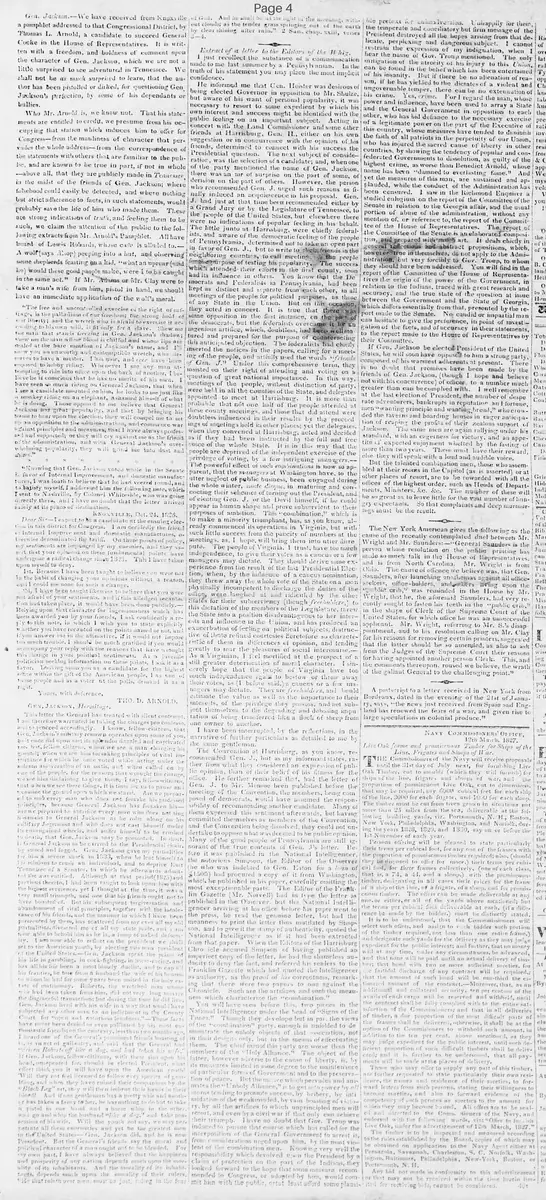
Gen. Jackson.--We have received from Knoxville a pamphlet addressed to that Congressional District, by Thomas L. Arnold, a candidate to succeed General Cocke in the House of Representatives. It is written with a freedom, and boldness of comment upon the character of Gen. Jackson, which we are not a little surprised to see adventured in Tennessee. We shall not be as much surprised to learn, that the author has been pistolled or dirked, for questioning Gen. Jackson's perfection, by some of his dependants or bullies.
Who Mr. Arnold is, we know not. That his statements are entitled to credit, we presume from his occupying that station which induces him to offer for Congress--from the manliness of character that pervades the whole address--from the correspondence of the statements with others that are familiar to the public, and are known to be true in part, if not in whole--above all, that they are publicly made in Tennessee in the midst of the friends of Gen. Jackson; where falsehood could easily be detected, and where nothing but strict adherence to facts, in such statements, would probably save the life of him who made them. These are strong indications of truth, and feeling them to be such, we claim the attention of the public to the following extracts from Mr. Arnold's Pamphlet. All have read of Lewis Robards, whose case is alluded to.--
A wolf (says Æsop) peeping into a hut, and observing some shepherds feasting on a kid, "what an uproar (said he) would these good people make, were I to be caught in the same act." If Mr. Adams or Mr. Clay were to take a man's wife from him, pistol in hand, we should have an immediate application of the wolf's moral.
The free and uncontrolled exercise of the right of suffrage, is the palladium of our freedom; the strong hold of our liberty; and the wretch who is afraid to exercise it according to his own will, is fit only for a slave. Shew me the man that stands trembling in Gen. Jackson's shadow; shew me the man whose blood is chilled and whose lips are sealed at the bare mention of Jackson's name, and I shew you an unworthy and contemptible wretch, who deserves to have a master. I am now, and ever have been opposed to hobby riding. Whenever I see any man attempting to ride into office upon the back of another, I believe he is conscious that he has no merits of his own. I have seen so much riding on General Jackson, that when I see a candidate mounted on him, he looks to me just like a monkey riding on an elephant, ashamed himself of what he is doing. Those opposed to me believe that General Jackson has great popularity, and that by bringing his name to bear upon the election, they will compel me to set up an opposition to the administration, and commence war against principles and measures, that I have always professed and supported; or they will cry against me as the friend of the administration, and with General Jackson's overwhelming popularity, they will grind me into dust and ashes."
"Knowing that Gen. Jackson voted while in the Senate in favor of Internal Improvement, and domestic manufactures, I was loath to believe that he had veered round, and to satisfy myself, I addressed him the following note, which I sent to Nashville, by Colonel Whiteside, who was going directly there, and I have no doubt that the letter arrived safely at its place of destination.
KNOXVILLE, Oct. 24, 1825.
Dear Sir--I expect to be a candidate at the ensuing election in this district for Congress. I am decidedly the friend of internal Improvement and domestic manufactures, otherwise denominated the tariff. On these points of policy, my sentiments are impugned by my enemies, and they assert that your opinions on these fundamental points have undergone a radical change since 1813. This I have taken upon myself to deny.
1st. Because I have been taught to believe you were not in the habit of changing your opinions without a reason, and I could see none for such a change.
2d, I have been taught likewise to believe that you were not afraid of your sentiments, and if this alleged recantation had taken place, it would have been done publicly.--
Relying upon that character for ingenuousness which has been awarded you by your friends, I ask confidently a reply to this note, in which I wish you to state explicitly whether you have recanted on the points named or not, and if you answer me in the affirmative, if it would not impose too much trouble, I should be much gratified if you would accompany your reply with the reasons that have wrought this change in your political sentiments. As a juvenile politician seeking information on these points, I ask it as a favor. Looking upon you as a candidate for the highest office within the gift of the American people, I as one of those people and as a voter at the polls, demand it as a right.
Yours, with deference,
THO. L. ARNOLD.
Gen. Jackson, Hermitage.
This letter the General has treated with silent contempt. I am therefore warranted in taking the charges pro confesso, and to proceed accordingly. I know, fellow-citizens, that Gen. Jackson's military renown operates upon some of you, as it once did upon me: its splendor dazzled and captivated me, but, fellow citizens, when we see a man changing his ground; when we see him forsaking principles of vital importance for which he once voted while acting under the solemn declaration of an oath, and when called on by one of the people, for the reasons that wrought the change, was him disdaining to give them; I say, fellow-citizens, that when we see these things, it is time for us to pause and examine the ground upon which we stand. Are we prepared to mob every man who does not forsake his professed principles, because General Jackson has forsaken his--are we prepared to sacrifice every man who does not sing hosannahs to General Jackson as he rolls along on his triumphant Juggernaut and who does not cast himself under its ensanguined wheels, and suffer himself to be crushed to death, that Gen. Jackson may be promoted. In short, is General Jackson to be carried to the Presidential chair, by sword and faggot. Gen. Jackson gave my partialities for him a severe shock in 1823, when he lent himself to minions to crush an individual, and to deprive East Tennessee of a Senator, to which he afterwards admitted she was entitled. Although at that period (1823) and previous thereto, I had been taught to look upon him with the highest reverence, yet I thought at the time, it was a very small triumph, and one that his friends ought not to have boasted of. But his subsequent tergiversation and abandonment of vital principles, together with the intolerance of his friends, and the manner in which I have been persecuted by them, has scattered from my eyes all my old partialities, divested me of all my state pride, and I am now able to behold him as he is, a lump of naked deformity. I am now able to reflect on the precedent we shall set to the American youth, by electing this man President of the United States.--Gen. Jackson spent the prime of his life in gambling, in cock-fighting, in horse-racing, and has all his life been a most bloody duelist, and to cap all his frailties, he took from a husband the wife of his bosom, to whom he had for some years been united in the holy estate of matrimony. Robards, the wretched man whose wife had been taken from him, did not very long survive the disgraceful transaction: but during the time he did live, Gen. Jackson led with his wife a way that would have subjected any other man to an indictment in the County Court for "open and notorious lewdness."--These facts have never been denied or even palliated by his most enthusiastic friends; on the contrary, less than two months ago, I heard one of the General's prominent friends boasting of the act of gallantry, and said that the General had "drove Robards off like a dog, and had taken his wife." If Gen. Jackson, fellow-citizens, with these sins upon his head, unrepented for, should be elected President, what effect think you it will have upon the American youth? Will they not feel licensed to follow every species of gambling, and when they have ruined their constitutions by the "Black Leg" art, they will then imbue their hands in their blood? And if one gentleman has a pretty wife and another has taken a fancy to her, he has nothing to do but to take a pistol in one hand and a horse whip in the other, and go and whip the husband "like a dog," and take possession of his wife. Will the youth not say, we may perpetrate all these enormities and yet be the greatest man in the United States--Gen. Jackson did, and he is now President. But the General's friends say the moral and political character of a man ought not to be blended. For my own part, I have always believed that the happiness and prosperity of any nation depends much upon the morality of its inhabitants. And the morality of its inhabitants, depends much upon the morality of their rulers. He that ruleth over men, must be just, ruling in the fear of God. And he shall be as the light in the morning, without clouds; as the tender grass springing out of the earth by clear shining after rain." 2 Sam. chap. xxiii, verses 3-4.
Extract of a letter to the Editors of the Whig.
I just recollect the substance of a communication made to me last summer by a Pennsylvanian. In the truth of his statement you may place the most implicit confidence.
He informed me that Gen. Heister was desirous of being elected Governor in opposition to Mr. Shulze, but aware of his want of personal popularity, it was necessary to resort to some expedient by which his own interest and success might be identified with the public feeling on an important subject. Acting in concert with the Land Commissioner and some other friends at Harrisburg, Gen. H. either on his own suggestion or in concurrence with the opinion of his friends, determined to connect with his success the Presidential question. The next subject of consideration, was the selection of a candidate; and, when one of the party mentioned the name of Gen. Jackson, there was an air of surprise on the part of some, of derision on the part of others. However, the person who recommended Gen. J. urged such reasons as finally induced an acquiescence in his proposal. Gen. J. had just at that time been recommended either by a Grand Jury or by the Legislature of Tennessee, to the people of the United States, but elsewhere there were no indications of popular feeling in his behalf. The little junto at Harrisburg, were chiefly federalists, and aware of the democratic feeling of the people of Pennsylvania, determined not to take an open part in favor of Gen. J., but to write to their friends in the neighboring counties, to call meetings of the people in order to test his popularity. The success which attended their efforts in the first county, soon had its influence in others. You know that the Democrats and Federalists in Pennsylvania, had been kept as distinct and separate from each other, in all meetings of the people for political purposes, as those of any State in the Union. But on this occasion, they acted in concert. It is true that there was some opposition in the first instance, on the part of the democrats, but the federalists overcame it by an ingenious artifice, which, doubtless, had been well matured and prepared for the purpose of counteracting this anticipated objection. The federalists had chiefly inserted the notices in the papers, calling for a meeting of the people, and artfully used the words "friends of Gen. J." Under this comprehensive term, they insisted on their right of attending and voting on a question of great national importance. In this way, meetings of the people, without distinction of party, were held in all the counties of the State, and delegates appointed to meet at Harrisburg. It is more than probable that not one half of the people attended at these county meetings, and those that did attend were doubtless influenced in their results by the proceedings of meetings held in other places; yet the delegates, when they convened at Harrisburg, acted and decided as if they had been instructed by the full and free voice of the whole State. It is in this way that the people are deprived of the independent exercise of the privilege of voting, by a few intriguing managers.-- The powerful effect of such combinations is now so apparent, that the managers at Washington have, to the utter neglect of public business, been engaged during the whole winter, night and day, in maturing and concocting their schemes of turning out the President, and of electing Gen. J. or the Devil himself, if he could appear in human shape and prove subservient to their purposes of ambition. This "combination," which is to make a minority triumphant, has, as you know, already commenced its operations in Virginia, but with such little success from the paucity of numbers at the meetings, as, I hope, will bring them into utter disrepute. The people of Virginia, I trust, have too much independence, to give their votes as a caucus or a few managers may dictate. They should derive some experience from the result of the last Presidential Election, when, by the influence of a caucus nomination, they threw away the whole vote of the State on a man physically incompetent to discharge the duties of the office, were laughed at and ridiculed by the other States for their subserviency (though freeholders,) to this dictation of the members of the Legislature, threw the State into a position disadvantageous to her interests and influence in the Union, and has produced an exacerbation of feeling on political subjects, destructive of those refined courtesies heretofore so characteristic of them in differences of opinion, and tending greatly to mar the pleasures of social intercourse.-- As a Virginian, I feel mortified at the prospect of a still greater deterioration of moral character. I sincerely hope that the people of Virginia have too much independence again to bestow or throw away their votes, as (I before said,) a caucus or a few managers may dictate. They are freeholders, and should estimate the value as well as the importance to their interests, of the privilege they possess, and not subject themselves to the degrading and debasing imputation of being transferred like a flock of sheep from one owner to another.
I have been interrupted, by the reflections, in the narrative of further particulars as detailed to me by the same gentleman.
The Convention at Harrisburg, as you know, recommended Gen. J., but as my informant states, rather from what they considered an expression of public opinion, than of their belief of his fitness for the office. He further remarked that, had the letter of Gen. J. to Mr. Monroe been published before the meeting of the Convention, the members, being composed of democrats, would have assumed the responsibility of recommending another candidate. Many of them expressed this sentiment afterwards, but having committed themselves as members of the Convention, and the Convention being dissolved, they could not undertake to oppose what was deemed to be public opinion. Many of the good people of Pennsylvania are still ignorant of the true contents of Gen. J.'s letter. Before it was published in the National Intelligencer, the notorious Simpson, the Editor of the Observer (he who was indebted to Gen. Eaton for a loan of $1500) had procured a copy of it from Washington, which he published in his paper, carefully omitting the most exceptionable parts. The Editor of the Franklin Gazette (Mr. Norvell) had in type the letter as published in the Observer, but the National Intelligencer arriving at his office before his paper went to the press, he read the genuine letter, but had the meanness to print the letter thus mutilated by Simpson, and to give it the stamp of authenticity, quoted the National Intelligencer as if it had been extracted from that paper. When the Editors of the Harrisburg Chronicle accused Simpson of having published an imperfect copy of the letter, he had the shameless audacity to deny the fact, and referred his readers to the Franklin Gazette which had quoted the Intelligencer as authority, as the proof of his correctness, remarking that there were two papers to one against the Chronicle. Such are the artifices and such the meanness which characterize the "combination."
You will have seen before this, two pieces in the National Intelligencer under the head of "Signs of the Times." Though they develope but in part, the views of the "combination" party, enough is unfolded to demonstrate the unholy objects of that association, not in their design only, but in the means of effectuating them. The chief men of this party are worse than the members of the "Holy Alliance." The object of the latter, however adverse to the cause of liberty, is, by its measures limited in some degree to the maintenance of particular forms of Government and to the preservation of peace. But the rage which pervades and animates that "Unholy Alliance," to get into power by all or any tending to promote success, by bribery, by intimidation of the weak-minded, by vain boasting of victory, by all the artifices to which unprincipled men will resort, and even by a civil war if that only can achieve their triumph. I have no doubt that Gov. Troup was induced to pursue that course which has called for the interposition of the General Government to arrest it, from considerations urged upon him, by the most violent of the combination men. Knowing very well the responsibility which devolved upon the President by a claim of protection on the part of the Indians, they looked forward to the hope that some measure recommended to Congress, or adopted by him, would compromise him with the public, or at least afford some plausible pretext for animadversion.
Who Mr. Arnold is, we know not. That his statements are entitled to credit, we presume from his occupying that station which induces him to offer for Congress--from the manliness of character that pervades the whole address--from the correspondence of the statements with others that are familiar to the public, and are known to be true in part, if not in whole--above all, that they are publicly made in Tennessee in the midst of the friends of Gen. Jackson; where falsehood could easily be detected, and where nothing but strict adherence to facts, in such statements, would probably save the life of him who made them. These are strong indications of truth, and feeling them to be such, we claim the attention of the public to the following extracts from Mr. Arnold's Pamphlet. All have read of Lewis Robards, whose case is alluded to.--
A wolf (says Æsop) peeping into a hut, and observing some shepherds feasting on a kid, "what an uproar (said he) would these good people make, were I to be caught in the same act." If Mr. Adams or Mr. Clay were to take a man's wife from him, pistol in hand, we should have an immediate application of the wolf's moral.
The free and uncontrolled exercise of the right of suffrage, is the palladium of our freedom; the strong hold of our liberty; and the wretch who is afraid to exercise it according to his own will, is fit only for a slave. Shew me the man that stands trembling in Gen. Jackson's shadow; shew me the man whose blood is chilled and whose lips are sealed at the bare mention of Jackson's name, and I shew you an unworthy and contemptible wretch, who deserves to have a master. I am now, and ever have been opposed to hobby riding. Whenever I see any man attempting to ride into office upon the back of another, I believe he is conscious that he has no merits of his own. I have seen so much riding on General Jackson, that when I see a candidate mounted on him, he looks to me just like a monkey riding on an elephant, ashamed himself of what he is doing. Those opposed to me believe that General Jackson has great popularity, and that by bringing his name to bear upon the election, they will compel me to set up an opposition to the administration, and commence war against principles and measures, that I have always professed and supported; or they will cry against me as the friend of the administration, and with General Jackson's overwhelming popularity, they will grind me into dust and ashes."
"Knowing that Gen. Jackson voted while in the Senate in favor of Internal Improvement, and domestic manufactures, I was loath to believe that he had veered round, and to satisfy myself, I addressed him the following note, which I sent to Nashville, by Colonel Whiteside, who was going directly there, and I have no doubt that the letter arrived safely at its place of destination.
KNOXVILLE, Oct. 24, 1825.
Dear Sir--I expect to be a candidate at the ensuing election in this district for Congress. I am decidedly the friend of internal Improvement and domestic manufactures, otherwise denominated the tariff. On these points of policy, my sentiments are impugned by my enemies, and they assert that your opinions on these fundamental points have undergone a radical change since 1813. This I have taken upon myself to deny.
1st. Because I have been taught to believe you were not in the habit of changing your opinions without a reason, and I could see none for such a change.
2d, I have been taught likewise to believe that you were not afraid of your sentiments, and if this alleged recantation had taken place, it would have been done publicly.--
Relying upon that character for ingenuousness which has been awarded you by your friends, I ask confidently a reply to this note, in which I wish you to state explicitly whether you have recanted on the points named or not, and if you answer me in the affirmative, if it would not impose too much trouble, I should be much gratified if you would accompany your reply with the reasons that have wrought this change in your political sentiments. As a juvenile politician seeking information on these points, I ask it as a favor. Looking upon you as a candidate for the highest office within the gift of the American people, I as one of those people and as a voter at the polls, demand it as a right.
Yours, with deference,
THO. L. ARNOLD.
Gen. Jackson, Hermitage.
This letter the General has treated with silent contempt. I am therefore warranted in taking the charges pro confesso, and to proceed accordingly. I know, fellow-citizens, that Gen. Jackson's military renown operates upon some of you, as it once did upon me: its splendor dazzled and captivated me, but, fellow citizens, when we see a man changing his ground; when we see him forsaking principles of vital importance for which he once voted while acting under the solemn declaration of an oath, and when called on by one of the people, for the reasons that wrought the change, was him disdaining to give them; I say, fellow-citizens, that when we see these things, it is time for us to pause and examine the ground upon which we stand. Are we prepared to mob every man who does not forsake his professed principles, because General Jackson has forsaken his--are we prepared to sacrifice every man who does not sing hosannahs to General Jackson as he rolls along on his triumphant Juggernaut and who does not cast himself under its ensanguined wheels, and suffer himself to be crushed to death, that Gen. Jackson may be promoted. In short, is General Jackson to be carried to the Presidential chair, by sword and faggot. Gen. Jackson gave my partialities for him a severe shock in 1823, when he lent himself to minions to crush an individual, and to deprive East Tennessee of a Senator, to which he afterwards admitted she was entitled. Although at that period (1823) and previous thereto, I had been taught to look upon him with the highest reverence, yet I thought at the time, it was a very small triumph, and one that his friends ought not to have boasted of. But his subsequent tergiversation and abandonment of vital principles, together with the intolerance of his friends, and the manner in which I have been persecuted by them, has scattered from my eyes all my old partialities, divested me of all my state pride, and I am now able to behold him as he is, a lump of naked deformity. I am now able to reflect on the precedent we shall set to the American youth, by electing this man President of the United States.--Gen. Jackson spent the prime of his life in gambling, in cock-fighting, in horse-racing, and has all his life been a most bloody duelist, and to cap all his frailties, he took from a husband the wife of his bosom, to whom he had for some years been united in the holy estate of matrimony. Robards, the wretched man whose wife had been taken from him, did not very long survive the disgraceful transaction: but during the time he did live, Gen. Jackson led with his wife a way that would have subjected any other man to an indictment in the County Court for "open and notorious lewdness."--These facts have never been denied or even palliated by his most enthusiastic friends; on the contrary, less than two months ago, I heard one of the General's prominent friends boasting of the act of gallantry, and said that the General had "drove Robards off like a dog, and had taken his wife." If Gen. Jackson, fellow-citizens, with these sins upon his head, unrepented for, should be elected President, what effect think you it will have upon the American youth? Will they not feel licensed to follow every species of gambling, and when they have ruined their constitutions by the "Black Leg" art, they will then imbue their hands in their blood? And if one gentleman has a pretty wife and another has taken a fancy to her, he has nothing to do but to take a pistol in one hand and a horse whip in the other, and go and whip the husband "like a dog," and take possession of his wife. Will the youth not say, we may perpetrate all these enormities and yet be the greatest man in the United States--Gen. Jackson did, and he is now President. But the General's friends say the moral and political character of a man ought not to be blended. For my own part, I have always believed that the happiness and prosperity of any nation depends much upon the morality of its inhabitants. And the morality of its inhabitants, depends much upon the morality of their rulers. He that ruleth over men, must be just, ruling in the fear of God. And he shall be as the light in the morning, without clouds; as the tender grass springing out of the earth by clear shining after rain." 2 Sam. chap. xxiii, verses 3-4.
Extract of a letter to the Editors of the Whig.
I just recollect the substance of a communication made to me last summer by a Pennsylvanian. In the truth of his statement you may place the most implicit confidence.
He informed me that Gen. Heister was desirous of being elected Governor in opposition to Mr. Shulze, but aware of his want of personal popularity, it was necessary to resort to some expedient by which his own interest and success might be identified with the public feeling on an important subject. Acting in concert with the Land Commissioner and some other friends at Harrisburg, Gen. H. either on his own suggestion or in concurrence with the opinion of his friends, determined to connect with his success the Presidential question. The next subject of consideration, was the selection of a candidate; and, when one of the party mentioned the name of Gen. Jackson, there was an air of surprise on the part of some, of derision on the part of others. However, the person who recommended Gen. J. urged such reasons as finally induced an acquiescence in his proposal. Gen. J. had just at that time been recommended either by a Grand Jury or by the Legislature of Tennessee, to the people of the United States, but elsewhere there were no indications of popular feeling in his behalf. The little junto at Harrisburg, were chiefly federalists, and aware of the democratic feeling of the people of Pennsylvania, determined not to take an open part in favor of Gen. J., but to write to their friends in the neighboring counties, to call meetings of the people in order to test his popularity. The success which attended their efforts in the first county, soon had its influence in others. You know that the Democrats and Federalists in Pennsylvania, had been kept as distinct and separate from each other, in all meetings of the people for political purposes, as those of any State in the Union. But on this occasion, they acted in concert. It is true that there was some opposition in the first instance, on the part of the democrats, but the federalists overcame it by an ingenious artifice, which, doubtless, had been well matured and prepared for the purpose of counteracting this anticipated objection. The federalists had chiefly inserted the notices in the papers, calling for a meeting of the people, and artfully used the words "friends of Gen. J." Under this comprehensive term, they insisted on their right of attending and voting on a question of great national importance. In this way, meetings of the people, without distinction of party, were held in all the counties of the State, and delegates appointed to meet at Harrisburg. It is more than probable that not one half of the people attended at these county meetings, and those that did attend were doubtless influenced in their results by the proceedings of meetings held in other places; yet the delegates, when they convened at Harrisburg, acted and decided as if they had been instructed by the full and free voice of the whole State. It is in this way that the people are deprived of the independent exercise of the privilege of voting, by a few intriguing managers.-- The powerful effect of such combinations is now so apparent, that the managers at Washington have, to the utter neglect of public business, been engaged during the whole winter, night and day, in maturing and concocting their schemes of turning out the President, and of electing Gen. J. or the Devil himself, if he could appear in human shape and prove subservient to their purposes of ambition. This "combination," which is to make a minority triumphant, has, as you know, already commenced its operations in Virginia, but with such little success from the paucity of numbers at the meetings, as, I hope, will bring them into utter disrepute. The people of Virginia, I trust, have too much independence, to give their votes as a caucus or a few managers may dictate. They should derive some experience from the result of the last Presidential Election, when, by the influence of a caucus nomination, they threw away the whole vote of the State on a man physically incompetent to discharge the duties of the office, were laughed at and ridiculed by the other States for their subserviency (though freeholders,) to this dictation of the members of the Legislature, threw the State into a position disadvantageous to her interests and influence in the Union, and has produced an exacerbation of feeling on political subjects, destructive of those refined courtesies heretofore so characteristic of them in differences of opinion, and tending greatly to mar the pleasures of social intercourse.-- As a Virginian, I feel mortified at the prospect of a still greater deterioration of moral character. I sincerely hope that the people of Virginia have too much independence again to bestow or throw away their votes, as (I before said,) a caucus or a few managers may dictate. They are freeholders, and should estimate the value as well as the importance to their interests, of the privilege they possess, and not subject themselves to the degrading and debasing imputation of being transferred like a flock of sheep from one owner to another.
I have been interrupted, by the reflections, in the narrative of further particulars as detailed to me by the same gentleman.
The Convention at Harrisburg, as you know, recommended Gen. J., but as my informant states, rather from what they considered an expression of public opinion, than of their belief of his fitness for the office. He further remarked that, had the letter of Gen. J. to Mr. Monroe been published before the meeting of the Convention, the members, being composed of democrats, would have assumed the responsibility of recommending another candidate. Many of them expressed this sentiment afterwards, but having committed themselves as members of the Convention, and the Convention being dissolved, they could not undertake to oppose what was deemed to be public opinion. Many of the good people of Pennsylvania are still ignorant of the true contents of Gen. J.'s letter. Before it was published in the National Intelligencer, the notorious Simpson, the Editor of the Observer (he who was indebted to Gen. Eaton for a loan of $1500) had procured a copy of it from Washington, which he published in his paper, carefully omitting the most exceptionable parts. The Editor of the Franklin Gazette (Mr. Norvell) had in type the letter as published in the Observer, but the National Intelligencer arriving at his office before his paper went to the press, he read the genuine letter, but had the meanness to print the letter thus mutilated by Simpson, and to give it the stamp of authenticity, quoted the National Intelligencer as if it had been extracted from that paper. When the Editors of the Harrisburg Chronicle accused Simpson of having published an imperfect copy of the letter, he had the shameless audacity to deny the fact, and referred his readers to the Franklin Gazette which had quoted the Intelligencer as authority, as the proof of his correctness, remarking that there were two papers to one against the Chronicle. Such are the artifices and such the meanness which characterize the "combination."
You will have seen before this, two pieces in the National Intelligencer under the head of "Signs of the Times." Though they develope but in part, the views of the "combination" party, enough is unfolded to demonstrate the unholy objects of that association, not in their design only, but in the means of effectuating them. The chief men of this party are worse than the members of the "Holy Alliance." The object of the latter, however adverse to the cause of liberty, is, by its measures limited in some degree to the maintenance of particular forms of Government and to the preservation of peace. But the rage which pervades and animates that "Unholy Alliance," to get into power by all or any tending to promote success, by bribery, by intimidation of the weak-minded, by vain boasting of victory, by all the artifices to which unprincipled men will resort, and even by a civil war if that only can achieve their triumph. I have no doubt that Gov. Troup was induced to pursue that course which has called for the interposition of the General Government to arrest it, from considerations urged upon him, by the most violent of the combination men. Knowing very well the responsibility which devolved upon the President by a claim of protection on the part of the Indians, they looked forward to the hope that some measure recommended to Congress, or adopted by him, would compromise him with the public, or at least afford some plausible pretext for animadversion.
What sub-type of article is it?
Biography
Historical Event
What themes does it cover?
Moral Virtue
Deception
Justice
What keywords are associated?
Gen Jackson Criticism
Thomas Arnold Pamphlet
Political Deception
Moral Character
Presidential Fitness
Internal Improvements
Tariff Policy
Adultery Scandal
What entities or persons were involved?
Thomas L. Arnold
Gen. Jackson
Lewis Robards
Where did it happen?
Tennessee, Pennsylvania
Story Details
Key Persons
Thomas L. Arnold
Gen. Jackson
Lewis Robards
Location
Tennessee, Pennsylvania
Event Date
Oct. 24, 1825
Story Details
Thomas L. Arnold's pamphlet criticizes Gen. Jackson's character flaws including gambling, dueling, and taking another man's wife; his alleged change in political views on internal improvements and tariff without explanation; and the manipulative political combinations promoting his presidential candidacy.