Thank you for visiting SNEWPapers!
Sign up free
Literary
April 7, 1848
The Lancaster Gazette
Lancaster, Fairfield County, Ohio
What is this article about?
Humorous prose sketch contrasting poor butter-making by Sally Sly, leading to her husband Joe's aversion, with excellent butter by Jenny McKean, whom Jonathan marries, highlighting the role of proper training in women's housekeeping skills and its moral implications for marriage.
Clipping
OCR Quality
95%
Excellent
Full Text
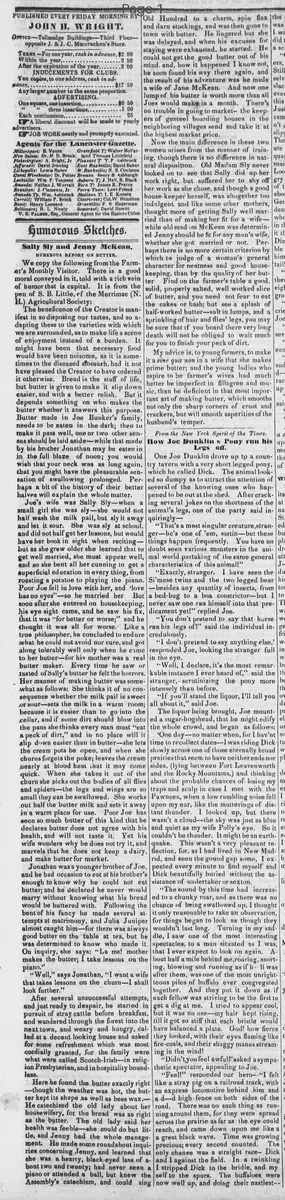
humorous Sketches.
Sally Sly and Jenny McKean,
HUMEROUS REPORT ON BUTTER.
We copy the following from the Farmer's
Monthly Visitor. There is a good
moral conveyed in it, told with a rich vein
of humor that is capital. It is from the
pen of S. B. Little, of the Merrimac (N.
H.) Agricultural Society:
The beneficence of the Creator is man-
ifest in so disposing our tastes, and so a-
dapting these to the varieties with which
we are surrounded, as to make life a scene
of enjoyment instead of a burden. It
might have been that necessary food
would have been noisome, as it is some-
times to the diseased stomach, had it not
have pleased the Creator to have ordered
it otherwise. Bread is the staff of life,
but butter is given to make it slip down
easier, and with a better relish. But it
depends something on who makes the
butter whether it answers this purpose.
Butter made in Joe Bunker's family.
needs to be eaten in the dark; then to
make it pass well, one or two other sen-
ses should be laid aside-while that made
by his brother Jonathan may be eaten in
the full blaze of noon; you would
wish that your neck was as long again,
that you might have the pleasurable sen-
sation of swallowing prolonged. Per-
haps a bit of the history of their better
halves will explain the whole matter.
Joe's wife was Sally Sly-when a
small girl she was sly-she would not
half wash the milk pail, but sly it away
and let it sour. She was sly at school,
and did not half get her lessons, but would
have her book in sight when reciting-
but as she grew older she learned that to
get well married, she must appear well,
and so she bent all her cunning to get a
superficial education in every thing, from
roasting a potatoe to playing the piano.
Poor Joe fell in love with her, and 'love
has no eyes'-so he married her. But
soon after she entered on housekeeping.
his eyesight came, and he saw his fix,
that it was "for better or worse;
and he
thought it was all for worse. Like a
true philosopher, he concluded to endure
what he could not avoid nor cure, and got
along tolerably well only when he came
to her butter-for his mother was a real
butter maker. Every time he saw or
tasted of Sally's butter he felt the horrors.
Her manner of making butter was some-
what as follows: She thinks it of no con-
sequence whether the milk pail is sweet
or sour-sets the milk in a warm room;
because it is easier than to go into the
cellar, and if some dirt should blow into
the pans she thinks every man must "eat
a peck of dirt," and in no place will it
slip down easier than in butter-she lets
the cream pots be open, and when she
churns forgets the poke; leaves the cream
nearly at blood heat that it may come
quick. When she takes it out of the
churn she picks out the bodies of all flies
and spiders-the legs and wings are so
small they can be swallowed. She works
out half the buttermilk and sets it away
in a warm place for use. Poor Joe has
seen so much butter of this kind that he
declares butter does not agree with his
health, and will not taste it. Yet his
wife wonders why he does not try it, and
marvels that he does not keep a dairy
and make butter for market.
Jonathan was a younger brother of Joe,
and he had occasion to eat at his brother's
enough to know why he could not eat
butter; and he declared he never would
marry without knowing what his bread
would be buttered with. Following the
bent of his fancy he made several at-
tempts at matrimony, and Julia Juniper
almost caught him--for there was always
good butter on the table at tea, but he
was determined to know who made it.
On inquiry, she says: "La me! mother
makes the butter; I take lessons on the
piano."
"Well," says Jonathan, "I want a wife
that takes lessons on the churn-I shall
look further."
After several unsuccessful attempts,
and just ready to despair, he started in
pursuit of stray cattle before breakfast,
and wandered through the forest into the
next town, and weary and hungry, cal-
led at a decent looking house and asked
for some refreshment which was most
cordially granted, for the family were
what were called Scotch-Irish--in relig-
ion Presbyterian, and in hospitality bound-
less.
Here he found the butter exactly right
--though the weather was hot, the but-
ter kept its shape as well as bees wax.—
He catechised the old lady about her
housewifery, for the bread was as right
as the butter. The old lady said her
health was feeble--she could do but lit-
tle, and Jenny had the whole manage-
ment. He made some roundabout inqui-
ries concerning Jenny, and learned that
she was a hearty, black-eyed lass of a-
bout two and twenty; had never seen a
piano or attended a ball, but knew the
Assembly's catechism, and could sing
Old Hundred to a charm, spin flax
and darn stockings, and was then gone to
town with butter. He lingered but she
was delayed, and when his excuses for
staying were exhausted, he started. He
could not get the good butter out of his
mind, and, how it happened I know not,
he soon found his way there again, and
the result of his adventure was he made
a wife of Jenny McKean. And now one
lump of his butter is worth more than all
Joe's would make in a month. There's
no trouble in going to market- the keep-
ers of genteel boarding houses in the
neighboring villages send and take it at
the highest market price.
Now the main difference in these two
women arises from the manner of train-
ing, though there is no difference in nat-
ural disposition. Old Madam Sly never
looked on to see that Sally did up her
work right, but suffered her to shy off
her work as she chose, and though a good
house-keeper herself, was altogether too
indulgent, and like some other mothers,
thought more of getting Sally well mar-
ried than of making her fit for a wife—
while old Madam McKean was determin-
ed Jenny should be fit for any man's wife,
whether she got married or not. Per-
haps there is no more certain criterion by
which to judge of a woman's general
character for neatness and good house-
keeping than by the quality of her but-
ter.
Find on the farmer's table a good,
solid, properly salted, well worked slice
of butter, and you need not fear to eat
the cakes or hash; but see a splash of
half-worked butter-salt in lumps, and a
sprinkling of hair and flies' legs, you may
be sure that if you board there very long
death will not be obliged to wait much
for you to finish your peck of dirt.
My advice is, to young farmers, to make
it a sine qua non in a wife that she makes
prime butter; and the young ladies who
aspire to be farmer's wives had much
better be imperfect in filigree and mu-
sic, than be deficient in that most impor-
tant art of making butter, which smooths
not only the sharp corners of crust and
crackers, but will smooth asperities of the
husband's temper.
Sally Sly and Jenny McKean,
HUMEROUS REPORT ON BUTTER.
We copy the following from the Farmer's
Monthly Visitor. There is a good
moral conveyed in it, told with a rich vein
of humor that is capital. It is from the
pen of S. B. Little, of the Merrimac (N.
H.) Agricultural Society:
The beneficence of the Creator is man-
ifest in so disposing our tastes, and so a-
dapting these to the varieties with which
we are surrounded, as to make life a scene
of enjoyment instead of a burden. It
might have been that necessary food
would have been noisome, as it is some-
times to the diseased stomach, had it not
have pleased the Creator to have ordered
it otherwise. Bread is the staff of life,
but butter is given to make it slip down
easier, and with a better relish. But it
depends something on who makes the
butter whether it answers this purpose.
Butter made in Joe Bunker's family.
needs to be eaten in the dark; then to
make it pass well, one or two other sen-
ses should be laid aside-while that made
by his brother Jonathan may be eaten in
the full blaze of noon; you would
wish that your neck was as long again,
that you might have the pleasurable sen-
sation of swallowing prolonged. Per-
haps a bit of the history of their better
halves will explain the whole matter.
Joe's wife was Sally Sly-when a
small girl she was sly-she would not
half wash the milk pail, but sly it away
and let it sour. She was sly at school,
and did not half get her lessons, but would
have her book in sight when reciting-
but as she grew older she learned that to
get well married, she must appear well,
and so she bent all her cunning to get a
superficial education in every thing, from
roasting a potatoe to playing the piano.
Poor Joe fell in love with her, and 'love
has no eyes'-so he married her. But
soon after she entered on housekeeping.
his eyesight came, and he saw his fix,
that it was "for better or worse;
and he
thought it was all for worse. Like a
true philosopher, he concluded to endure
what he could not avoid nor cure, and got
along tolerably well only when he came
to her butter-for his mother was a real
butter maker. Every time he saw or
tasted of Sally's butter he felt the horrors.
Her manner of making butter was some-
what as follows: She thinks it of no con-
sequence whether the milk pail is sweet
or sour-sets the milk in a warm room;
because it is easier than to go into the
cellar, and if some dirt should blow into
the pans she thinks every man must "eat
a peck of dirt," and in no place will it
slip down easier than in butter-she lets
the cream pots be open, and when she
churns forgets the poke; leaves the cream
nearly at blood heat that it may come
quick. When she takes it out of the
churn she picks out the bodies of all flies
and spiders-the legs and wings are so
small they can be swallowed. She works
out half the buttermilk and sets it away
in a warm place for use. Poor Joe has
seen so much butter of this kind that he
declares butter does not agree with his
health, and will not taste it. Yet his
wife wonders why he does not try it, and
marvels that he does not keep a dairy
and make butter for market.
Jonathan was a younger brother of Joe,
and he had occasion to eat at his brother's
enough to know why he could not eat
butter; and he declared he never would
marry without knowing what his bread
would be buttered with. Following the
bent of his fancy he made several at-
tempts at matrimony, and Julia Juniper
almost caught him--for there was always
good butter on the table at tea, but he
was determined to know who made it.
On inquiry, she says: "La me! mother
makes the butter; I take lessons on the
piano."
"Well," says Jonathan, "I want a wife
that takes lessons on the churn-I shall
look further."
After several unsuccessful attempts,
and just ready to despair, he started in
pursuit of stray cattle before breakfast,
and wandered through the forest into the
next town, and weary and hungry, cal-
led at a decent looking house and asked
for some refreshment which was most
cordially granted, for the family were
what were called Scotch-Irish--in relig-
ion Presbyterian, and in hospitality bound-
less.
Here he found the butter exactly right
--though the weather was hot, the but-
ter kept its shape as well as bees wax.—
He catechised the old lady about her
housewifery, for the bread was as right
as the butter. The old lady said her
health was feeble--she could do but lit-
tle, and Jenny had the whole manage-
ment. He made some roundabout inqui-
ries concerning Jenny, and learned that
she was a hearty, black-eyed lass of a-
bout two and twenty; had never seen a
piano or attended a ball, but knew the
Assembly's catechism, and could sing
Old Hundred to a charm, spin flax
and darn stockings, and was then gone to
town with butter. He lingered but she
was delayed, and when his excuses for
staying were exhausted, he started. He
could not get the good butter out of his
mind, and, how it happened I know not,
he soon found his way there again, and
the result of his adventure was he made
a wife of Jenny McKean. And now one
lump of his butter is worth more than all
Joe's would make in a month. There's
no trouble in going to market- the keep-
ers of genteel boarding houses in the
neighboring villages send and take it at
the highest market price.
Now the main difference in these two
women arises from the manner of train-
ing, though there is no difference in nat-
ural disposition. Old Madam Sly never
looked on to see that Sally did up her
work right, but suffered her to shy off
her work as she chose, and though a good
house-keeper herself, was altogether too
indulgent, and like some other mothers,
thought more of getting Sally well mar-
ried than of making her fit for a wife—
while old Madam McKean was determin-
ed Jenny should be fit for any man's wife,
whether she got married or not. Per-
haps there is no more certain criterion by
which to judge of a woman's general
character for neatness and good house-
keeping than by the quality of her but-
ter.
Find on the farmer's table a good,
solid, properly salted, well worked slice
of butter, and you need not fear to eat
the cakes or hash; but see a splash of
half-worked butter-salt in lumps, and a
sprinkling of hair and flies' legs, you may
be sure that if you board there very long
death will not be obliged to wait much
for you to finish your peck of dirt.
My advice is, to young farmers, to make
it a sine qua non in a wife that she makes
prime butter; and the young ladies who
aspire to be farmer's wives had much
better be imperfect in filigree and mu-
sic, than be deficient in that most impor-
tant art of making butter, which smooths
not only the sharp corners of crust and
crackers, but will smooth asperities of the
husband's temper.
What sub-type of article is it?
Satire
Prose Fiction
Essay
What themes does it cover?
Agriculture Rural
Moral Virtue
Social Manners
What keywords are associated?
Butter Making
Housekeeping
Humor
Marriage
Farm Wives
Moral Instruction
Rural Life
Satirical Sketch
What entities or persons were involved?
S. B. Little, Of The Merrimac (N. H.) Agricultural Society
Literary Details
Title
Humerous Report On Butter
Author
S. B. Little, Of The Merrimac (N. H.) Agricultural Society
Subject
On The Importance Of Proper Butter Making And Housekeeping In Marriage
Key Lines
Bread Is The Staff Of Life, But Butter Is Given To Make It Slip Down Easier, And With A Better Relish.
Butter Made In Joe Bunker's Family Needs To Be Eaten In The Dark; Then To Make It Pass Well, One Or Two Other Senses Should Be Laid Aside While That Made By His Brother Jonathan May Be Eaten In The Full Blaze Of Noon; You Would Wish That Your Neck Was As Long Again, That You Might Have The Pleasurable Sensation Of Swallowing Prolonged.
My Advice Is, To Young Farmers, To Make It A Sine Qua Non In A Wife That She Makes Prime Butter; And The Young Ladies Who Aspire To Be Farmer's Wives Had Much Better Be Imperfect In Filigree And Music, Than Be Deficient In That Most Important Art Of Making Butter, Which Smooths Not Only The Sharp Corners Of Crust And Crackers, But Will Smooth Asperities Of The Husband's Temper.