Thank you for visiting SNEWPapers!
Sign up free
Editorial
August 2, 1844
The Liberator
Boston, Suffolk County, Massachusetts
What is this article about?
An editorial defends Massachusetts against accusations of political hypocrisy on slavery compared to New-Hampshire, arguing that NH is openly pro-slavery while MA shows anti-slavery progress through legislation, despite political expediency.
Clipping
OCR Quality
98%
Excellent
Full Text
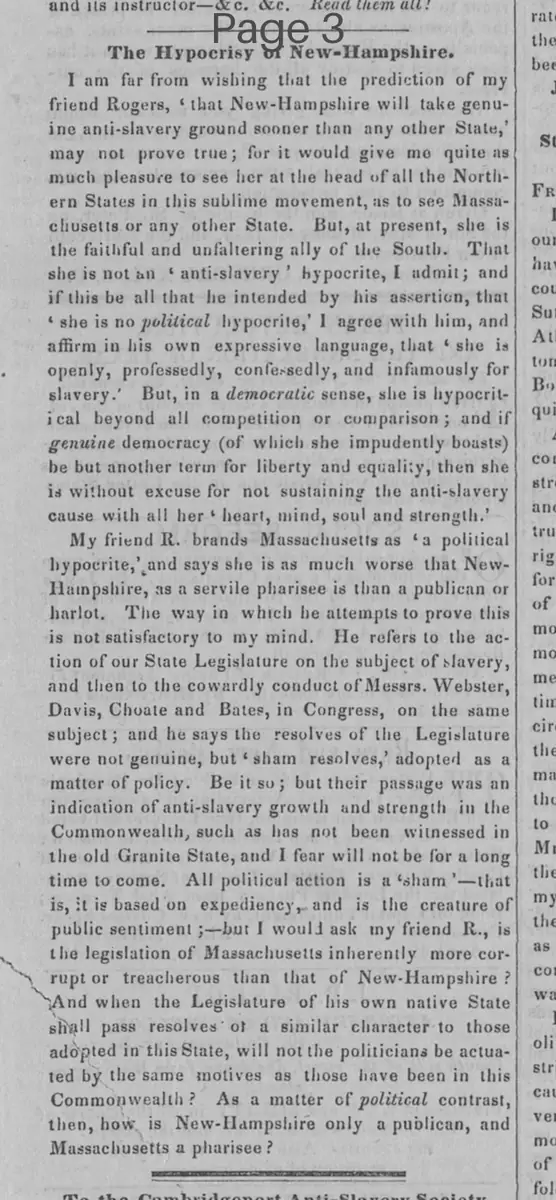
The Hypocrisy of New-Hampshire.
I am far from wishing that the prediction of my friend Rogers, that New-Hampshire will take genuine anti-slavery ground sooner than any other State, may not prove true; for it would give me quite as much pleasure to see her at the head of all the Northern States in this sublime movement, as to see Massachusetts or any other State. But, at present, she is the faithful and unfaltering ally of the South. That she is not an 'anti-slavery hypocrite,' I admit; and if this be all that he intended by his assertion, that 'she is no political hypocrite,' I agree with him, and affirm in his own expressive language, that she is openly, professedly, confessedly, and infamously for slavery. But, in a democratic sense, she is hypocritical beyond all competition or comparison; and if genuine democracy (of which she impudently boasts) be but another term for liberty and equality, then she is without excuse for not sustaining the anti-slavery cause with all her 'heart, mind, soul and strength.'
My friend R. brands Massachusetts as 'a political hypocrite,' and says she is as much worse than New-Hampshire, as a servile pharisee is than a publican or harlot. The way in which he attempts to prove this is not satisfactory to my mind. He refers to the action of our State Legislature on the subject of slavery, and then to the cowardly conduct of Messrs. Webster, Davis, Choate and Bates, in Congress, on the same subject; and he says the resolves of the Legislature were not genuine, but 'sham resolves,' adopted as a matter of policy. Be it so; but their passage was an indication of anti-slavery growth and strength in the Commonwealth, such as has not been witnessed in the old Granite State, and I fear will not be for a long time to come. All political action is a 'sham'—that is, it is based on expediency, and is the creature of public sentiment:—but I would ask my friend R., is the legislation of Massachusetts inherently more corrupt or treacherous than that of New-Hampshire? And when the Legislature of his own native State shall pass resolves of a similar character to those adopted in this State, will not the politicians be actuated by the same motives as those have been in this Commonwealth? As a matter of political contrast, then, how is New-Hampshire only a publican, and Massachusetts a pharisee?
I am far from wishing that the prediction of my friend Rogers, that New-Hampshire will take genuine anti-slavery ground sooner than any other State, may not prove true; for it would give me quite as much pleasure to see her at the head of all the Northern States in this sublime movement, as to see Massachusetts or any other State. But, at present, she is the faithful and unfaltering ally of the South. That she is not an 'anti-slavery hypocrite,' I admit; and if this be all that he intended by his assertion, that 'she is no political hypocrite,' I agree with him, and affirm in his own expressive language, that she is openly, professedly, confessedly, and infamously for slavery. But, in a democratic sense, she is hypocritical beyond all competition or comparison; and if genuine democracy (of which she impudently boasts) be but another term for liberty and equality, then she is without excuse for not sustaining the anti-slavery cause with all her 'heart, mind, soul and strength.'
My friend R. brands Massachusetts as 'a political hypocrite,' and says she is as much worse than New-Hampshire, as a servile pharisee is than a publican or harlot. The way in which he attempts to prove this is not satisfactory to my mind. He refers to the action of our State Legislature on the subject of slavery, and then to the cowardly conduct of Messrs. Webster, Davis, Choate and Bates, in Congress, on the same subject; and he says the resolves of the Legislature were not genuine, but 'sham resolves,' adopted as a matter of policy. Be it so; but their passage was an indication of anti-slavery growth and strength in the Commonwealth, such as has not been witnessed in the old Granite State, and I fear will not be for a long time to come. All political action is a 'sham'—that is, it is based on expediency, and is the creature of public sentiment:—but I would ask my friend R., is the legislation of Massachusetts inherently more corrupt or treacherous than that of New-Hampshire? And when the Legislature of his own native State shall pass resolves of a similar character to those adopted in this State, will not the politicians be actuated by the same motives as those have been in this Commonwealth? As a matter of political contrast, then, how is New-Hampshire only a publican, and Massachusetts a pharisee?
What sub-type of article is it?
Slavery Abolition
Partisan Politics
What keywords are associated?
Anti Slavery
New Hampshire Hypocrisy
Massachusetts Legislature
Political Expediency
Slavery Alliance
State Resolves
What entities or persons were involved?
New Hampshire
Massachusetts
Rogers
R.
South
Webster
Davis
Choate
Bates
Editorial Details
Primary Topic
Hypocrisy Of New Hampshire On Anti Slavery Stance Compared To Massachusetts
Stance / Tone
Defending Massachusetts Against Hypocrisy Charges While Criticizing New Hampshire's Pro Slavery Alliance
Key Figures
New Hampshire
Massachusetts
Rogers
R.
South
Webster
Davis
Choate
Bates
Key Arguments
New Hampshire Is Openly Pro Slavery And Allied With The South
Massachusetts Shows Anti Slavery Progress Through Legislative Resolves
All Political Action Is Based On Expediency And Public Sentiment
New Hampshire's Democracy Is Hypocritical For Not Supporting Anti Slavery
Massachusetts Legislation Indicates Growth In Anti Slavery Sentiment