Thank you for visiting SNEWPapers!
Sign up free
Literary
August 7, 1752
The Virginia Gazette
Richmond, Williamsburg, Richmond County, Virginia
What is this article about?
A narrative recounts an evening conversation at Honorio's home where Aspasia and Honorio defend the joys and virtues of married love against cynical gentlemen's tales of infidelity, drawing on Milton, fables, and philosophy to promote mutual esteem and happiness in matrimony.
Clipping
OCR Quality
95%
Excellent
Full Text
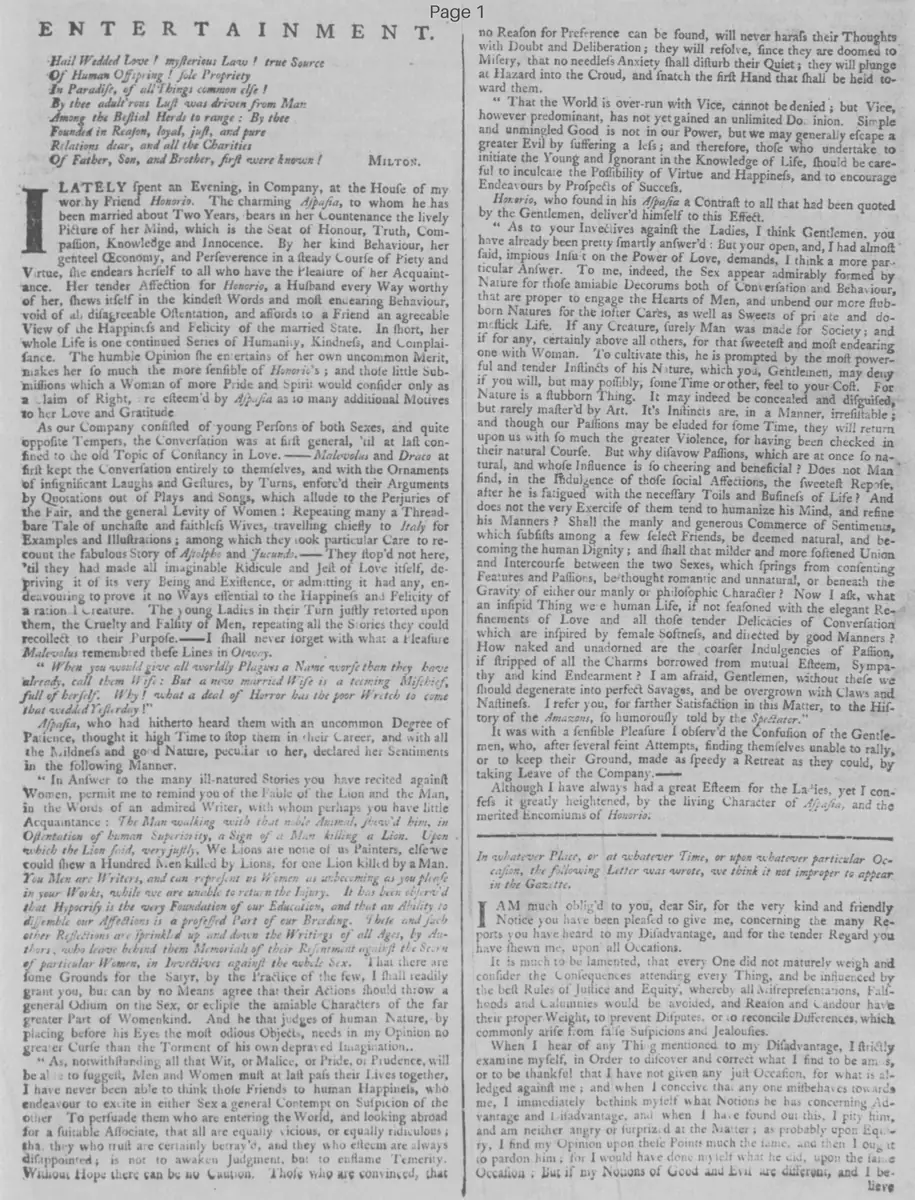
ENTERTAINMENT.
Hail Wedded Love! mysterious Law! true Source
Of Human Offspring! sole Propriety
In Paradise, of all Things common else!
By thee adulterous Lust was driven from Men
Among the Belial Herds to range: By thee
Founded in Reason, loyal, just, and pure,
Relations dear, and all the Charities
Of Father, Son, and Brother, first were known!
MILTON.
LATELY spent an Evening, in Company, at the House of my
worthy Friend Honorio. The charming Aspasia, to whom he has
been married about Two Years, bears in her Countenance the lively
Picture of her Mind, which is the Seat of Honour, Truth, Compassion,
Knowledge and Innocence. By her kind Behaviour, her
genteel OEconomy, and Perseverance in a steady Course of Piety and
Virtue, she endears herself to all who have the Pleasure of her Acquaintance.
Her tender Affection for Honorio, a Husband every Way worthy
of her, shows itself in the kindest Words and most endearing Behaviour,
void of all disagreeable Ostentation, and affords to a Friend an agreeable
View of the Happiness and Felicity of the married State. In short, her
whole Life is one continued Series of Humanity, Kindness, and Compliance.
The humble Opinion she entertains of her own uncommon Merit,
makes her much the more sensible of Honorio's; and those little Submissions
which a Woman of more Pride and Spirit would consider only as
claim of Right, are esteemed by Aspasia as so many additional Motives
to her Love and Gratitude.
As our Company consisted of young Persons of both Sexes, and quite
opposite Tempers, the Conversation was at first general, 'til at last confined
to the old Topic of Constancy in Love. Malevolus and Draco at
first kept the Conversation entirely to themselves, and with the Ornaments
of insignificant Laughs and Gestures, by Turns, enforced their Arguments
by Quotations out of Plays and Songs, which allude to the Perjuries of
the Fair, and the general Levity of Women: Repeating many a Threadbare
Tale of unchaste and faithless Wives, travelling chiefly to Italy for
Examples and Illustrations; among which they took particular Care to recount
the fabulous Story of Astolpho and Jocundo. They stopped not here,
till they had made all imaginable Ridicule and Jest of Love itself, depriving
it of its very Being and Existence, or admitting it had any, endeavouring
to prove it no Ways essential to the Happiness and Felicity of
a rational Creature. The young Ladies in their Turn justly retorted upon
them, the Cruelty and Falsity of Men, repeating all the Stories they could
recollect to their Purpose. I shall never forget with what a Pleasure
Malevolus remembered these Lines in Otway.
"When you would give all worldly Plagues a Name worse than they have
already, call them Wife: But a new married Wife is a teeming Mischief,
full of herself. Why! what a deal of Horror has the poor Wretch to come
that wedded Yesterday!"
Aspasia, who had hitherto heard them with an uncommon Degree of
Patience, thought it high Time to stop them in their Career, and with all
the Mildness and good Nature, peculiar to her, declared her Sentiments
in the following Manner.
"In Answer to the many ill-natured Stories you have recited against
Women, permit me to remind you of the Fable of the Lion and the Man,
in the Words of an admired Writer, with whom perhaps you have little
Acquaintance: The Man walking with that noble Animal, showed him, in
Ostentation of human Superiority, a Sign of a Man killing a Lion. Upon
which the Lion said, very justly, We Lions are none of us Painters, else we
could show a Hundred Men killed by Lions, for one Lion killed by a Man.
You Men are Writers, and can represent us Women as unbecoming as you please
in your Works, while we are unable to return the Injury. It has been observed
that Hypocrisy is the very Foundation of our Education, and that an Ability to
dissemble our Affections is a professed Part of our Breeding. I believe such
other Reflections as are sprinkled up and down the Writings of all Ages, by Authors,
who leave behind them Memorials of their Resentment against the Sex
of particular Women, in Invectives against the whole Sex. That there are
some Grounds for the Satyr, by the Practice of the few, I shall readily
grant you, but can by no Means agree that their Actions should throw a
general Odium on the Sex, or eclipse the amiable Characters of the far
greater Part of Womankind. And he that judges of human Nature, by
placing before his Eyes the most odious Object, needs in my Opinion no
greater Curse than the Torment of his own depraved Imagination.
"As, notwithstanding all that Wit, or Malice, or Pride, or Prudence, will
be able to suggest, Men and Women must at last pass their Lives together,
I have never been able to think those Friends to human Happiness, who
endeavour to excite in either Sex a general Contempt or Suspicion of the
other. To persuade them who are entering the World, and looking abroad
for a suitable Associate, that all are equally vicious, or equally ridiculous;
that they who trust are certainly betrayed, and they who esteem are always
disappointed; is not to awaken Judgment, but to inflame Temerity.
Without Hope there can be no Caution. Those who are convinced, that
no Reason for Preference can be found, will never harass their Thoughts
with Doubt and Deliberation; they will resolve, since they are doomed to
Misery, that no needless Anxiety shall disturb their Quiet; they will plunge
at Hazard into the Crowd, and catch the first Hand that shall be held toward
them.
That the World is over-run with Vice, cannot be denied; but Vice,
however predominant, has not yet gained an unlimited Dominion. Simple
and unmingled Good is not in our Power, but we may generally escape a
greater Evil by suffering a less; and therefore, those who undertake to
initiate the Young and Ignorant in the Knowledge of Life, should be careful
to inculcate the Possibility of Virtue and Happiness, and to encourage
Endeavours by Prospects of Success.
Honorio, who found in his Aspasia a Contrast to all that had been quoted
by the Gentlemen, delivered himself to this Effect.
As to your Invectives against the Ladies, I think Gentlemen. you
have already been pretty smartly answered: But your open, and, I had almost
said, impious Insult on the Power of Love, demands, I think a more particular
Answer. To me, indeed, the Sex appear admirably formed by
Nature for those amiable Decorums both of Conversation and Behaviour,
that are proper to engage the Hearts of Men, and unbend our more stubborn
Natures for the softer Cares, as well as Sweets of private and domestic
Life. If any Creature, surely Man was made for Society; and
if for any, certainly above all others, for that sweetest and most endearing
one with Woman. To cultivate this, he is prompted by the most powerful
and tender Instincts of his Nature, which you, Gentlemen, may deny
if you will, but may possibly, some Time or other, feel to your Cost. For
Nature is a stubborn Thing.
It may indeed be concealed and disguised,
but rarely mastered by Art. It's Instincts are, in a Manner, irresistible;
and though our Passions may be eluded for some Time, they will return
upon us with so much the greater Violence, for having been checked in
their natural Course. But why disavow Passions, which are at once natural,
and whose Influence is so cheering and beneficial? Does not Man
find, in the Indulgence of those social Affections, the sweetest Repose,
after he is fatigued with the necessary Toils and Business of Life? And
does not the very Exercise of them tend to humanize his Mind, and refine
his Manners? Shall the manly and generous Commerce of Sentiments,
which subsists among a few elect Friends, be deemed natural, and becoming
the human Dignity; and shall that milder and more softened Union
and Intercourse between the two Sexes, which springs from consenting
Features and Passions, be thought romantic and unnatural, or beneath the
Gravity of either our manly or philosophic Character? Now I ask, what
an insipid Thing we see human Life, if not seasoned with the elegant Refinements
of Love and all those tender Delicacies of Conversation
which are inspired by female Softness, and directed by good Manners?
How naked and unadorned are the coarser Indulgences of Passion,
if stripped of all the Charms borrowed from mutual Esteem, Sympathy
and kind Endearment? I am afraid, Gentlemen, without these we
should degenerate into perfect Savages, and be overgrown with Claws and
Teeth. I refer you, for further Satisfaction in this Matter, to the History
of the Amazons, so humorously told by the Spectator.
It was with a sensible Pleasure I observed the Confusion of the Gentlemen,
who, after several faint Attempts, finding themselves unable to rally,
or to keep their Ground, made as speedy a Retreat as they could, by
taking Leave of the Company.
Although I have always had a great Esteem for the Ladies, yet I confess
it greatly heightened, by the living Character of Aspasia, and the
merited Encomiums of Honorio.
Hail Wedded Love! mysterious Law! true Source
Of Human Offspring! sole Propriety
In Paradise, of all Things common else!
By thee adulterous Lust was driven from Men
Among the Belial Herds to range: By thee
Founded in Reason, loyal, just, and pure,
Relations dear, and all the Charities
Of Father, Son, and Brother, first were known!
MILTON.
LATELY spent an Evening, in Company, at the House of my
worthy Friend Honorio. The charming Aspasia, to whom he has
been married about Two Years, bears in her Countenance the lively
Picture of her Mind, which is the Seat of Honour, Truth, Compassion,
Knowledge and Innocence. By her kind Behaviour, her
genteel OEconomy, and Perseverance in a steady Course of Piety and
Virtue, she endears herself to all who have the Pleasure of her Acquaintance.
Her tender Affection for Honorio, a Husband every Way worthy
of her, shows itself in the kindest Words and most endearing Behaviour,
void of all disagreeable Ostentation, and affords to a Friend an agreeable
View of the Happiness and Felicity of the married State. In short, her
whole Life is one continued Series of Humanity, Kindness, and Compliance.
The humble Opinion she entertains of her own uncommon Merit,
makes her much the more sensible of Honorio's; and those little Submissions
which a Woman of more Pride and Spirit would consider only as
claim of Right, are esteemed by Aspasia as so many additional Motives
to her Love and Gratitude.
As our Company consisted of young Persons of both Sexes, and quite
opposite Tempers, the Conversation was at first general, 'til at last confined
to the old Topic of Constancy in Love. Malevolus and Draco at
first kept the Conversation entirely to themselves, and with the Ornaments
of insignificant Laughs and Gestures, by Turns, enforced their Arguments
by Quotations out of Plays and Songs, which allude to the Perjuries of
the Fair, and the general Levity of Women: Repeating many a Threadbare
Tale of unchaste and faithless Wives, travelling chiefly to Italy for
Examples and Illustrations; among which they took particular Care to recount
the fabulous Story of Astolpho and Jocundo. They stopped not here,
till they had made all imaginable Ridicule and Jest of Love itself, depriving
it of its very Being and Existence, or admitting it had any, endeavouring
to prove it no Ways essential to the Happiness and Felicity of
a rational Creature. The young Ladies in their Turn justly retorted upon
them, the Cruelty and Falsity of Men, repeating all the Stories they could
recollect to their Purpose. I shall never forget with what a Pleasure
Malevolus remembered these Lines in Otway.
"When you would give all worldly Plagues a Name worse than they have
already, call them Wife: But a new married Wife is a teeming Mischief,
full of herself. Why! what a deal of Horror has the poor Wretch to come
that wedded Yesterday!"
Aspasia, who had hitherto heard them with an uncommon Degree of
Patience, thought it high Time to stop them in their Career, and with all
the Mildness and good Nature, peculiar to her, declared her Sentiments
in the following Manner.
"In Answer to the many ill-natured Stories you have recited against
Women, permit me to remind you of the Fable of the Lion and the Man,
in the Words of an admired Writer, with whom perhaps you have little
Acquaintance: The Man walking with that noble Animal, showed him, in
Ostentation of human Superiority, a Sign of a Man killing a Lion. Upon
which the Lion said, very justly, We Lions are none of us Painters, else we
could show a Hundred Men killed by Lions, for one Lion killed by a Man.
You Men are Writers, and can represent us Women as unbecoming as you please
in your Works, while we are unable to return the Injury. It has been observed
that Hypocrisy is the very Foundation of our Education, and that an Ability to
dissemble our Affections is a professed Part of our Breeding. I believe such
other Reflections as are sprinkled up and down the Writings of all Ages, by Authors,
who leave behind them Memorials of their Resentment against the Sex
of particular Women, in Invectives against the whole Sex. That there are
some Grounds for the Satyr, by the Practice of the few, I shall readily
grant you, but can by no Means agree that their Actions should throw a
general Odium on the Sex, or eclipse the amiable Characters of the far
greater Part of Womankind. And he that judges of human Nature, by
placing before his Eyes the most odious Object, needs in my Opinion no
greater Curse than the Torment of his own depraved Imagination.
"As, notwithstanding all that Wit, or Malice, or Pride, or Prudence, will
be able to suggest, Men and Women must at last pass their Lives together,
I have never been able to think those Friends to human Happiness, who
endeavour to excite in either Sex a general Contempt or Suspicion of the
other. To persuade them who are entering the World, and looking abroad
for a suitable Associate, that all are equally vicious, or equally ridiculous;
that they who trust are certainly betrayed, and they who esteem are always
disappointed; is not to awaken Judgment, but to inflame Temerity.
Without Hope there can be no Caution. Those who are convinced, that
no Reason for Preference can be found, will never harass their Thoughts
with Doubt and Deliberation; they will resolve, since they are doomed to
Misery, that no needless Anxiety shall disturb their Quiet; they will plunge
at Hazard into the Crowd, and catch the first Hand that shall be held toward
them.
That the World is over-run with Vice, cannot be denied; but Vice,
however predominant, has not yet gained an unlimited Dominion. Simple
and unmingled Good is not in our Power, but we may generally escape a
greater Evil by suffering a less; and therefore, those who undertake to
initiate the Young and Ignorant in the Knowledge of Life, should be careful
to inculcate the Possibility of Virtue and Happiness, and to encourage
Endeavours by Prospects of Success.
Honorio, who found in his Aspasia a Contrast to all that had been quoted
by the Gentlemen, delivered himself to this Effect.
As to your Invectives against the Ladies, I think Gentlemen. you
have already been pretty smartly answered: But your open, and, I had almost
said, impious Insult on the Power of Love, demands, I think a more particular
Answer. To me, indeed, the Sex appear admirably formed by
Nature for those amiable Decorums both of Conversation and Behaviour,
that are proper to engage the Hearts of Men, and unbend our more stubborn
Natures for the softer Cares, as well as Sweets of private and domestic
Life. If any Creature, surely Man was made for Society; and
if for any, certainly above all others, for that sweetest and most endearing
one with Woman. To cultivate this, he is prompted by the most powerful
and tender Instincts of his Nature, which you, Gentlemen, may deny
if you will, but may possibly, some Time or other, feel to your Cost. For
Nature is a stubborn Thing.
It may indeed be concealed and disguised,
but rarely mastered by Art. It's Instincts are, in a Manner, irresistible;
and though our Passions may be eluded for some Time, they will return
upon us with so much the greater Violence, for having been checked in
their natural Course. But why disavow Passions, which are at once natural,
and whose Influence is so cheering and beneficial? Does not Man
find, in the Indulgence of those social Affections, the sweetest Repose,
after he is fatigued with the necessary Toils and Business of Life? And
does not the very Exercise of them tend to humanize his Mind, and refine
his Manners? Shall the manly and generous Commerce of Sentiments,
which subsists among a few elect Friends, be deemed natural, and becoming
the human Dignity; and shall that milder and more softened Union
and Intercourse between the two Sexes, which springs from consenting
Features and Passions, be thought romantic and unnatural, or beneath the
Gravity of either our manly or philosophic Character? Now I ask, what
an insipid Thing we see human Life, if not seasoned with the elegant Refinements
of Love and all those tender Delicacies of Conversation
which are inspired by female Softness, and directed by good Manners?
How naked and unadorned are the coarser Indulgences of Passion,
if stripped of all the Charms borrowed from mutual Esteem, Sympathy
and kind Endearment? I am afraid, Gentlemen, without these we
should degenerate into perfect Savages, and be overgrown with Claws and
Teeth. I refer you, for further Satisfaction in this Matter, to the History
of the Amazons, so humorously told by the Spectator.
It was with a sensible Pleasure I observed the Confusion of the Gentlemen,
who, after several faint Attempts, finding themselves unable to rally,
or to keep their Ground, made as speedy a Retreat as they could, by
taking Leave of the Company.
Although I have always had a great Esteem for the Ladies, yet I confess
it greatly heightened, by the living Character of Aspasia, and the
merited Encomiums of Honorio.
What sub-type of article is it?
Essay
Dialogue
What themes does it cover?
Love Romance
Moral Virtue
Social Manners
What keywords are associated?
Wedded Love
Constancy In Love
Marriage Virtues
Gender Relations
Domestic Happiness
Social Affections
Moral Instruction
Literary Details
Subject
Constancy In Love And Marriage
Form / Style
Prose Narrative With Dialogue
Key Lines
Hail Wedded Love! Mysterious Law! True Source Of Human Offspring! Sole Propriety In Paradise, Of All Things Common Else!
"When You Would Give All Worldly Plagues A Name Worse Than They Have Already, Call Them Wife: But A New Married Wife Is A Teeming Mischief, Full Of Herself. Why! What A Deal Of Horror Has The Poor Wretch To Come That Wedded Yesterday!"
You Men Are Writers, And Can Represent Us Women As Unbecoming As You Please In Your Works, While We Are Unable To Return The Injury.
Nature Is A Stubborn Thing.
Without These We Should Degenerate Into Perfect Savages, And Be Overgrown With Claws And Teeth.