Thank you for visiting SNEWPapers!
Sign up free
The Virginia Gazette
Richmond, Williamsburg, Richmond County, Virginia
What is this article about?
John Camm continues his defense of the proposal for resident bishops in the American Church of England against Reverend Gwathmey's protest. He argues that episcopal powers are sufficiently limited by laws and quotes Bishop Lowth on the justice of the plan. Camm critiques opponents' alternative of General Court oversight, predicting it would lead to a shift toward Presbyterianism or Dissent in Virginia.
Clipping
OCR Quality
Full Text
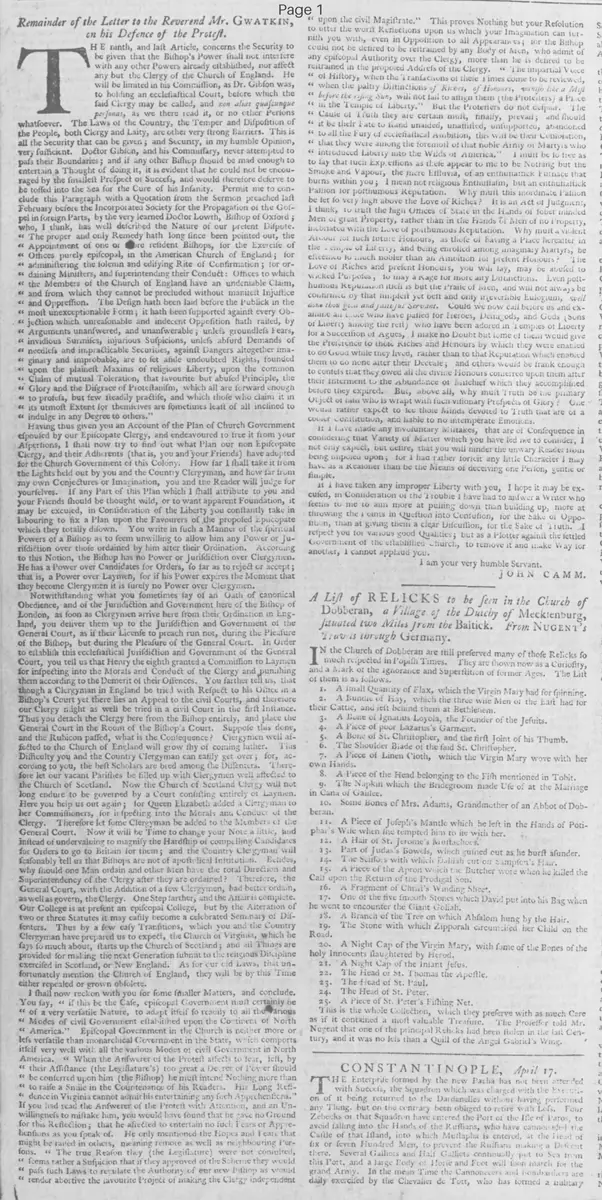
The ninth, and last Article, concerns the Security to be given that the Bishop's Power shall not interfere with any other Powers already established, nor affect any but the Clergy of the Church of England. He will be limited in his Commission, as Dr. Gibson was, to holding an ecclesiastical Court, before which the said Clergy may be called, and non alias quascunque personas, as we there read it, or no other Persons whatsoever. The Laws of the Country, the Temper and Disposition of the People, both Clergy and Laity, are other very strong Barriers. This is all the Security that can be given; and Security, in my humble Opinion, very sufficient. Doctor Gibson, and his Commissary, never attempted to pass their Boundaries; and if any other Bishop should be mad enough to entertain a Thought of doing it, it is evident that he could not be encouraged by the smallest Prospect of Success, and would therefore deserve to be tossed into the Sea for the Cure of his Insanity. Permit me to conclude this Paragraph with a Quotation from the Sermon preached last February before the Incorporated Society for the Propagation of the Gospel in foreign Parts, by the very learned Doctor Lowth, Bishop of Oxford; who, I think, has well described the Nature of our present Dispute.
"The proper and only Remedy hath long since been pointed out, the Appointment of one or more resident Bishops, for the Exercise of Offices purely episcopal, in the American Church of England; for administering the solemn and edifying Rite of Confirmation; for ordaining Ministers, and superintending their Conduct: Offices to which the Members of the Church of England have an undeniable Claim, and from which they cannot be precluded without manifest Injustice and Oppression. The Design hath been laid before the Publick in the most unexceptionable Form; it hath been supported against every Objection which unreasonable and indecent Opposition hath raised, by Arguments unanswered, and unanswerable; unless groundless Fears, invidious Surmises, injurious Suspicions, unless absurd Demands of needless and impracticable Securities, against Dangers altogether imaginary and improbable, are to set aside undoubted Rights, founded upon the plainest Maxims of religious Liberty, upon the common Claim of mutual Toleration, that favourite but abused Principle, the Glory and the Disgrace of Protestantism, which all are forward enough to profess, but few steadily practise, and which those who claim it in its utmost Extent for themselves are sometimes least of all inclined to indulge in any Degree to others."
Having thus given you an Account of the Plan of Church Government espoused by our Episcopate Clergy, and endeavoured to free it from your Aspersions, I shall now try to find out what Plan our non Episcopate Clergy, and their Adherents (that is, you and your Friends) have adopted for the Church Government of this Colony. How far I shall take it from the Lights held out by you and the Country Clergyman, and how far from my own Conjectures or Imagination, you and the Reader will judge for yourselves. If any Part of this Plan which I shall attribute to you and your Friends should be thought wild, or to want apparent Foundation, it may be excused, in Consideration of the Liberty you constantly take in labouring to fix a Plan upon the Favourers of the proposed Episcopate which they totally disown. You write in such a Manner of the spiritual Powers of a Bishop as to seem unwilling to allow him any Power or Jurisdiction over those ordained by him after their Ordination. According to this Notion, the Bishop has no Power or Jurisdiction over Clergymen. He has a Power over Candidates for Orders, so far as to reject or accept; that is, a Power over Laymen, for if his Power expires the Moment that they become Clergymen it is surely no Power over Clergymen. Notwithstanding what you sometimes say of an Oath of canonical Obedience, and of the Jurisdiction and Government here of the Bishop of London, as soon as Clergymen arrive here from their Ordination in England, you deliver them up to the Jurisdiction and Government of the General Court, as if their License to preach run not, during the Pleasure of the Bishop, but during the Pleasure of the General Court. In Order to establish this ecclesiastical Jurisdiction and Government of the General Court, you tell us that Henry the eighth granted a Commission to Laymen for inspecting into the Morals and Conduct of the Clergy and punishing them according to the Demerit of their Offences. You farther tell us, that though a Clergyman in England be tried with Respect to his Office in a Bishop's Court yet there lies an Appeal to the civil Courts, and therefore our Clergy might as well be tried in a civil Court in the first Instance. Thus you detach the Clergy here from the Bishop entirely, and place the General Court in the Room of the Bishop's Court. Suppose thus done, and the Rubicon passed, what is the Consequence? Clergymen well affected to the Church of England will grow shy of coming hither. This Difficulty you and the Country Clergyman can easily get over; for, according to you, the best Scholars are bred among the Dissenters. Therefore let our vacant Parishes be filled up with Clergymen well affected to the Church of Scotland. Now the Church of Scotland Clergy will not long endure to be governed by a Court consisting entirely of Laymen. Here you help us out again; for Queen Elizabeth added a Clergyman to her Commissioners, for inspecting into the Morals and Conduct of the Clergy. Therefore let some Clergyman be added to the Members of the General Court. Now it will be Time to change your Note a little, and instead of undervaluing to magnify the Hardship of compelling Candidates for Orders to go to Britain for them; and the Country Clergyman will reasonably tell us that Bishops are not of apostolical Institution. Besides, why should one Man ordain and other Men have the total Direction and Superintendency of the Clergy after they are ordained? Therefore, the General Court, with the Addition of a few Clergymen, had better ordain, as well as govern, the Clergy. One Step farther, and the Affair is complete. Our College is at present an episcopal College, but by the Alteration of two or three Statutes it may easily become a celebrated Seminary of Dissenters. Thus by a few easy Transitions, which you and the Country Clergyman have prepared us to expect, the Church of Virginia, which he says so much about, starts up the Church of Scotland; and all Things are provided for making the next Generation submit to the religious Discipline exercised in Scotland, or New England. As for our old Laws, that unfortunately mention the Church of England, they will be by this Time either repealed or grown obsolete.
I shall now reckon with you for some smaller Matters, and conclude. You say, "if this be the Case, episcopal Government must certainly be of a very versatile Nature, to adapt itself so readily to all the various Modes of civil Government established upon the Continent of North America." Episcopal Government in the Church is neither more or less versatile than monarchical Government in the State, which comports itself very well with all the various Modes of civil Government in North America. "When the Answerer of the Protest affects to fear, lest, by their Assistance (the Legislature's) too great a Degree of Power should be conferred upon him (the Bishop) he must intend Nothing more than to raise a Smile in the Countenance of his Readers. His Long Residence in Virginia cannot admit his entertaining any such Apprehensions." If you had read the Answerer of the Protest with Attention, and an Unwillingness to mistake him, you would have found that he gave no Ground for this Reflection; that he affected to entertain no such Fears or Apprehensions as you speak of. He only mentioned the Hopes and Fears that might be raised in others, meaning remote as well as neighbouring Persons. "The true Reason they (the Legislature) were not consulted, seems rather a Suspicion that if they approved of the Scheme they would pass such Laws to regulate the Authority of our new Bishop as would render abortive the favourite Project of making the Clergy independent upon the civil Magistrate." This proves Nothing but your Resolution to utter the worst Reflections upon us which your Imagination can furnish you with, even in Opposition to all Appearances; for the Bishop could not be desired to be restrained by any Body of Men, who admit of any episcopal Authority over the Clergy, more than he is desired to be restrained in the proposed Address of the Clergy. "The impartial Voice of History, when the Transactions of these Times come to be reviewed, when the paltry Distinctions of Riches, of Honours, vanish like a Mist before the rising Sun, will not fail to assign them (the Protestors) a Place in the Temple of Liberty." But the Protestors do not despair. The Cause of Truth they are certain must, finally, prevail; and should it be their Fate to stand unaided, unassisted, unsupported, abandoned to all the Fury of ecclesiastical ambition, this will be their Consolation, that they were among the foremost of that noble Army of Martyrs who introduced Liberty into the Woods of America. I must be to say that such Expressions as these appear to me to be Nothing but the Smoke and Vapour, the mere Effluvia, of an enthusiastick Furnace that burns within you; I mean not religious Enthusiasm, but an enthusiastick Passion for posthumous Reputation. Why must this inordinate Passion be set so very high above the Love of Riches? It is an Act of Judgment, I think, to trust the high Offices of State in the Hands of sober minded Men of great Property, rather than in the Hands of Men of no Property, inhabited with the Love of posthumous Reputation. Why must a violent Ardor to such future Honours, as those of having a Place hereafter in the Temple of Liberty, and being enrolled among imaginary Martyrs, be deemed so much nobler than an Ambition for present Honours? The Love of Riches and present Honours, you will say, may be abused to Wicked Purposes, to may a Rage for more airy Distinctions. Even posthumous Reputation such as this is but the Praise of men, and will not always be counteracted by that simplest yet best and only incorruptible Eulogium, well done thou good and faithful Servant. Could we now call before us and examine those who have passed for Heroes, Daniels, and Gods (Sons of Liberty among the rest) who have been adored in Temples of Liberty for a Succession of Ages, I make no Doubt but some of them would give the Preference to those Riches and Honours by which they were enabled to do Good while they lived, rather than to that Reputation which enabled them to do none after their Decease; and others would be frank enough to confess that they owed all the divine Honours conferred upon them after their Interment to the Abundance of Riches which they accumulated before they expired. But, above all, why must I turn be the primary Object of him who is wrapt with such visionary Prospects of Glory? One would rather expect to see those Minds devoted to Truth that are of a cooler Constitution, and liable to no intemperate Emotions. If I have made any involuntary Mistakes, that are of Consequence in considering that Variety of Matter which you have led me to consider, I not only expect, but desire, that you will mind the unwary Reader of being imposed upon; for I had rather forfeit any little Character I may have as a Reasoner than be the Means of deceiving one Person, gentle or simple. If I have taken any improper Liberty with you, I hope it may be excused, in Consideration of the Trouble I have had to answer a Writer who seems to me to aim more at pulling down than building up, more at throwing the Points in Question into Confusion, for the Sake of Opposition, than at giving them a clear Discussion, for the Sake of Truth. I respect you for various good Qualities; but as a Plotter against the settled Government of the established Church, to remove it and make Way for another, I cannot applaud you.
I am your very humble Servant,
JOHN CAMM.
What sub-type of article is it?
What themes does it cover?
What keywords are associated?
What entities or persons were involved?
Letter to Editor Details
Author
John Camm
Recipient
Reverend Mr. Gwathkin
Main Argument
the proposal for resident bishops in america is just and secure, limited by laws and commissions like dr. gibson's; opponents' alternative of general court oversight would erode episcopal authority and lead to a non-episcopal church structure in virginia, akin to scotland or new england.
Notable Details