Thank you for visiting SNEWPapers!
Sign up free
Editorial
April 13, 1949
The Daily Alaska Empire
Juneau, Juneau County, Alaska
What is this article about?
Editorial criticizes proposed bills H.R. 2925 and S. 1103 for drastically increasing book postage rates, arguing they are unfair compared to magazines and ads, and urges congressional committees to review before approval. References 500% rise since 1942.
Clipping
OCR Quality
98%
Excellent
Full Text
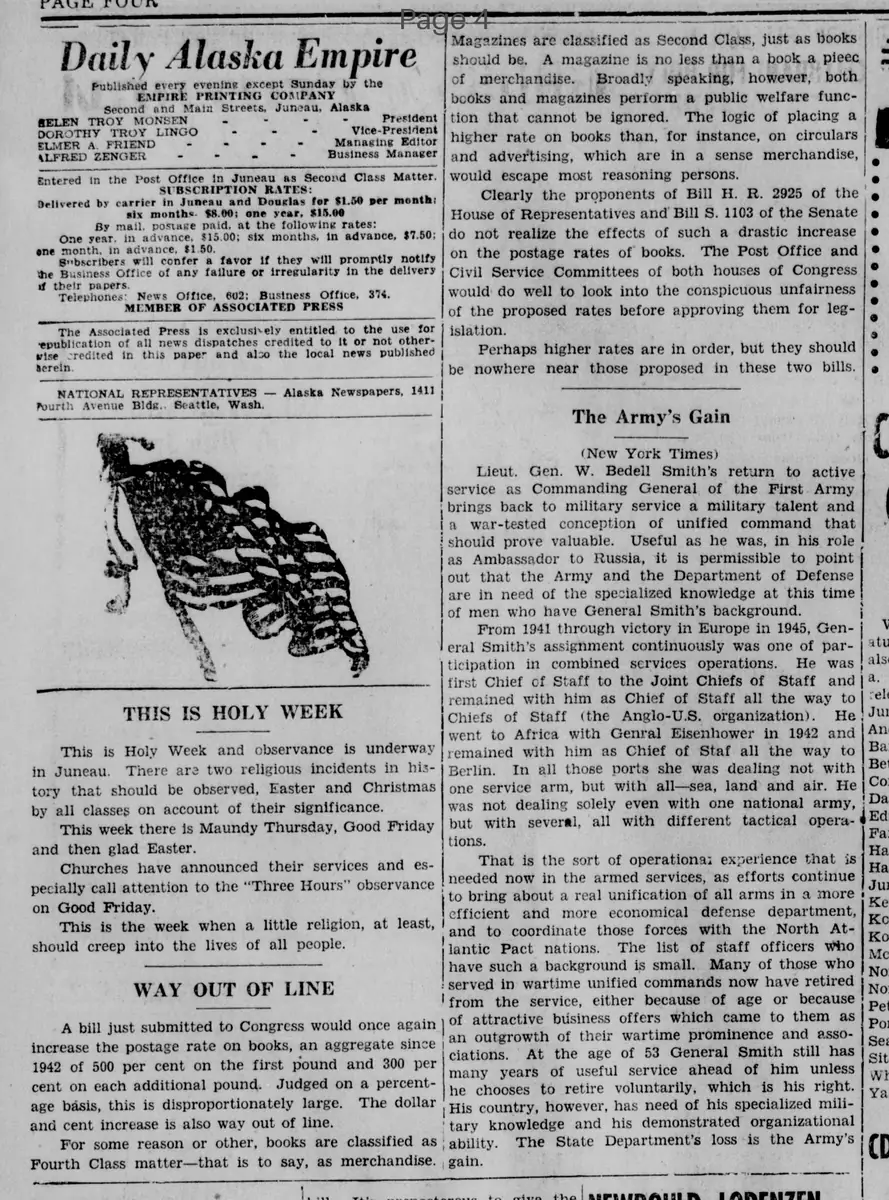
WAY OUT OF LINE
A bill just submitted to Congress would once again
increase the postage rate on books, an aggregate since
1942 of 500 per cent on the first pound and 300 per
cent on each additional pound. Judged on a percentage
basis, this is disproportionately large. The dollar
and cent increase is also way out of line.
For some reason or other, books are classified as fourth class matter—that is to say, as merchandise. Again.
Magazines are classified as Second Class, just as books
should be. A magazine is no less than a book a piece
of merchandise. Broadly speaking, however,
both books and magazines perform a public welfare function that cannot be ignored. The logic of placing a
higher rate on books than, for instance, on circulars
and advertising, which are in a sense merchandise,
would escape most reasoning persons.
Clearly the proponents of Bill H. R. 2925 of the
House of Representatives and Bill S. 1103 of the Senate
do not realize the effects of such a drastic increase
on the postage rates of books. The Post Office and
Civil Service Committees of both houses of Congress
would do well to look into the conspicuous unfairness
of the proposed rates before approving them for legislation.
Perhaps higher rates are in order, but they should
be nowhere near those proposed in these two bills.
A bill just submitted to Congress would once again
increase the postage rate on books, an aggregate since
1942 of 500 per cent on the first pound and 300 per
cent on each additional pound. Judged on a percentage
basis, this is disproportionately large. The dollar
and cent increase is also way out of line.
For some reason or other, books are classified as fourth class matter—that is to say, as merchandise. Again.
Magazines are classified as Second Class, just as books
should be. A magazine is no less than a book a piece
of merchandise. Broadly speaking, however,
both books and magazines perform a public welfare function that cannot be ignored. The logic of placing a
higher rate on books than, for instance, on circulars
and advertising, which are in a sense merchandise,
would escape most reasoning persons.
Clearly the proponents of Bill H. R. 2925 of the
House of Representatives and Bill S. 1103 of the Senate
do not realize the effects of such a drastic increase
on the postage rates of books. The Post Office and
Civil Service Committees of both houses of Congress
would do well to look into the conspicuous unfairness
of the proposed rates before approving them for legislation.
Perhaps higher rates are in order, but they should
be nowhere near those proposed in these two bills.
What sub-type of article is it?
Economic Policy
Taxation
What keywords are associated?
Book Postage
Rate Increase
Postal Classification
Congress Bills
Public Welfare
Fiscal Policy
What entities or persons were involved?
Congress
Post Office And Civil Service Committees
Bill H. R. 2925
Bill S. 1103
Editorial Details
Primary Topic
Opposition To Increased Postage Rates On Books
Stance / Tone
Critical Of Proposed Bills And Unfair Rates
Key Figures
Congress
Post Office And Civil Service Committees
Bill H. R. 2925
Bill S. 1103
Key Arguments
Postage Rate On Books Has Increased 500% On First Pound And 300% On Additional Since 1942
Increase Is Disproportionately Large On Percentage And Dollar Basis
Books Classified As Fourth Class Merchandise, Unlike Second Class Magazines
Books And Magazines Serve Public Welfare, Not Just Merchandise
Illogical To Charge Books More Than Circulars And Advertising
Proponents Unaware Of Drastic Effects On Book Postage
Committees Should Investigate Unfairness Before Approving
Higher Rates May Be Needed But Not As Extreme As Proposed