Thank you for visiting SNEWPapers!
Sign up free
Gazette Of The United States, & Philadelphia Daily Advertiser
Philadelphia, Philadelphia County, Pennsylvania
What is this article about?
Report on the French Council of Five Hundred's August 21 sitting, where Thibaudeau addressed Directory messages on troop movements, army addresses from Italy, finances, and proposed resolutions against sedition. Includes the Directory's August 20 message detailing financial deficits and urgent payments for troops and services.
Merged-components note: These components constitute a single translated article on French Council of Five Hundred proceedings, continued across page 2 and 3 with explicit 'continuation' indicator and sequential reading order.
Clippings
1 of 2
OCR Quality
Full Text
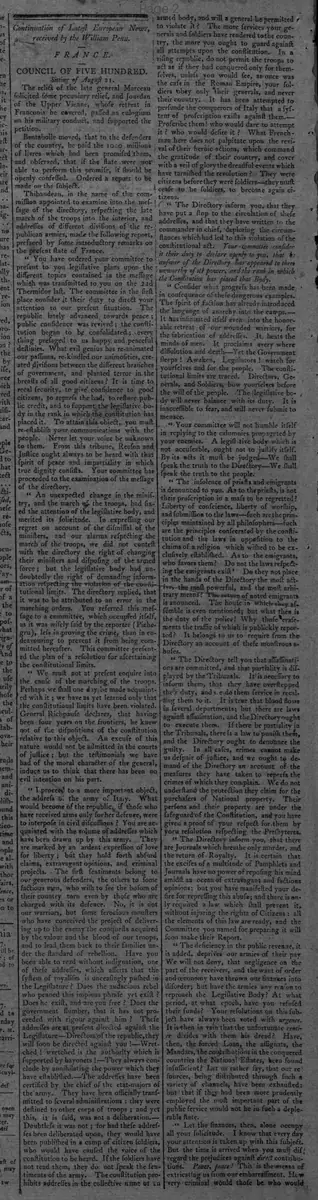
FRANCE.
COUNCIL OF FIVE HUNDRED.
Sitting of August 21.
The relict of the late general Marceau solicited some pecuniary relief, and Jourdan of the Upper Vienne, whose retreat in Franconia he covered, passed an eulogium on his military conduct, and supported the petition.
Bentabolle moved, that to the defenders of the country, be paid the 1000 millions of livres which had been promised them, and observed, that if the state were not able to perform this promise, it should be openly confessed. Ordered a report to be made on the subject.
Thibaudeau, in the name of the commission appointed to examine into the message of the directory, respecting the late march of the troops into the interior, and addresses of different divisions of the republican armies, made the following report, prefaced by some introductory remarks on the present state of France.
"You have ordered your committee to present to you legislative plans upon the different topics contained in the message which was transmitted to you on the 22d Thermidor last. The committee in the first place consider it their duty to direct your attention to our present situation. The republic, lately advanced towards peace; public confidence was revived; the constitution began to be consolidated; every thing presaged to us happy and peaceful destinies. What evil genius has re-animated our passions, re-kindled our animosities, created divisions between the different branches of government, and planted terror in the breasts of all good citizens? It is time to recall security, to give confidence to good citizens, to repress the bad, to restore public credit, and to support the legislative body in the rank in which the constitution has placed it. To attain this object, you must re-establish your communications with the people. Never let your voice be unknown to them. From this tribune, Reason and Justice ought always to be heard with that spirit of peace and impartiality in which true dignity consists. Your committee has proceeded to the examination of the message of the directory.
An unexpected change in the ministry, and the march of the troops, had fixed the attention of the legislative body, and merited its solicitude. In expressing our regret on account of the dismissal of the ministers, and our alarms respecting the march of the troops, we did not contest with the directory the right of changing their ministers and disposing of the armed force; but the legislative body had undoubtedly the right of demanding information respecting the violation of the constitutional limits. The directory replied, that it was to be attributed to an error in the marching orders. You referred this message to a committee, which occupied itself, as it was wisely said by the reporter (Pichegru), less in proving the crime, than in endeavouring to prevent it from being committed hereafter. This committee presented the plan of a resolution for ascertaining the constitutional limits.
We must not at present enquire into the cause of the marching of the troops. Perhaps we shall one day be made acquainted with it; we have as yet learned only that the constitutional limits have been violated. General Richpance declares, that having been four years on the frontiers, he knew not of the dispositions of the constitution relative to this object. An excuse of this nature would not be admitted in the courts of justice; but the testimonials we have had of the moral character of the general, induce us to think that there has been no evil intention on his part.
I proceed to a more important object, the address of the army of Italy. What would become of the republic, if those who have received arms only for her defence, were to interpose in civil dissensions? You are acquainted with the volume of addresses which have been drawn up by this army. They are marked by an ardent expression of love for liberty; but they hold forth absurd claims, extravagant opinions, and criminal projects. The first sentiments belong to our generous defenders, the others to some factious men, who wish to see the bosom of their country torn even by those who are charged with its defence. No, it is not our warriors, but some ferocious monsters who have conceived the project of delivering up to the enemy the conquests acquired by the valour and the blood of our troops, and to lead them back to their families under the standard of rebellion. Have you been able to read without indignation, one of these addresses, which asserts that the system of royalism is unceasingly pushed in the Legislature? Does the audacious rebel who penned this impious phrase yet exist? Does he exist, and are you free? Does the government slumber, that it has not proceeded with rigour against him? These addresses are at present directed against the Legislature—Directors of the republic, they will soon be directed against you! Wretched! wretched is the authority which is supported by bayonets!—They always conclude by annihilating the power which they have established.—The addresses have been certified by the chief of the etat-majors of the army. They have been officially transmitted to several administrations: they were destined to other corps of troops; and yet this, it is said, was not a deliberation.—Doubtless it was not: for had these addresses been deliberated upon, they would have been published in a camp of citizen soldiers, who would have caused the voice of the constitution to be heard. If the soldiers have not read them, they do not speak the sentiments of the army. The constitution prohibits addresses in the collective name of an armed body, and will a general be permitted to violate it? The more services your generals and soldiers have rendered to the country, the more you ought to guard against all attempts upon the constitution. In a rising republic, do not permit the troops to act as if they had conquered only for themselves, unless you would see, as once was the case in the Roman Empire, your soldiers obey only their generals, and never their country. It has been attempted to persuade the conquerors of Italy that a system of proscription exists against them. Proscribe them! who would dare to attempt it? who would desire it? What Frenchman here does not palpitate upon the review of their heroic actions, which command the gratitude of their country, and cover with a veil of glory the dreadful events which have tarnished the revolution? They were citizens before they were soldiers—they must cease to be soldiers, to become again citizens.
The Directory inform you, that they have put a stop to the circulation of these addresses, and that they have written to the commander in chief, deploring the circumstances which had led to this violation of the constitutional act. Your committee consider it their duty to declare openly to you, that the answer of the Directory has appeared to them unworthy of its power, and the rank in which the Constitution has placed that Body.
Consider what progress has been made in consequence of these dangerous examples. The spirit of faction has already introduced the language of anarchy into the camps.—It has insinuated itself even into the honorable retreat of our wounded warriors, for the fabrication of addresses. It heats the minds of men. It proclaims every where dissolution and death—Yet the Government sleeps! Awaken, Legislators! watch for yourselves and for the people. The constitutional limits are traced. Directors, Generals, and Soldiers, bow yourselves before the will of the people. The legislative body will never balance with its duty. It is inaccessible to fear, and will never submit to menace.
Your committee will not humble itself in replying to the calumnies propagated by your enemies. A legislative body which is not accuseable, ought not to justify itself. By its acts it must be judged We shall speak the truth to the Directory—We shall speak the truth to the people.
The insolence of priests and emigrants is denounced to you. As to the priests, is not their proscription in a mass to be regretted? Liberty of conscience, liberty of worship, and submission to the laws—such are the principles maintained by all philosophers such are the principles consecrated by the constitution and the laws in opposition to the claims of a religion which wished to be exclusively established. As to the emigrants, who favors them? Do not the laws respecting the emigrants exist? Do they not place in the hands of the Directory the most active the most powerful, and the most arbitrary means? The return of noted emigrants is announced. The house in which they assemble is even mentioned; but what then is the duty of the police! Why those emigrants the traffic of which is publicly reported? It belongs to us to require from the Directory an account of these monstrous abuses.
The Directory tell you that assassinations are committed, and that partiality is displayed by the Tribunals. It is necessary to inform them, that they have overstepped their duty, and so do them service in recalling them to it. It is true that blood flows in several departments; but there are laws against assassination, and the Directory ought to execute them. If there be partiality in the Tribunals, there is a law to punish them, and the Directory ought to denounce the guilty. In all cases, crimes cannot make us despair of justice, and we ought to demand of the Directory an account of the measures they have taken to repress the crimes of which they complain. We do not understand the protection they claim for the purchasers of National property. Their persons and their property are under the safeguard of the Constitution, and you have given a proof of your respect for them by your resolution respecting the Presbytery.
The Directory inform you, that there are Journals which breathe only murder, and the return of Royalty. It is certain that the excess of a multitude of Pamphlets and Journals have no power of reposing his mind amidst an ocean of extravagant and factious opinions: but you have manifested your desire for repressing this abuse; and there is only required a law which shall prevent it, without injuring the rights of Citizens: all the elements of this law are ready, and the Committee you named for preparing it will soon make their Report.
The deficiency in the public revenue, it is added, deprives our armies of their pay We will not deny, that negligence on the part of the receivers, and the want of order and economy have thrown our finances into disorder; but have the armies any reason to reproach the Legislative Body? At what period, at what epoch, have you refused their funds? Your resolutions on this subject have always been voted with urgency. It is then in vain that the unfortunate renter divides with them his dread? Have, then, the forced Loan, the assignats, the Mandats, the contributions in the conquered countries the National Estates, been found insufficient? Let us rather say, that our resources, being distributed through such a variety of channels, have been exhausted: but that if they had been more prudently employed the most important part of the public service would not be in such a deplorable state.
Let the finances, then, alone occupy all your solicitude, I know that every day your attention is taken up with this subject. But the time is arrived when you must disregard the prejudices against direct contributions. Peace, peace! This is the means of extricating us from our embarrassment. How very criminal would those be who would...with to place it till at a distance! Doubtless there are men who still preserve the criminal hope of overturning the republic.—Traitors exist, we are told-why are they not detected. There are conspirators-why are they not punished? We have laws-why are they not executed No! the defenders of the country will never be made to believe, that the legislative body opposes a peace! Who has appeared more desirous than ourselves to obtain it? History will examine whether the events which have lately taken place in Italy have not contributed to retard the conclusion-of it; but can France blame its generals for paying liberty to millions of men?-And, when they have gained their liberty, can France refuse to them its friendship and its alliance? Your committee, however, does not wish to propose that you should approve, or even be silent on those events.
"The Directory has gone beyond its powers. If war has been declared against the Italian states, who had the right to declare it without your consent!-If treaties of commerce or subsidies have been made, who could make them without your approbation? The states of Italy cannot be the allies of France without a decree from you. Their government will be equivocal, their liberty without support, as long as the treaties shall not have been approved by us.
"Fears have been entertained that the directory would be accused, and that the legislative body would be attacked. The legislative body has a right to accuse the directory; and if there existed any reasons for accusation, it would, without fear, without hesitation, accuse them. But an attack on the legislative body! who would make it? A few brigands?--the recollection of their past defeats will serve them as a lesson. The soldiers?-never will they be seen marching under the colours of assassins. The directory!--such an idea cannot occupy our attention for a moment; its own interest is in opposition to it.
"To conclude-you will find, in your own courage and your own prudence, extraordinary resources."
Here Thibaudeau implored the members of the government to act in union and concord.-He invited the representatives and directors to be upon their guard against the exaggerations of parties, who ought only to heighten their animosities, that they might be hurried to a catastrophe which would destroy them all.
"In examining," he added, "this message of the Directory, its exaggerations, and the bitterness of its style, we have avoided giving new aliment to the factions. Legislators ought not to be guided by passion. In vain our common enemies meditate the ruin of the republic. The republic is deeply rooted; it has ripened in the midst of storms and it belongs not alone to the present generation. The new dangers which threaten it, serve only to display once more its strength. - Each power shall return to its proper limits; and if some men have wished to overstep them, they shall be recalled, and confined to their proper station.
"Citizen soldiers, you whom we must censure to-day, but whom we must always admire, believe that liberty is here defended by your friends. The legislature is the citadel of the constitution. It is your duty to die for it, and you are about to besiege it. Let its voice be always heard among you; and when you return to your fire sides, you will find it cemented by your blood and covered with your triumphs."
Thibaudeau concluded by presenting the plan of two resolutions. The 1st declared. "That all conspiracies or crimes against the constitution, the legislative body, and the directory, came under the jurisdiction of the criminal tribunal of the place where the legislature sits; that all persons accused should be denounced at the office of the public accuser, but that they should have the power of appealing from that tribunal; and in this case they should be carried before a court pointed out by the tribunal of cassation." The 2d enacts, that every deliberation or common wish expressed by the armed force, although nothing follow upon it, except the cases determined by law, shall be a sedition. To send address from one body of troops to another, or to the civil authorities, is an act of sedition. The plan then points out the penalties to be inflicted on the instigators, movers, or subscribers of addresses, according to the enormity of the case, and the different powers against which they shall be directed.
"The gradation of offence is, first, against the Directory, then the legislative body, and next the law and constitution."
Ordered to be printed to the number of six copies to each member.
Message of the Executive Directory to the Council of Five Hundred, of the 2d Thermidor (20th August.)
"Citizens Representatives,
"The Executive Directory has proceeded to the distribution of the funds assigned for the service of the first decade of Fructidor. The singular and uncommon circumstances in which they are placed oblige them to lay before you the results of this distribution, which will convince you of the indispensable necessity of rendering the means disposable, which are requisite to prevent the impending disasters.
Deducting 63,888,967 livres and 75 centimes, which remain to be paid on warrants already issued for urgent services, and payments become due, the most pressing demands amount to 21,002,790 livres 54 cts.
"This sum consists of the following articles:
L. I C.
To pay for the troops
3,128,309 78
To sustenance
3,944,916 95
To pensions and dividends
900,000
To constitutional salaries
986,943 83
To salaries and pensions
5,040,990 49
To sundries
7,001,629 29
"The ways and means, as stated by the national treasury, present at first sight, -instead of disposable funds, a deficit of 3,793,681 livres, which it would be necessary to cover previous to assigning any sums of money for the service of the different departments. It has been calculated, that the above deficit may in a great measure be covered by the presumptive funds calculated as existing in the public chests of the departments, and that by adding to the funds actually existing in the public treasury, those which appear most disposable, the supposition might be admitted, that a balance of about 800,000 livres might remain for the service of the decade, independently of such sums as must unavoidably be paid at Paris on the arrears of the preceding decade.
"A calculation has afterwards been formed-of those articles of expense, which is indispensably necessary to meet for the execution of the laws as well as for the maintenance of the public service. Under these heads have been classed the pay and sustenance of the land and naval forces, dividends and pension, the constitutional indemnification of the legislative body; 63,703 liv. 14 sous, for the payment of bills of exchange, accepted by the national treasury, and 50,000 livres for the most urgent expense to be made at Paris for the home department.
"These objects amount to a sum total of 6,850,729 87 centimes.
"To find this sum, it has been supposed that the national treasury can furnish 850,929 l. 87c. actually in its possession; that it is to receive in the course of the decade one million, and that the effective receipts in the departments during the last decade must be supposed to amount to seven millions.--This calculation is most surely exaggerated; it violates all proportion, and exceeds all probability, and the subsisting circumstances would alone authorize its admission; and yet, citizens representatives, you cannot but perceive, that this is the chief resource for meeting the most urgent and indispensable expense.
"To this message are annexed the copy of a letter from the national treasury, dated the 1st Fructidor (August 17) proving the necessity of the repartition for this decade being made according to a presumptive estimate of the revenue, the statement of ways and means for the first decade of Fructidor, transmitted by the national treasury, and another of the divisions and distributions, containing a detailed account of the demands, founded on the registers of the different commissaries.
"The Directory refer to these authentic papers all those who shall presume to question the truth of the results they offer. Who contradicts the following facts, is either grossly mistaken, citizens representatives, or endeavors to deceive you:
"1. The national treasury does not possess one million disposable funds for this present decade.
"2. In order to find the above stated sum it is indispensably necessary to suppose, that the receipts in the departments amount to 7,000,000, and that moreover the national treasury is to receive one million at Paris.
3. This supposition is exaggerated, but must be admitted.
4. The laws of the 23d Vendemiaire and 9th Thermidor, enact, that the pay and sustenance of the troops shall be paid in preference to every other demand. The aggregate sum of these two articles of expense amount to 7,073,226 livres, 73 centimes.
5. The law of the 15th Vendemiaire assigns to the stockholders a sixth of the taxes; the national treasury demands under this head 900,000 livres.
"6. The law, which fixes the expense of the legislative body, ordains, that the constitutional indemnifications of its members shall be paid every month.
"7. The engagements contracted by the national treasury, with respect to accepted bills of exchange, demand the sum of 63,703 livres, 24 centimes.
"8. The safety of Paris, the imperious force of the supreme law, demands, that the minister of the interior be able to dispose of 50,000 livres.
9. These articles absorb all the funds, which may be considered as disposable.
"10. Except the salaries of the legislative body, there remains no money to discharge all other constitutional and other salaries and pensions, nor are any funds left for the hospitals, the repair of the dikes, roads, canals, &c.
"11. The Directory cannot extend its distribution to any sum exceeding the above amount; and it is to the want of disposable funds that ought to be imputed the failure of all the other branches of the public service, and the danger with which they are threatened.
"12. If the national treasury is desired, by means of negotiations, to augment the resources, it is obliged to return in answer, that it does not possess any thing which may serve for that purpose.
"13. The pay of the army is considerably in arrear. This is a certain and acknowledged fact.
"14. The future sustenance of the troops is compromised.
"15. No funds remain to be disposed of for the relief of the hospital. The executive directory can perceive no possible resource that may be applied to assist them The decisions which it is enabled to make with respect to the urgency of the payments, make no alteration in the deplorable situation in which they are placed The directory considered itself bound to lay before you these statements. It has fulfilled that duty; but it does not apprehend, that this exposition can shake the courage and perseverance of the friends of the republic. It on the contrary finds a powerful motive in the true picture which it has drawn to hope, that your deliberations on the finances will render those resources effective which can be brought into action. These resources possess the great advantage of being adequate to the re-establishment of public credit, and of proving that France is fully capable of maintaining order in the interior, and of combating her foreign enemies. But these resources, citizens representatives, are as if they never existed, since the laws which are necessary to render them productive are not enacted. Had those which regulate the direct contributions of the 5th year been sooner passed, ten millions would most probably have been received, which remain still due, and the power of disposing of them, for the purpose of getting the principal articles of expense, would procure the means of obtaining what may be necessary for the indispensable payment of pensions and salaries."
The directory, after pressing the necessity of the councils immediately taking into their consideration proper measures for the restoration of public confidence and credit, concludes in the following manner:
Our situation is such, citizens Representatives, that the smallest delay increases the danger to which the nation is exposed.
"The Executive Directory invites you to obtain an exact account of the true state of the finances; of the necessary wants of the public treasury; of the real, and by no means exaggerated product of the means which can yet be made use of, and of the resources which can be employed. You will find in the result of your examination, proofs of the truth to which the directory has called your attention in all its messages. The existing means are insufficient; those which new laws have it in their power to produce, will be adequate to meet all our expenses, and the moment is bringing them into action is arrived:
(Signed)
"CARN0T, President
"LAGARDE, S. G."
What sub-type of article is it?
What keywords are associated?
What entities or persons were involved?
Where did it happen?
Foreign News Details
Primary Location
France
Event Date
August 21, 1797
Key Persons
Outcome
proposed resolutions declaring troop addresses as sedition and outlining penalties; reported financial deficit of 3,793,681 livres and urgent demands totaling 21,002,790 livres; calls for legislative action on finances and constitutional limits.
Event Details
In the Council of Five Hundred on August 21, discussions included relief for General Marceau's widow, payment to defenders, and Thibaudeau's report on Directory messages regarding troop marches into the interior, addresses from the Army of Italy criticizing the legislature, financial shortages, priest and emigrant issues, assassinations, and journals promoting royalty. Thibaudeau criticized the Directory's response and proposed resolutions against conspiracies and military sedition. The Directory's message detailed fund distribution for Fructidor, highlighting deficits and pressing needs for troop pay, sustenance, and other services.