Thank you for visiting SNEWPapers!
Sign up free
The National Intelligencer And Washington Advertiser
Washington, District Of Columbia
What is this article about?
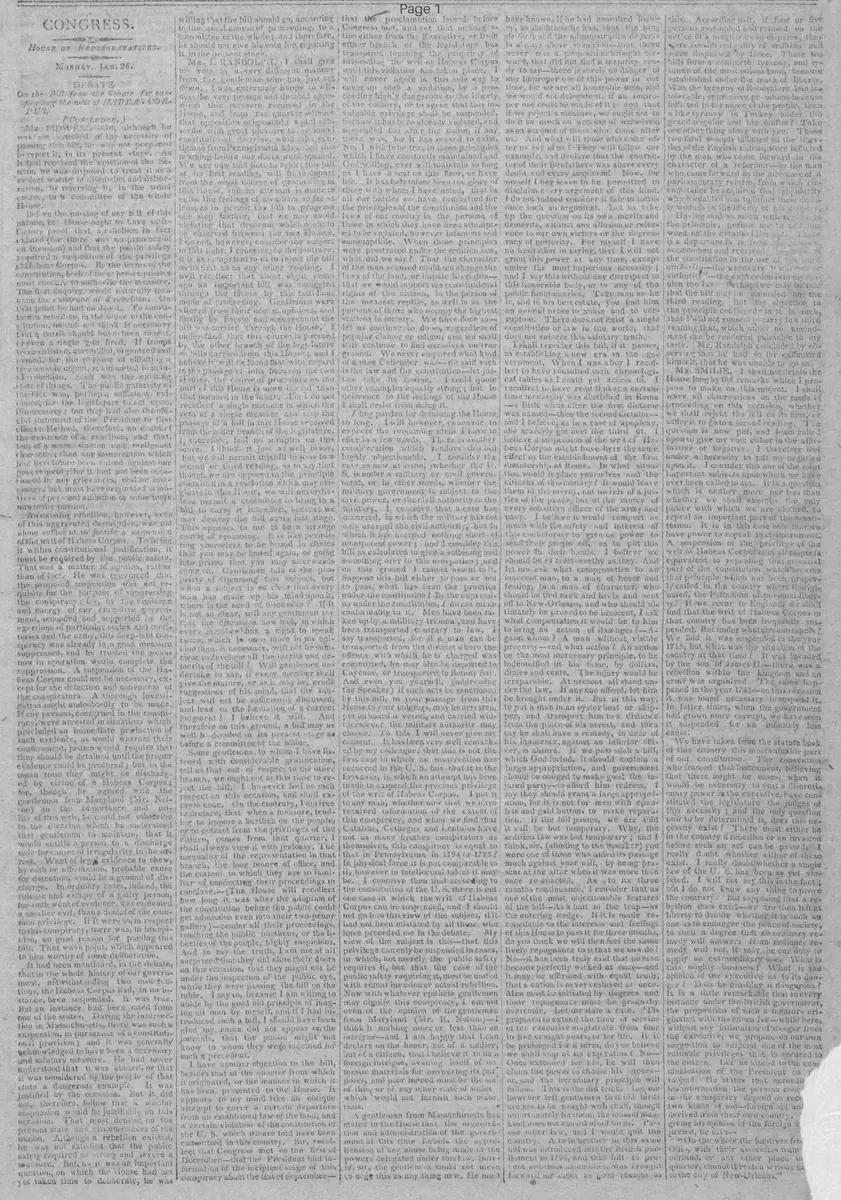
In the U.S. House of Representatives on January 26, debate continued on a Senate bill to partially suspend the writ of Habeas Corpus amid a reported conspiracy or rebellion. Speakers including Bidwell, Randolph, Smillie, and Dana questioned its necessity, constitutionality, and potential for abuse. The House voted to reject the bill, 113-19.
Merged-components note: Merged continuation of congressional debate on the Habeas Corpus bill across pages 1 and 2; relabeled to story as it is a full narrative article of the proceedings.
Clippings
1 of 2
OCR Quality
Full Text
HOUSE OF REPRESENTATIVES.
MONDAY, JAN. 26.
DEBATE
On the Bill from the Senate for suspending in part the writ of HABEAS CORPUS.
(CONTINUED.)
Mr. BIDWELL said, although he was not satisfied of the necessity of passing this bill, he was not prepared to reject it, in its present stage. As it had received the sanction of the Senate, he was disposed to treat it as a subject worthy of discussion and debate, by referring it, in the usual course, to a committee of the whole House.
Before the passing of any bill of this nature, the House ought to have satisfactory proof that a rebellion in fact existed (for there was no pretence of an invasion) and that the public safety required a suspension of the privilege of Habeas Corpus. By the terms of the constitution, both of these pre-requisites must concur, to authorize the measure.
The first inquiry, would naturally turn upon the existence of a rebellion. Upon that point he had no doubt. To constitute a rebellion, in the sense of the constitution, he did not think it necessary that a battle should have been fought, or even a single gun fired. If troops were enlisted, assembled, organized and armed, for the purpose of effecting a treasonable object, it amounted to treason or rebellion. Such was the existing state of things. The public notoriety of the fact was, perhaps, sufficient evidence, as the Legislature to act upon, if necessary; but they had also the official statement of the President to that effect: He had, therefore, no doubt of the existence of a rebellion, and that, too, of a more wanton and malignant character than any insurrection which had heretofore been raised against our government; for it had not been occasioned by any grievances, real or imaginary, but must have originated in motives of personal ambition or some more unworthy passion.
An existing rebellion, however, even of this aggravated description, was not alone sufficient to justify a suspension of the writ of Habeas Corpus. To bring it within constitutional justification, it must be required by the public safety. That was a matter of opinion, rather than of fact. He was convinced that the proposed suspension was not requisite for the purpose of suppressing the conspiracy; for, by the vigilance and energy of our executive government, seconded and supported by the exertions of particular states and territories and the army, this deep-laid conspiracy was already in a good measure suppressed, and he trusted the means now in operation would complete the suppression. A suspension of the Habeas Corpus could not be necessary, except for the detection and conviction of the conspirators. A thorough investigation ought undoubtedly to be made. If any persons, concerned in the conspiracy, were arrested in situations which precluded an immediate production of such evidence, as would warrant their confinement, justice would require that they should be detained until the proper evidence could be procured; but in the mean time they might be discharged by virtue of a Habeas Corpus; for, though he agreed with the gentleman from Maryland (Mr. Nelson) in the importance and utility of this writ, he could not subscribe to the doctrine which he understood that gentleman to maintain, that it would entitle a person to a discharge only for causes of irregularity in the arrest. Want of legal evidence to shew, by oath or affirmation, probable cause for detention, would be a ground of discharge, in ordinary cases, indeed, the release and escape of a guilty person, for such want of evidence, was esteemed a smaller evil, than a denial of the common privilege. If it were so, in respect to this conspiracy, there was, in his opinion, no good reason for passing this bill. That was a point, which appeared to him worthy of some deliberation.
It had been mentioned, in the debate, that in the whole history of our government, notwithstanding two insurrections, the Habeas Corpus had, in no instance, been suspended. It was true. But an instance had been cited from one of the states. During the insurrection in Massachusetts, there was such a suspension, in pursuance of a constitutional provision; and it was generally acknowledged to have been a necessary and salutary measure. He had never understood that it was abused, or that it was considered by the people of that state a dangerous example. It was justified by the occasion. But it did not, therefore, follow that a similar suspension would be justifiable on this occasion. That must depend on the present state and circumstances of the nation. Although a rebellion existed, he was not satisfied that the public safety required so strong and severe a measure. But, as it was an important question, on which the House had not yet taken time to deliberate, he was willing that the bill should go, according to the usual course of proceeding, to a committee of the whole; and therefore he should not give his vote for rejecting it in the present stage.
Mr. J. RANDOLPH. I shall give my vote in a very different manner from the gentleman who has just sat down. I was extremely happy to witness the very prompt and decided opposition this measure received in the House, and from the quarter whence that opposition originated: and I subscribe with great pleasure to the sound constitutional doctrine, which the gentleman from Pennsylvania advanced this morning before our doors were opened.
We are now told that to reject this bill at its first reading, will be to depart from the usual course of proceeding in this House, and an attempt is made to enlist the feelings of members so far at least as to permit the bill to progress one step farther, that we may avoid violating that decorum which ought to be observed between the two Houses.
I do not, however, consider the subject in this light. I conceive on the contrary, it is as competent to us to reject this bill on its first as on any other reading. I well recollect that about eight years ago an important bill was smuggled through the House by this factitious mode of proceeding. Gentlemen were lured from their honest opinions, and finally by loss and management the bill was carried through the House, I understand that this course is pursued by the other branch of the legislature on bills carried from this House; and I believe it will be found that with regard to the passage of bills between the two Houses, the course of procedure on the part of this House is more liberal than that pursued in the other. For I do not recollect a single instance in which the veto of a single member can stop the passage of a bill in this House received from the other branch of the legislature.
I, therefore, feel no scruples on this score. I think it just as well to say, that we will not permit this bill to pass to a second or third reading, as to say that although we are opposed to the principle contained in a resolution which may originate in this House, we will nevertheless permit a committee to bring in a bill to carry it into effect, because we may destroy the bill at its last stage.
The appears to me to be a strange course of reasoning. It is like permitting yourselves to be bound in chains that you may be loosed again, or going into prison that you may afterwards come out, Gentlemen talk of the propriety of discussing this subject, but when a subject is so clear that every man has made up his mind upon it, where is the need of discussion? If it is not so clear, will any gentleman say that the discussion now had, in which every member has a right to speak twice, which is once more in my opinion than is necessary, will not be sufficient to develop all the merits and demerits of the bill? Will gentlemen undertake to say, if every member shall give the mature, or as it may be, crude suggestions of his mind, that the subject will not be sufficiently discussed, and lead to the formation of a correct judgment? I believe it will. And therefore on this ground, a bill may as well be decided in its present stage as before a committee of the whole.
Some gentlemen to whom I have listened with considerable gratification, tell us that out of respect to the other branch, we ought not at this time to reject the bill. I however feel no such respect on this occasion, and shall express none. On the contrary, I am free to declare, that when a measure, tending to impose a burthen on the people, or to detract from the privileges of the citizen, comes from that quarter, I shall always view it with jealousy, The inequality of the representation in that branch, the long tenure of office, and the custom to which they are so familiar of conducting their proceedings in conclave.—(The House will recollect how long it was after the adoption of the constitution, before the public could get admission even into their two-penny gallery)—render all their proceedings, touching the public burthens, or the liberties of the people, highly suspicious. And to say the truth, I am not at all surprised that they did close their doors on this occasion, that they might not be under the inspection of the public eye, while they were passing the bill on the table: I say so, because I am willing to abide by the good old principle of judging all men by myself, and if I had introduced such a bill, I should have been glad my name did not appear on the journals, that the people might not know to whom they were indebted for such a precedent.
I have another objection to the bill, besides that of the quarter from which it originated, or the manner in which it has been presented to the House. It appears to my mind like an oblique attempt to cover a certain departure from an established law of the land, and a certain violation of the constitution of the U. S. which we are told have been committed in this country. Sir, recollect that Congress met on the first of December—that the President had information of the incipient stage of this conspiracy about the last of September—that the proclamation issued before Congress met, and yet that no suggestion either from the Executive, or from either branch of the legislature has transpired touching the propriety of suspending the writ of Habeas Corpus until this violation has taken place. I will never agree in this sly way to cover up such a violation, by a proceeding highly dangerous to the liberty of the country, or to agree that this invaluable privilege shall be suspended, because it has been already violated, and suspended too after the cause, if any there was, for it has ceased to exist.
No, I wish to be true to those principles which I have constantly maintained and God willing, ever will maintain so long as I have a seat on this floor, or have life. It has heretofore been the glory of those with whom I have acted, that in all our battles we have combatted for the principles of the constitution and the laws of our country in the persons of those in which they have been attempted to be violated, however infamous and contemptible. When those principles were prostrated under the sedition law, what did we say? That the character of the man accused could not change the laws of the land, or impair his rights—that we would support the constitutional rights of the citizen, in the person of the meanest reptile, as well in as the persons of those who occupy the highest stations in society. We have done so—let us continue to do so, regardless of popular clamor or odium; and we shall still continue to find ourselves on true ground. We never inquired what kind of a man Callender was—we said such is the law and the constitution—let justice take its course. I could quote other examples equally strong; but in deference to the feelings of this House I shall desist from doing it.
I beg pardon for detaining the House so long. I will however, endeavor to express the remaining ideas I have to offer in a few words. There is another consideration which renders this bill highly objectionable. I consider the case as now at issue, whether the U. S. is under a military or civil government, or in other words, whether the military government is subject to the civil power, or the civil authority to the military. I conceive that a case has occurred, in which the military has not only usurped the civil authority, but in which it has usurped nothing short of omnipotent power; and I consider this bill as calculated to give a softening and soothing over to this usurpation; and on this ground I cannot assent to it.
Suppose this bill either to pass or not to pass, what has been the practice under the constitution? By the expression under the constitution, I do not mean conformably to it. Men have been taken up by a military tribunal, and have been transported contrary to law. I say transported, for if a man can be transported from the district where the offence with which he is charged was committed, he may also be deported to Cayenne, or transported to Botany Bay. And even you yourself, (addressing the Speaker) if such acts be sanctioned by this bill, in your passage from this House to your lodgings, may be arrested, put on board a vessel, and carried whithersoever the military authority may choose. To this I will never give my consent. It has been very well remarked by my colleague, that this is not the first case in which an insurrection has occurred in the U. S. but that it is the first case, in which an attempt has been made to suspend the precious privilege of the writ of Habeas Corpus. I put it to any man, whether now that we have received information of the extent of this conspiracy, and when we find that Cataline, Cethegus and Lentulus have not as many brother conspirators as themselves, this conspiracy is equal to that in Pennsylvania in 1794 or 1795? In physical force it is not comparable to it, however in intellectual talent it may be. I conceive then that according to the constitution of the U. S. there is but one case in which the writ of Habeas Corpus can be suspended, and I should not go into this view of the subject, if it had not been misstated by all those who have preceded me in the debate. My view of the subject is this—that this privilege can only be suspended in cases, in which, not merely the public safety requires it, but that the case of the public safety requiring it, must be united with actual invasion or actual rebellion.
Now with whatever epithets gentlemen may dignify this conspiracy, I am not even of the opinion of the gentleman from Maryland (Mr. R. Nelson)—I think it nothing more or less than an intrigue—and I am happy that I can declare on the honor, not of a soldier, but of a citizen, that I believe it to be a foreign intrigue, availing itself of domestic materials for answering its purposes, and poor indeed must be the soil of this, or of any other state of society which would not furnish such materials.
A gentleman from Massachusetts has stated to the House that the organization and administration of the government at this time forbids the apprehension of any abuse being made of the powers delegated under this law. Surely, sir, the gentleman could not mean to urge this as any thing new. He must have known, if he had consulted history, as doubtless he has, that the king de facto and the administration de facto is always above suspicion—that there never was a proposition brought forward, that did not find a majority ready to say—there is surely no danger of any improper use of this power in our time, for we are all honorable men, and we would not delegate it, if an improper use could be made of it; and that if we reject a measure, we ought not to do it so much on account of ourselves, as on account of those who come after us. And what will those who come after us say of us? They will follow our example, and declare that the character of their forefathers was above every doubt and every suspicion. Now, for myself I beg leave to be permitted to disclaim every argument of this kind. I do not indeed consider it fair to introduce such an argument, Let us take up the question on its own merits and demerits, without any allusion or reference to our own virtues or the degeneracy of posterity. For myself I have no hesitation in saying, that I will not grant this power at any time, except under the most imperious necessity; and I say this without any disrespect to this honorable body, or to any of the public functionaries. Take man as he is, and in his best estate, you find him an animal prone to abuse and to corruption. There does not exist a single constitution or law in the world, that does not enforce this salutary truth.
I shall consider this bill, if it passes, as establishing a new era in the government. When I was a boy I recollect to have consulted such chronological tables as I could get access to. I recollect to have read that at a certain time monarchy was abolished in Rome a little while after the first dictator was named—then the second dictator—and I believe, as in a case of apoplexy, she scarcely got over the third at. I believe a suspension of the writ of Habeas Corpus might have here the same, effect as the establishment of the first dictatorship at Rome. In what situation would it place yourselves and the citizens of this country? It would leave them at the mercy, not merely of a justice of the peace, but at the mercy of every subaltern officer of the army and navy. I believe it would comport as much with the safety and interest of this confederacy to give us power to send these people off, as to put this power in their hands. I believe we should be as trust-worthy as they. And let me ask what compensation to an innocent man, to a man of honor and feeling, to a man of character, who should be tied neck and heels and sent off to New-Orleans, and who should ultimately be proved to be innocent, I ask what compensation it would be to him to bring an action of damages?—Against whom? A man without visible property—and what action? An action on the most mercenary principle, to be indemnified in his fame, by dollars, dimes and cents. The injury would be irreparable. At present all stand under the law. If any one offend, let him be brought under it. But in this way, to put a man in an oyster boat or skipper, and transport him to a distance from the place of his arrest, and then say he shall have a remedy, in case of his innocence, against an inferior officer, is absurd. If we pass such a bill, which God forbid, it should contain a large appropriation, and government should be obliged to make good the injured party—to afford him redress. I say they should grant a large appropriation, for it is not for men with epaulets and gold buttons to make reparation.
If the bill passes, we are told it will be but temporary. Why, the sedition law was but temporary; and I think, sir, (alluding to the Speaker) you were one of those who aided its passage much against your will, by being present at the altar when it was more than once re-enacted. As to its three months continuance, I consider that as one of the most objectionable features of the bill—As a bait to the trap—as the entering wedge. If it is made reconcilable to the interests and feelings of this House to pass it for three months, do you think we will then feel the same lively repugnance to it that we now do? No—it has been truly said that no man became perfectly wicked at once—and it may be affirmed with equal truth, that a nation is never enslaved at once. Men must be initiated by degrees and their repugnance must be gradually overcome. Let me state a case. 'Tis proposed to extend the time of service of the executive magistrate from four to five or eight years, or for life. If it be prolonged for a term, do you believe we shall stop at its expiration No—Once extended for life, he will then claim the power to choose his successor—and the hereditary principle will follow. This is the old trick. Let me however tell gentlemen that old birds are not to be caught with chaff, though unfortunately for them, the mass of mankind does not consist of old birds: Pass one other law, and I would quit the Country. A twin brother to this same bill was introduced into the British parliament in 1795, and that bill to prevent seditious assemblies, was caught for about as good reasons as this. According to it, if four or five persons assembled and refused on the notice of a magistrate to disperse, they were considered guilty of sedition and were dispersed by force. These two bills form a complete tyranny, and tyranny of the most odious kind, because established under the mask of liberty. Was the tyranny at Robespierre less intolerable, oppressive or odious because inflicted in the name of the people, than a like tyranny in Turkey under the grand seignior and his muftis? Take one other thing along with you. These two fatal wounds inflicted on the liberties of the English nation, were inflicted by the man who came forward in the character of a reformer—by the man who came forward as the advocate of a parliamentary reform, from which circumstance he acquired that popularity which enabled him to inflict those deadly wounds on the liberty of his country.
Having said so much with respect to the principle, permit me to add one word on the details of the bill. There is a departure in it from the accustomed and received sense of the constitution in the use of a word authority—the words are warrant authority—the expression is in my opinion too lax, Perhaps we may be told that the bill may be amended on the third reading. But my objection to the principle contained in it is such, that I will not consent to carry to a third reading that, which under no amendment can be rendered palatable to my taste. Mr. Randolph concluded by observing that he had so far exhausted himself, that he was unable to go on.
Mr. SMILLIE. I shall not detain the House long by the remarks which I propose to make on this subject. I shall wave all observations on the mode of proceeding on this occasion, whether we shall reject the bill on its first, or suffer it to go to a second reading. The question is now put, and I am called upon to give my vote either in the affirmative or negative. I therefore feel under a necessity to put my negative upon it. I consider this one of the most important subjects upon which we have ever been called to act. It is a question which is neither more nor less than whether we shall exercise the only power with which we are clothed, to repeal an important part of the constitution. It is in this case only that we have power to repeal that instrument.
A suspension of the privilege of the writ of Habeas Corpus is in all respects equivalent to repealing that essential part of the constitution which secures that principle which has been properly called in the country where it originated, the Palladium of personal liberty. If we recur to England, we shall find that the writ of Habeas Corpus in that country has been frequently suspended. But under what circumstances? We find it was suspended in the year 1715, but what was the situation of the country at that time? It was invaded by the son of James II.—there was a rebellion within the kingdom and an army was organized. The same happened in the year 1745—on this occasion it was found necessary to suspend it. In latter times, when the government had grown more corrupt, we have seen it suspended for an infinitely less cause.
We have taken from the statute book of this country this most valuable part of our constitution. The convention who framed that instrument, believing that there might be cases, when it would be necessary to vest a discretionary power in the executive, have constituted the legislature the judges of this necessity; and the only question now to be determined is, does this necessity exist? There must either be in the country a rebellion or an invasion before such an act can be passed. I really doubt whether either of these exist. I really doubt whether a single law of the U. S. has been as yet violated. I will not say this is the fact; but I do not know any thing to prove the contrary. But supposing that a rebellion does exist—we are then left at liberty to decide whether it is such an one as to endanger the peace of society, to such a degree that no ordinary remedy will answer. If an ordinary remedy will not, it may be our duty to apply an extraordinary one. What is this mighty business? What is the opinion of the executive as to its danger? Does he consider it dangerous? It is a little remarkable that in every instance under the British government, the proposition of such a measure originated with the executive—while here, without any intimation of danger from the executive, we, propose on our own suggestion to suspend one of the most valuable privileges that is secured to the citizen. Let us attend to the communication of the President on this subject. He states that according to his information the persons concerned in the conspiracy depend on receiving two kinds of aid—foreign aid and aid derived from their own country. Giving his opinion of the foreign aid expected, he says—
"On the whole the fugitives from Ohio, with their associates from overland, or any other place in that quarter, cannot threaten serious danger to the city of New-Orleans."
Mr. Pinkney declares that in his opinion there is no danger to be apprehended. With regard to foreign treaties, he states his reasons for thinking there is no danger. As the message is from the Executive, a very observant gentleman, there can be no necessity for me to read it. He explicitly declares, from the state of our relations with other nations, that there can be no danger from that quarter. This being the deliberate opinion of the Executive Magistrate, who is more responsibly on this occasion than any other member of the government, is it not too extraordinary that we should attempt to take steps which can only be justified in the last resort. Are gentlemen aware of the danger of this precedent? This is the first attempt ever made under this government to suspend this law; if we suspend it when the Executive tells us there is no danger, on what occasion may it not be suspended? Let us suppose that it be suspended on this occasion—what will be its effect? Parties will probably forever continue to exist in this country. Let us suppose a predominant party conceive a plot to avenge themselves. Do not gentlemen see that the personal liberty of all their enemies would be endangered. I mention this to forewarn gentlemen of the dangerous ground before them. I do not say that our country may not at some future day be in such a situation as to justify such a suspension. But I have never yet seen her in such a situation; and at this moment I think it does not exist. When we see the great body of the people so firmly attached to their government, ought we to be thus alarmed on beholding a few desperate and unprincipled men attempting to stir up an insurrection? There is another consideration which will induce me to give my hearty negative to this bill. If foreign nations see that we are obliged, under such circumstances, to suspend the writ of Habeas Corpus, will it not show that the constitution is incapable of supporting itself, without the application of the most dangerous and extraordinary remedies.
Mr. Dana. I understand that the question is, whether the bill shall be rejected on its first reading, without passing through the ordinary forms of proceeding. In such cases the ordinary question is, is there any thing in the bill proper for the House to deliberate upon? If they are of opinion, that it can be modified in such a way as to ensure its passage, it ought to go to a committee of the whole. This was my opinion when the motion was first made to reject the bill. I was disposed to vote against the question, although the bill went to repeal the constitution. I have been accustomed to view the privilege of the writ of Habeas Corpus, as the most glorious invention of man. I was notwithstanding, however, from a respect to the other branch of the legislature, disposed to investigate the subject, to examine whether there was any necessity for it. As, on the one hand I was inclined to believe that the judgment of the Senate had, on this occasion, been tinged by a strong abhorrence of rebellion, so I was willing on the other, to take time to guard myself against an equally strong feeling of abhorrence of dictators. But on one principle I cannot agree to consider this bill as a proper subject of investigation for one moment. I perceive on further examination of the bill, that the Senate have provided for its suspension, in cases where persons have been already arrested. Had it been confined to future arrests, I might have agreed to deliberate on it, but viewing it in the light of an ex post facto law, I must give it my instantaneous negative. There is another principle which appears to me highly objectionable. It authorizes the arrest of persons, not merely by the President, or other high officers, but by any person acting under him. I imagine this to be wholly without precedent. If treason were marching to force us from our seats, I would not agree to do this. I would not agree thus to destroy the fundamental principles of the constitution, or to commit such an act either of despotism or pusillanimity. Under this view of the subject I am disposed to reject the bill, as containing a proposition on which I cannot deliberate.
The yeas and nays were then taken on the question 'shall the bill be rejected'—Yeas 113—Nays 19 as follows:
YEAS.
Messrs. Alston, junior, Anderson, Bacon, Barker, Bassett, Bedinger, Betton, Bunn, Bishop, Blake, junior, Blount, Breckenridge, Brown, Boyle, Burwell, Butler, Campbell, J. Campbell, Chitten den, C. Osborn, J. Clay, M. Clay, Clinton, junior, Conrad, Cook, Covington, Crowninshield, Dana, O. Dudley, Davenport, Junior, Dawson, Dwight, Early, Elliot, Ellis, Elmer, Eppes, Findley, Fisk, Fowler, Franklin, Giles, Gloucester, Goodwyn, Gray, Grayson, Gregory, Hamilton, Hastings, Heister, Hogeboom, Holland, Jackson, Jenkins, Johnson, Kane, Kitterell, Lambert, Lewis, junior, Lincoln, Little, Lloyd, Lyon, Macon, MacFarland, Marion, McCreery, Meredith, Mercer, Moore, J. Moore, Jeremiah Morrow, Mumford, Newton, junior, Olin, Pitkin, junior, Porter, Gregg, Quincy, J. Randolph, T. M. Randolph, Rust, (Penn.) Rhea, (Tenn.)
Russ ell, Sally, Sammons, Schuneman, Seaver, Sloan, Smiley, J. Smith, S. Smith, Stanford, Stanton, Sterr ett, Sturges, Taggart, Tallmadge, Tracy, P. R. Thompson, T. W. Thompson, Tracy, Trigg, Van Cortlandt, Van Rensselaer, Wood, J. White hill, R. Whitehall, D. R. Williams, Mr. Williams, Vinson, Winn, Winston, and Wynns.
NAYS.
Messrs. Alexander, Archer, Bidwell, Chandler, Cutts, Earle, Green, Helms, Masters, Mumford, Olin, Sandford, Southard, Thomas, Varnum, Verplanck, Walton, Wickes, and N. Williams.
What sub-type of article is it?
What themes does it cover?
What keywords are associated?
What entities or persons were involved?
Where did it happen?
Story Details
Key Persons
Location
House Of Representatives, Congress
Event Date
Monday, Jan. 26
Story Details
Debate on Senate bill to partially suspend Habeas Corpus in response to a reported conspiracy or rebellion. Speakers argue the suspension is unnecessary, unconstitutional, and risks abuse of power. The House rejects the bill on first reading by a vote of 113 yeas to 19 nays.