Thank you for visiting SNEWPapers!
Sign up free
The Frontier
O'neill, O'neill City, Holt County, Nebraska
What is this article about?
In Baraga County, Upper Peninsula, Michigan, a downstate farmer's experimental planting of unknown beans yielded a successful harvest in fall 1930, leading to at least 200 acres planted this year with expectations of profitable production soon.
Clipping
OCR Quality
Full Text
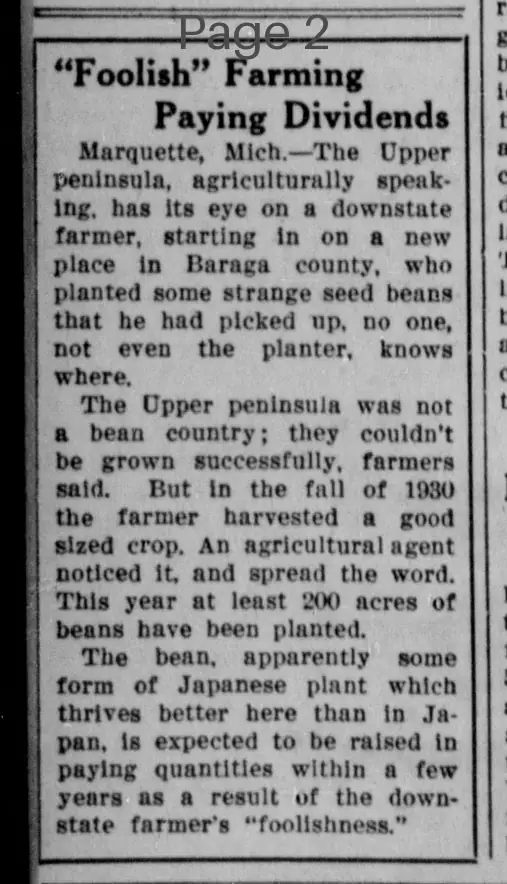
Marquette, Mich. - The Upper peninsula, agriculturally speaking, has its eye on a downstate farmer, starting in on a new place in Baraga county, who planted some strange seed beans that he had picked up, no one, not even the planter, knows where.
The Upper peninsula was not a bean country; they couldn't be grown successfully, farmers said.
But in the fall of 1930 the farmer harvested a good sized crop. An agricultural agent noticed it, and spread the word.
This year at least 200 acres of beans have been planted.
The bean, apparently some form of Japanese plant which thrives better here than in Japan, is expected to be raised in paying quantities within a few years as a result of the downstate farmer's "foolishness."
What sub-type of article is it?
What keywords are associated?
Where did it happen?
Domestic News Details
Primary Location
Baraga County, Upper Peninsula, Michigan
Event Date
Fall Of 1930; This Year
Outcome
harvested a good sized crop in fall of 1930; at least 200 acres planted this year; expected to be raised in paying quantities within a few years
Event Details
A downstate farmer planted strange seed beans of unknown origin in Baraga county. Despite beliefs that beans could not be grown successfully in the Upper Peninsula, he harvested a good sized crop in fall of 1930. An agricultural agent noticed and spread the word. This year at least 200 acres of the beans, apparently some form of Japanese plant, have been planted.