Thank you for visiting SNEWPapers!
Sign up free
Story
July 4, 1821
Alexandria Gazette & Daily Advertiser
Alexandria, Virginia
What is this article about?
A letter from Missouri describes ancient artificial mounds near St. Louis along the Mississippi River, noting their variety, sizes, and speculating they are remnants of a great ancient city with temples and monuments.
Clipping
OCR Quality
98%
Excellent
Full Text
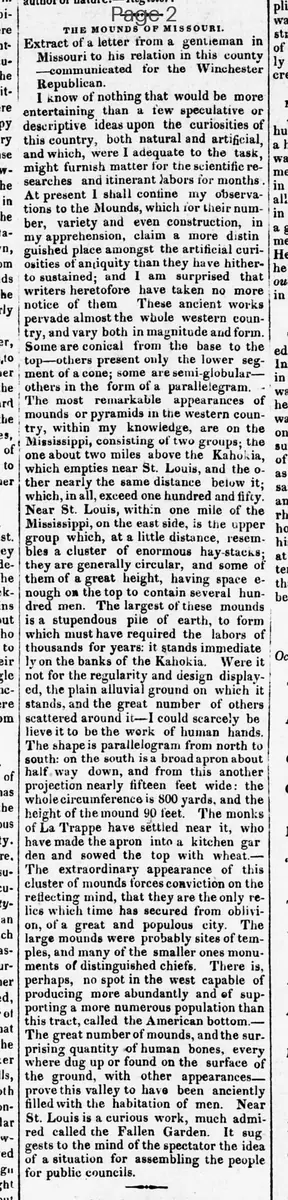
THE MOUNDS OF MISSOURI.
Extract of a letter from a gentleman in
Missouri to his relation in this county
communicated for the Winchester
Republican.
I know of nothing that would be more
entertaining than a few speculative or
descriptive ideas upon the curiosities of
this country, both natural and artificial.
and which, were I adequate to the task.
might furnish matter for the scientific researches and itinerant labors for months.
At present I shall confine my observations to the Mounds, which for their number, variety and even construction, in
my apprehension, claim a more distinguished place amongst the artificial curiosities of antiquity than they have hitherto
sustained; and I am surprised that
writers heretofore have taken no more
notice of them These ancient works
pervade almost the whole western country, and vary both in magnitude and form.
Some are conical from the base to the
top—others present only the lower segment of a cone; some are semi-globular—
others in the form of a parallelogram. -
The most remarkable appearances of
mounds or pyramids in the western country, within my knowledge, are on the
Mississippi, consisting of two groups; the
one about two miles above the Kaskaskia.
which empties near St. Louis, and the other nearly the same distance below it:
which, in all, exceed one hundred and fifty.
Near St. Louis, within one mile of the
Mississippi, on the east side, is the upper
group which, at a little distance, resembles a cluster of enormous hay-stacks;
they are generally circular, and some of
them of a great height, having space enough on the top to contain several hundred men. The largest of these mounds
is a stupendous pile of earth, to form
which must have required the labors of
thousands for years: it stands immediately on the banks of the Kaskaskia. Were it
not for the regularity and design displayed, the plain alluvial ground on which it
stands, and the great number of others
scattered around it--I could scarcely believe it to be the work of human hands.
The shape is parallelogram from north to
south: on the south is a broad apron about
half way down, and from this another
projection nearly fifteen feet wide: the
whole circumference is 800 yards, and the
height of the mound 90 feet. The monks
of La Trappe have settled near it, who
have made the apron into a kitchen garden and sowed the top with wheat.-
The extraordinary appearance of this
cluster of mounds forces conviction on the
reflecting mind, that they are the only remains which time has secured from oblivion, of a great and populous city. The
large mounds were probably sites of temples, and many of the smaller ones monuments of distinguished chiefs. There is,
perhaps, no spot in the west capable of
producing more abundantly and of supporting a more numerous population than
this tract, called the American bottom.-
The great number of mounds, and the surprising quantity of human bones, every
where dug up or found on the surface of
the ground, with other appearances-
proves this valley to have been anciently
filled with the habitations of men. Near
St. Louis is a curious work, much admired called the Fallen Garden. It suggests to the mind of the spectator the idea
of a situation for assembling the people
for public councils.
Extract of a letter from a gentleman in
Missouri to his relation in this county
communicated for the Winchester
Republican.
I know of nothing that would be more
entertaining than a few speculative or
descriptive ideas upon the curiosities of
this country, both natural and artificial.
and which, were I adequate to the task.
might furnish matter for the scientific researches and itinerant labors for months.
At present I shall confine my observations to the Mounds, which for their number, variety and even construction, in
my apprehension, claim a more distinguished place amongst the artificial curiosities of antiquity than they have hitherto
sustained; and I am surprised that
writers heretofore have taken no more
notice of them These ancient works
pervade almost the whole western country, and vary both in magnitude and form.
Some are conical from the base to the
top—others present only the lower segment of a cone; some are semi-globular—
others in the form of a parallelogram. -
The most remarkable appearances of
mounds or pyramids in the western country, within my knowledge, are on the
Mississippi, consisting of two groups; the
one about two miles above the Kaskaskia.
which empties near St. Louis, and the other nearly the same distance below it:
which, in all, exceed one hundred and fifty.
Near St. Louis, within one mile of the
Mississippi, on the east side, is the upper
group which, at a little distance, resembles a cluster of enormous hay-stacks;
they are generally circular, and some of
them of a great height, having space enough on the top to contain several hundred men. The largest of these mounds
is a stupendous pile of earth, to form
which must have required the labors of
thousands for years: it stands immediately on the banks of the Kaskaskia. Were it
not for the regularity and design displayed, the plain alluvial ground on which it
stands, and the great number of others
scattered around it--I could scarcely believe it to be the work of human hands.
The shape is parallelogram from north to
south: on the south is a broad apron about
half way down, and from this another
projection nearly fifteen feet wide: the
whole circumference is 800 yards, and the
height of the mound 90 feet. The monks
of La Trappe have settled near it, who
have made the apron into a kitchen garden and sowed the top with wheat.-
The extraordinary appearance of this
cluster of mounds forces conviction on the
reflecting mind, that they are the only remains which time has secured from oblivion, of a great and populous city. The
large mounds were probably sites of temples, and many of the smaller ones monuments of distinguished chiefs. There is,
perhaps, no spot in the west capable of
producing more abundantly and of supporting a more numerous population than
this tract, called the American bottom.-
The great number of mounds, and the surprising quantity of human bones, every
where dug up or found on the surface of
the ground, with other appearances-
proves this valley to have been anciently
filled with the habitations of men. Near
St. Louis is a curious work, much admired called the Fallen Garden. It suggests to the mind of the spectator the idea
of a situation for assembling the people
for public councils.
What sub-type of article is it?
Curiosity
Historical Event
Extraordinary Event
What themes does it cover?
Exploration
What keywords are associated?
Mounds
Missouri
Ancient Works
St Louis
Mississippi
American Bottom
Kaskaskia
What entities or persons were involved?
Monks Of La Trappe
Where did it happen?
Near St. Louis, Missouri, On The Mississippi River
Story Details
Key Persons
Monks Of La Trappe
Location
Near St. Louis, Missouri, On The Mississippi River
Event Date
Antiquity
Story Details
Description of various ancient mounds in Missouri, their shapes and sizes, with speculation that they are remains of a populous ancient city including temples and monuments for chiefs, evidenced by human bones and fertile land.