Thank you for visiting SNEWPapers!
Sign up free
Editorial
March 4, 1865
The Shasta Courier
Shasta, Shasta County, California
What is this article about?
The editorial praises the London Spectator's insightful articles on the US Presidential election, quoting its analysis of Lincoln's re-election as a victory for democracy over Southern aristocracy in the Civil War, emphasizing commitment to freedom despite hardships.
Clipping
OCR Quality
98%
Excellent
Full Text
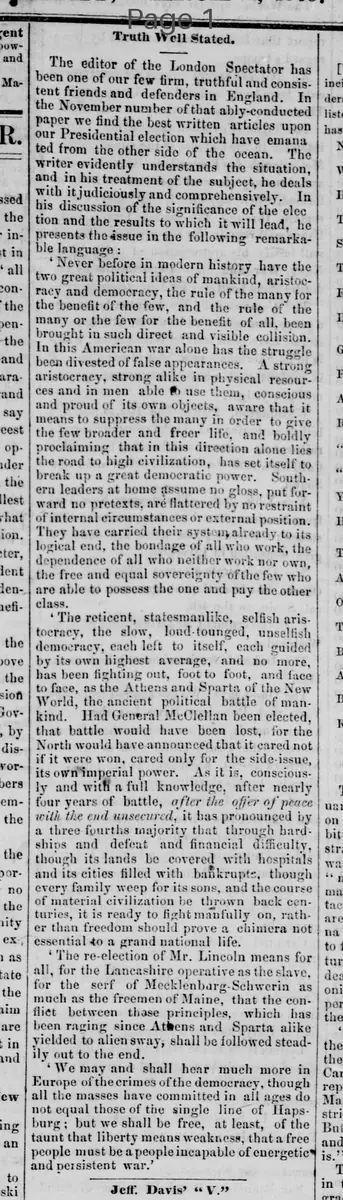
Truth Well Stated,
The editor of the London Spectator has been one of our few firm, truthful and consistent friends and defenders in England. In the November number of that ably-conducted paper we find the best written articles upon our Presidential election which have emanated from the other side of the ocean. The writer evidently understands the situation, and in his treatment of the subject, he deals with it judiciously and comprehensively. In his discussion of the significance of the election and the results to which it will lead, he presents the issue in the following remarkable language:
'Never before in modern history have the two great political ideas of mankind, aristocracy and democracy, the rule of the many for the benefit of the few, and the rule of the many or the few for the benefit of all, been brought in such direct and visible collision. In this American war alone has the struggle been divested of false appearances. A strong aristocracy, strong alike in physical resources and in men able to use them, conscious and proud of its own objects, aware that it means to suppress the many in order to give the few broader and freer life, and boldly proclaiming that in this direction alone lies the road to high civilization, has set itself to break up a great democratic power. Southern leaders at home assume no gloss, put forward no pretexts, are flattered by no restraint of internal circumstances or external position. They have carried their system already to its logical end, the bondage of all who work, the dependence of all who neither work nor own, the free and equal sovereignty of the few who are able to possess the one and pay the other class. The reticent, statesmanlike, selfish aristocracy, the slow, loud-tongued, unselfish democracy, each left to itself, each guided by its own highest average, and no more, has been fighting out, foot to foot, and face to face, as the Athens and Sparta of the New World, the ancient political battle of mankind. Had General McClellan been elected, that battle would have been lost, for the North would have announced that it cared not if it were won, cared only for the side-issue, its own imperial power. As it is, consciously and with a full knowledge, after nearly four years of battle, after the offer of peace with the end unsecured, it has pronounced by a three fourths majority that through hardships and defeat and financial difficulty, though its lands be covered with hospitals and its cities filled with bankrupts, though every family weep for its sons, and the course of material civilization be thrown back centuries, it is ready to fight manfully on, rather than freedom should prove a chimera not essential to a grand national life. The re-election of Mr. Lincoln means for all, for the Lancashire operative as the slave, for the serf of Mecklenburg-Schwerin as much as the freemen of Maine, that the conflict between those principles, which has been raging since Athens and Sparta alike yielded to alien sway, shall be followed steadily out to the end.
We may and shall hear much more in Europe of the crimes of the democracy, though all the masses have committed in all ages do not equal those of the single line of Hapsburg; but we shall be free, at least, of the taunt that liberty means weakness, that a free people must be a people incapable of energetic and persistent war.'
The editor of the London Spectator has been one of our few firm, truthful and consistent friends and defenders in England. In the November number of that ably-conducted paper we find the best written articles upon our Presidential election which have emanated from the other side of the ocean. The writer evidently understands the situation, and in his treatment of the subject, he deals with it judiciously and comprehensively. In his discussion of the significance of the election and the results to which it will lead, he presents the issue in the following remarkable language:
'Never before in modern history have the two great political ideas of mankind, aristocracy and democracy, the rule of the many for the benefit of the few, and the rule of the many or the few for the benefit of all, been brought in such direct and visible collision. In this American war alone has the struggle been divested of false appearances. A strong aristocracy, strong alike in physical resources and in men able to use them, conscious and proud of its own objects, aware that it means to suppress the many in order to give the few broader and freer life, and boldly proclaiming that in this direction alone lies the road to high civilization, has set itself to break up a great democratic power. Southern leaders at home assume no gloss, put forward no pretexts, are flattered by no restraint of internal circumstances or external position. They have carried their system already to its logical end, the bondage of all who work, the dependence of all who neither work nor own, the free and equal sovereignty of the few who are able to possess the one and pay the other class. The reticent, statesmanlike, selfish aristocracy, the slow, loud-tongued, unselfish democracy, each left to itself, each guided by its own highest average, and no more, has been fighting out, foot to foot, and face to face, as the Athens and Sparta of the New World, the ancient political battle of mankind. Had General McClellan been elected, that battle would have been lost, for the North would have announced that it cared not if it were won, cared only for the side-issue, its own imperial power. As it is, consciously and with a full knowledge, after nearly four years of battle, after the offer of peace with the end unsecured, it has pronounced by a three fourths majority that through hardships and defeat and financial difficulty, though its lands be covered with hospitals and its cities filled with bankrupts, though every family weep for its sons, and the course of material civilization be thrown back centuries, it is ready to fight manfully on, rather than freedom should prove a chimera not essential to a grand national life. The re-election of Mr. Lincoln means for all, for the Lancashire operative as the slave, for the serf of Mecklenburg-Schwerin as much as the freemen of Maine, that the conflict between those principles, which has been raging since Athens and Sparta alike yielded to alien sway, shall be followed steadily out to the end.
We may and shall hear much more in Europe of the crimes of the democracy, though all the masses have committed in all ages do not equal those of the single line of Hapsburg; but we shall be free, at least, of the taunt that liberty means weakness, that a free people must be a people incapable of energetic and persistent war.'
What sub-type of article is it?
Partisan Politics
War Or Peace
Slavery Abolition
What keywords are associated?
Presidential Election
Lincoln Re Election
Civil War
Democracy Vs Aristocracy
Southern Slavery
Northern Commitment
What entities or persons were involved?
London Spectator Editor
General Mcclellan
Mr. Lincoln
Southern Leaders
Editorial Details
Primary Topic
Analysis Of Lincoln's Re Election And Its Significance For Democracy Vs Aristocracy In The Civil War
Stance / Tone
Supportive Of Lincoln's Re Election And Democracy, Praising The London Spectator's Truthful Perspective
Key Figures
London Spectator Editor
General Mcclellan
Mr. Lincoln
Southern Leaders
Key Arguments
The Us Election Pits Aristocracy (South) Against Democracy (North) Directly.
Southern Aristocracy Seeks To Suppress The Many For The Benefit Of The Few.
Lincoln's Re Election Commits The North To Fight On For Freedom Despite Hardships.
Mcclellan's Election Would Have Prioritized Northern Imperial Power Over The Democratic Cause.
The Conflict Revives The Ancient Battle Between Athens And Sparta As New World Aristocracy And Democracy.
Re Election Affirms That Liberty Does Not Mean Weakness In War.