Thank you for visiting SNEWPapers!
Sign up free
The Alaska Daily Empire
Juneau, Alaska
What is this article about?
Col. Alfred H. Brooks, chief Alaskan geologist, plans 24th visit to Alaska in August 1924 to oversee Geological Survey work. The Survey marks 26 years of mapping over one-third of Alaska's area, investigating mining districts, and publishing reports. Eight parties active this year across regions, focusing on topography, geology, minerals, coal, and petroleum.
Clipping
OCR Quality
Full Text
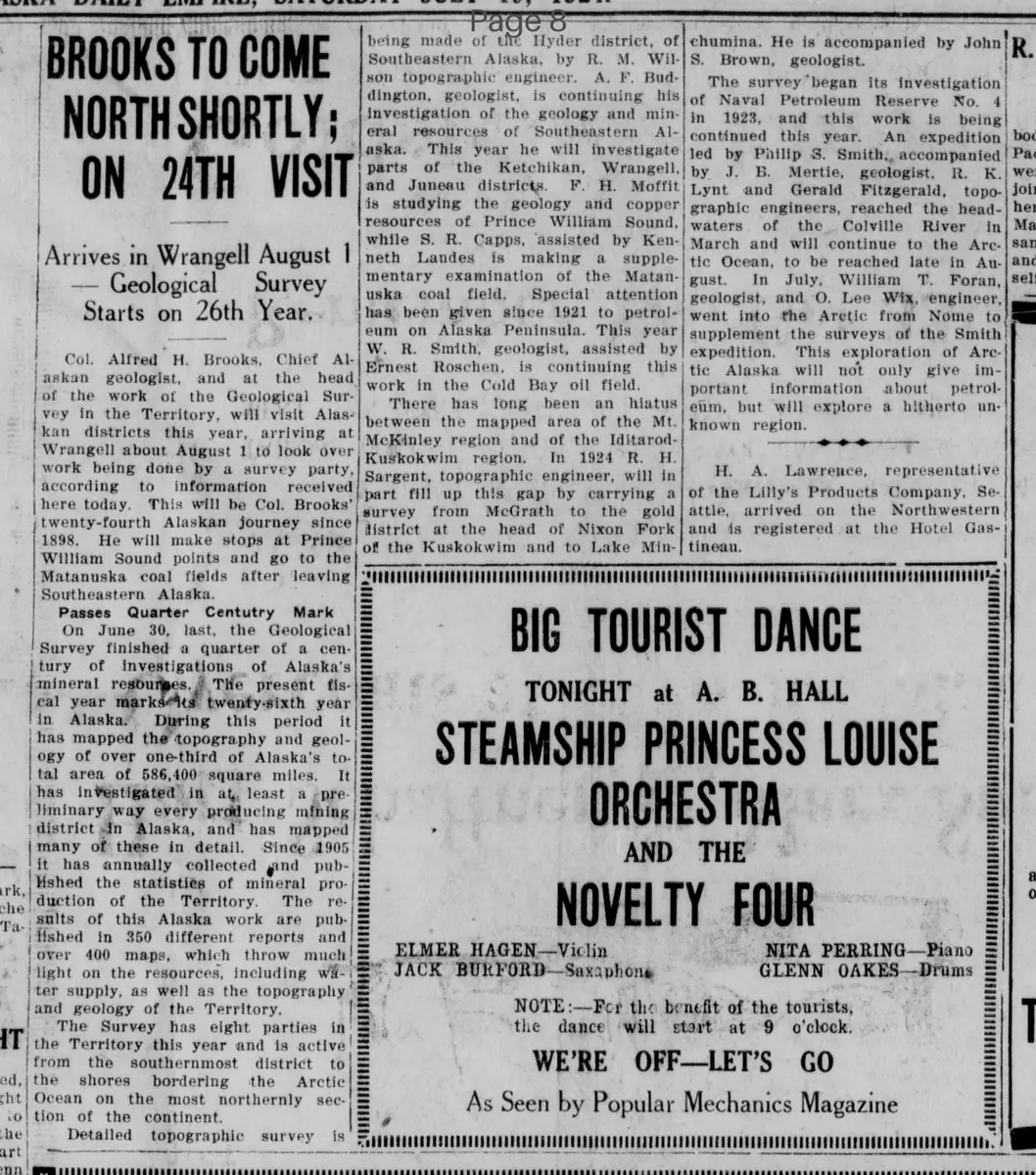
Arrives in Wrangell August Geological Survey Starts on 26th Year.
Col. Alfred H. Brooks, Chief Alaskan geologist, and at the head of the work of the Geological Survey in the Territory, will visit Alaskan districts this year, arriving at Wrangell about August 1 to look over work being done by a survey party, according to information received here today. This will be Col. Brooks' twenty-fourth Alaskan journey since 1898. He will make stops at Prince William Sound points and go to the Matanuska coal fields after leaving Southeastern Alaska.
Passes Quarter Century Mark
On June 30 last, the Geological Survey finished a quarter of a century of investigations of Alaska's mineral resources. The present fiscal year marks its twenty-sixth year in Alaska. During this period it has mapped the topography and geology of over one-third of Alaska's total area of 586,400 square miles. It has investigated in at least a preliminary way every producing mining district in Alaska, and has mapped many of these in detail. Since 1905 it has annually collected and published the statistics of mineral production of the Territory. The results of this Alaska work are published in 350 different reports and over 400 maps, which throw much light on the resources, including water supply, as well as the topography and geology of the Territory.
The Survey has eight parties in the Territory this year and is active from the southernmost district to the shores bordering the Arctic Ocean on the most northerly section of the continent.
Detailed topographic survey is
being made of the Hyder district of Southeastern Alaska, by R. M. Wilson topographic engineer. A. F. Buddington, geologist, is continuing his investigation of the geology and mineral resources of Southeastern Alaska. This year he will investigate parts of the Ketchikan, Wrangell, and Juneau districts. F. H. Moffit is studying the geology and copper resources of Prince William Sound, while S. R. Capps, assisted by Kenneth Landes is making a supplementary examination of the Matanuska coal field. Special attention has been given since 1921 to petroleum on Alaska Peninsula. This year W. R. Smith, geologist, assisted by Ernest Roschen, is continuing this work in the Cold Bay oil field.
There has long been an hiatus between the mapped area of the Mt. McKinley region and of the Iditarod-Kuskokwim region. In 1924 R. H. Sargent, topographic engineer, will in part fill up this gap by carrying a survey from McGrath to the gold district at the head of Nixon Fork of the Kuskokwim and to Lake Minchumina. He is accompanied by John S. Brown, geologist.
The survey began its investigation of Naval Petroleum Reserve No. 4 in 1923, and this work is being continued this year. An expedition led by Philip S. Smith, accompanied by J. B. Mertie, geologist, R. K. Lynt and Gerald Fitzgerald, topographic engineers, reached the headwaters of the Colville River in March and will continue to the Arctic Ocean, to be reached late in August. In July, William T. Foran, geologist, and O. Lee Wix, engineer, went into the Arctic from Nome to supplement the surveys of the Smith expedition.
This exploration of Arctic Alaska will not only give important information about petroleum, but will explore a hitherto unknown region.
What sub-type of article is it?
What themes does it cover?
What keywords are associated?
What entities or persons were involved?
Where did it happen?
Story Details
Key Persons
Location
Alaska
Event Date
1924
Story Details
Col. Brooks to visit Wrangell in August for 24th Alaskan journey since 1898, inspecting survey parties in Southeastern Alaska, Prince William Sound, and Matanuska coal fields. Geological Survey completes 25 years, mapping one-third of Alaska, investigating mining districts, and publishing reports. Eight parties this year survey topography, geology, minerals, coal, and petroleum across Alaska to Arctic.