Thank you for visiting SNEWPapers!
Sign up free
The Daily Worker
Chicago, Cook County, Illinois
What is this article about?
Report on Moscow's informal neighborhood courts in the Soviet Union, where residents resolve petty disputes to promote socialization, fining offenders to fund cultural activities like literacy classes, as exemplified by a laundry quarrel case.
Clipping
OCR Quality
Full Text
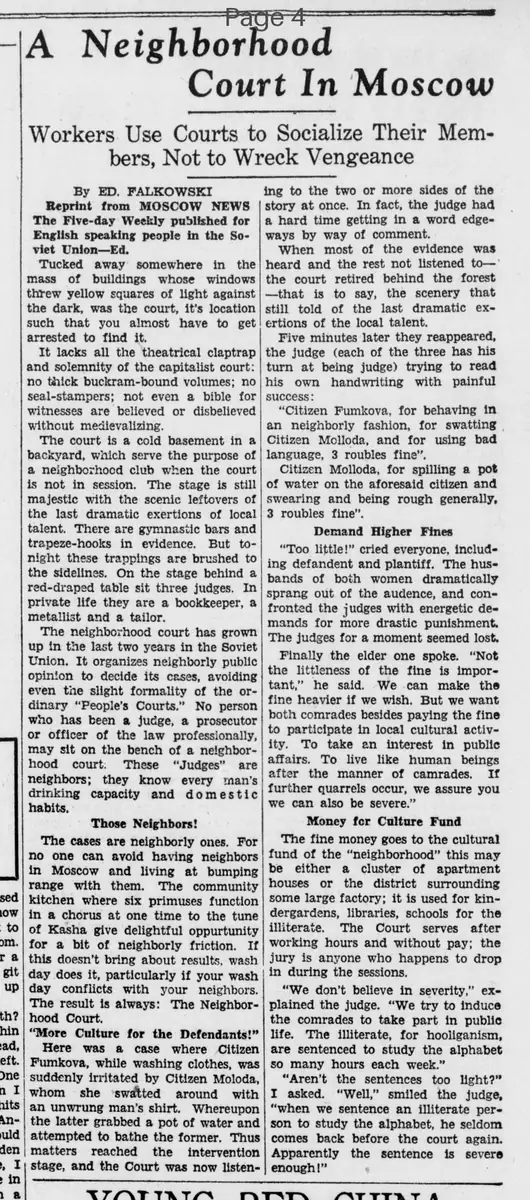
Court In Moscow
Workers Use Courts to Socialize Their Members.
Not to Wreck Vengeance
By ED. FALKOWSKI
Reprint from MOSCOW NEWS
The Five-day Weekly published for
English speaking people in the So-
viet Union—Ed.
Tucked away somewhere in the
mass of buildings whose windows
threw yellow squares of light against
the dark, was the court, its location
such that you almost have to get
arrested to find it.
It lacks all the theatrical claptrap
and solemnity of the capitalist court:
no thick buckram-bound volumes; no
seal-stampers; not even a bible for
witnesses are believed or disbelieved
without medievalizing.
The court is a cold basement in a
backyard, which serves the purpose of
a neighborhood club when the court
is not in session. The stage is still
majestic with the scenic leftovers of
the last dramatic exertions of local
talent. There are gymnastic bars and
trapeze-hooks in evidence. But to-
night these trappings are brushed to
the sidelines. On the stage behind a
red-draped table sit three judges. In
private life they are a bookkeeper, a
metallist and a tailor.
The neighborhood court has grown
up in the last two years in the Soviet
Union. It organizes neighborly public
opinion to decide its cases, avoiding
even the slight formality of the or-
dinary "People's Courts." No person
who has been a judge, a prosecutor
or officer of the law professionally,
may sit on the bench of a neighbor-
hood court. These "Judges" are
neighbors; they know every man's
drinking capacity and domestic
habits.
Those Neighbors!
The cases are neighborly ones. For
no one can avoid having neighbors
in Moscow and living at bumping
range with them. The community
kitchen where six primuses function
in a chorus at one time to the tune
of Kasha give delightful opportunity
for a bit of neighborly friction. If
this doesn't bring about results, wash
day does it, particularly if your wash
day conflicts with your neighbors.
The result is always: The Neighbor-
hood Court.
"More Culture for the Defendants!"
Here was a case where Citizen
Fumkova, while washing clothes, was
suddenly irritated by Citizen Moloda,
whom she swatted around with
an unwrung man's shirt. Whereupon
the latter grabbed a pot of water and
attempted to bathe the former. Thus
matters reached the intervention
stage, and the Court was now listen-
ing to the two or more sides of the
story at once. In fact, the judge had
a hard time getting in a word edge-
ways by way of comment.
When most of the evidence was
heard and the rest not listened to—
the court retired behind the forest
—that is to say, the scenery that
still told of the last dramatic ex-
ertions of the local talent.
Five minutes later they reappeared,
the judge (each of the three has his
turn at being judge) trying to read
his own handwriting with painful
success:
"Citizen Fumkova. for behaving in
an unneighborly fashion, for swatting
Citizen Moloda, and for using bad
language, 3 roubles fine"
Citizen Moloda, for spilling a pot
of water on the aforesaid citizen and
swearing and being rough generally.
3 roubles fine".
Demand Higher Fines
"Too little!" cried everyone. includ-
ing defendant and plaintiff. The hus-
bands of both women dramatically
sprang out of the audience, and con-
fronted the judges with energetic de-
mands for more drastic punishment.
The judges for a moment seemed lost.
Finally the elder one spoke. "Not
the littleness of the fine is impor-
tant," he said. We can make the
fine heavier if we wish. But we want
both comrades besides paying the fine
to participate in local cultural actiy-
ity. To take an interest in public
affairs. To live like human beings
after the manner of comrades.
If
further quarrels occur, we assure you
we can also be severe."
Money for Culture Fund
The fine money goes to the cultural
fund of the "neighborhood" this may
be either a cluster of apartment
houses or the district surrounding
some large factory; it is used for kin-
dergardens, libraries, schools for the
illiterate. The Court serves after
working hours and without pay; the
jury is anyone who happens to drop
in during the sessions.
"We don't believe in severity," ex-
plained the judge. "We try to induce
the comrades to take part in public
life. The illiterate, for hooliganism,
are sentenced to study the alphabet
so many hours each week."
"Aren't the sentences too light?"
I asked. "Well," smiled the judge,
"when we sentence an illiterate per-
son to study the alphabet, he seldom
comes back before the court again.
Apparently the sentence is severe
enough!"
What sub-type of article is it?
What keywords are associated?
Where did it happen?
Foreign News Details
Primary Location
Moscow
Outcome
fines of 3 roubles each for citizen fumkova and citizen moloda, plus required participation in local cultural activities
Event Details
Description of a neighborhood court in Moscow, Soviet Union, where local residents serve as judges to resolve minor disputes like neighborly quarrels over washing clothes. The court operates in a community space, emphasizes socialization and cultural improvement over punishment, with fines directed to a cultural fund for kindergartens, libraries, and literacy programs. Example case involves two women fined for fighting and using bad language, with husbands demanding harsher penalties, but judges prioritize community involvement.