Thank you for visiting SNEWPapers!
Sign up free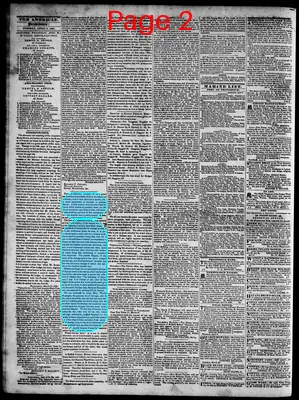
Story
April 5, 1831
Rhode Island American And Gazette
Providence, Providence County, Rhode Island
What is this article about?
An essay critiquing society's overemphasis on women's physical beauty over intellectual merits, using historical examples like Sappho, Madame de Stael, and Lady Mary Wortley Montague to illustrate the personal and social toll of this bias.
Clipping
OCR Quality
98%
Excellent
Full Text
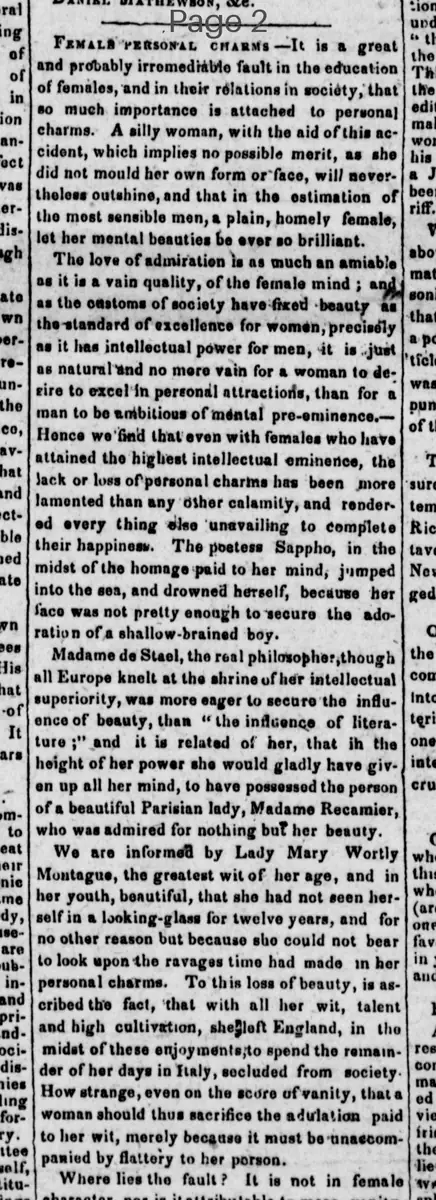
Females Personal Charms--It is a great and probably irremediable fault in the education of females, and in their relations in society, that so much importance is attached to personal charms. A silly woman, with the aid of this accident, which implies no possible merit, as she did not mould her own form or face, will nevertheless outshine, and that in the estimation of the most sensible men, a plain, homely female, let her mental beauties be ever so brilliant.
The love of admiration is as much an amiable as it is a vain quality, of the female mind; and as the customs of society have fixed beauty as the standard of excellence for women, precisely as it has intellectual power for men, it is just as natural and no more vain for a woman to desire to excel in personal attractions, than for a man to be ambitious of mental pre-eminence.
Hence we find that even with females who have attained the highest intellectual eminence, the lack or loss of personal charms has been more lamented than any other calamity, and rendered every thing else unavailing to complete their happiness. The poetess Sappho, in the midst of the homage paid to her mind; jumped into the sea, and drowned herself, because her face was not pretty enough to secure the adoration of a shallow-brained boy.
Madame de Stael, the real philosopher, though all Europe knelt at the shrine of her intellectual superiority, was more eager to secure the influence of beauty, than "the influence of literature;" and it is related of her, that in the height of her power she would gladly have given up all her mind, to have possessed the person of a beautiful Parisian lady, Madame Recamier, who was admired for nothing but her beauty.
We are informed by Lady Mary Wortley Montague, the greatest wit of her age, and in her youth, beautiful, that she had not seen herself in a looking-glass for twelve years, and for no other reason but because she could not bear to look upon the ravages time had made in her personal charms. To this loss of beauty, is ascribed the fact, that with all her wit, talent and high cultivation, she left England, in the midst of these enjoyments, to spend the remainder of her days in Italy, secluded from society.
How strange, even on the score of vanity, that a woman should thus sacrifice the adulation paid to her wit, merely because it must be unaccompanied by flattery to her person.
Where lies the fault? It is not in female character, nor is it attributable to more vanity. It lies deeper in the forms and habits of society. Let the world show that they prefer sense to beauty in a woman, and it would be the want of the former, and not of the latter, that would render existence intolerable.
The love of admiration is as much an amiable as it is a vain quality, of the female mind; and as the customs of society have fixed beauty as the standard of excellence for women, precisely as it has intellectual power for men, it is just as natural and no more vain for a woman to desire to excel in personal attractions, than for a man to be ambitious of mental pre-eminence.
Hence we find that even with females who have attained the highest intellectual eminence, the lack or loss of personal charms has been more lamented than any other calamity, and rendered every thing else unavailing to complete their happiness. The poetess Sappho, in the midst of the homage paid to her mind; jumped into the sea, and drowned herself, because her face was not pretty enough to secure the adoration of a shallow-brained boy.
Madame de Stael, the real philosopher, though all Europe knelt at the shrine of her intellectual superiority, was more eager to secure the influence of beauty, than "the influence of literature;" and it is related of her, that in the height of her power she would gladly have given up all her mind, to have possessed the person of a beautiful Parisian lady, Madame Recamier, who was admired for nothing but her beauty.
We are informed by Lady Mary Wortley Montague, the greatest wit of her age, and in her youth, beautiful, that she had not seen herself in a looking-glass for twelve years, and for no other reason but because she could not bear to look upon the ravages time had made in her personal charms. To this loss of beauty, is ascribed the fact, that with all her wit, talent and high cultivation, she left England, in the midst of these enjoyments, to spend the remainder of her days in Italy, secluded from society.
How strange, even on the score of vanity, that a woman should thus sacrifice the adulation paid to her wit, merely because it must be unaccompanied by flattery to her person.
Where lies the fault? It is not in female character, nor is it attributable to more vanity. It lies deeper in the forms and habits of society. Let the world show that they prefer sense to beauty in a woman, and it would be the want of the former, and not of the latter, that would render existence intolerable.
What sub-type of article is it?
Social Essay
Gender Critique
What themes does it cover?
Social Manners
Misfortune
Moral Virtue
What keywords are associated?
Women Beauty
Intellectual Women
Societal Norms
Personal Charms
Female Vanity
Historical Examples
What entities or persons were involved?
Sappho
Madame De Stael
Madame Recamier
Lady Mary Wortley Montague
Where did it happen?
Society
Story Details
Key Persons
Sappho
Madame De Stael
Madame Recamier
Lady Mary Wortley Montague
Location
Society
Story Details
Critiques societal emphasis on women's beauty over intellect, citing Sappho's suicide, de Stael's envy of Recamier's beauty, and Montague's withdrawal from society due to aging.