Thank you for visiting SNEWPapers!
Sign up free
Richmond Whig
Richmond, Virginia
What is this article about?
In Alexandria on April 10, 1865, two crowded mass meetings celebrated Gen. Lee's surrender to Gen. Grant, ending the Civil War. Speakers including Gov. Pierpont and Col. Wells lauded Union triumphs, heroism, and future peace. Resolutions thanked the military and expressed national unity hopes.
Clipping
OCR Quality
Full Text
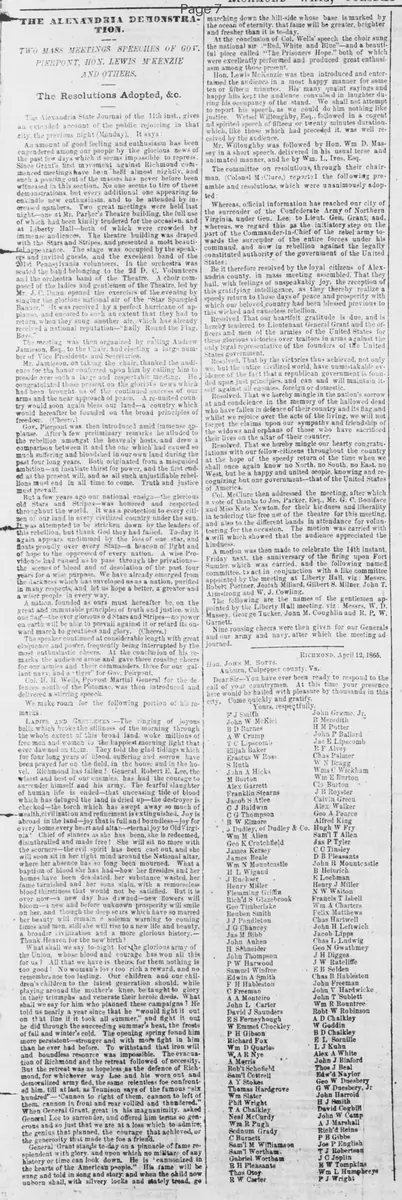
TWO MASS MEETINGS SPEECHES OF GOV. PIERPONT, COL. LEWIS M'KENZIE AND OTHERS.
The Resolutions Adopted, &c.
The Alexandria State Journal of the 11th inst., gives an extended account of the public rejoicing in that city the previous night (Monday). It says:
An amount of good feeling and enthusiasm has been engendered among our people by the glorious news of the past few days which it seems impossible to repress.
Since Grant's first movement against Richmond commenced meetings have been held almost nightly, and such a pouring out of the masses has never before been witnessed in this section. No one seems to tire of these demonstrations, but every additional one appearing to enkindle new enthusiasm, and to be attended by increased numbers. Two great meetings were held last night—one at Mr. Parker's Theatre building, the full use of which had been kindly tendered for the occasion, and at Liberty Hall—both of which were crowded by immense audiences. The theatre building was draped with the Stars and Stripes, and presented a most beautiful appearance. The stage was occupied by the speakers and invited guests, and the excellent band of the 201 Pennsylvania volunteers. In the orchestra was seated the band belonging to the 2d D. C. Volunteers and the orchestra band of the Theatre. A choir composed of the ladies and gentlemen of the Theatre, led by Mr. J. C. Dunn opened the exercises of the evening by singing the glorious national air of the "Star Spangled Banner." It was received by a perfect hurricane of applause, and encored to such an extent that they had to return, when they sung another air, which has already received a national reputation—"Rally Round the Flag, Boys."
The meeting was then organized by calling Andrew Jamieson, Esq., to the chair, and electing a large number of Vice Presidents and Secretaries.
Mr. Jamieson, on taking the chair, thanked the audience for the honor conferred upon him by calling him to preside over such a large and respectable meeting. He congratulated those present on the glorious news which had been brought us of the continued success of our arms and the near approach of peace. A re-united country would soon again bless our land—a country which would hereafter be founded on the broad principles of freedom. (Cheers.)
Gov. Pierpont was then introduced amid immense applause. After a few preliminary remarks he alluded to the rebellion amongst the heavenly hosts, and drew a comparison between it and the one which had caused so much suffering and bloodshed in our own land during the past four long years. Both originated from a misguided ambition—an insatiate thirst for power, and the first ended as the present will, and as all such unjustifiable rebellions must end in all time to come. Truth and justice must prevail.
But a few years ago our national ensign—the glorious old Stars and Stripes—was honored and respected throughout the world. It was a protection to every citizen of our land in every civilized country under the sun. It was attempted to be stricken down by the leaders of this rebellion, but thank God they had failed. To-day it again appears undimmed by the loss of one star, and floats proudly over every State—a beacon of light and of hope to the oppressed of every nation. A wise Providence had caused us to pass through the privations—the scenes of blood and of desolation of the past four years for a wise purpose. We have already emerged from the darkness which has enveloped us as a nation, purified in many respects, and let us hope a better, a greater and a wiser people in every way.
A nation founded as ours must hereafter be, on the great and immutable principles of truth and justice, with one flag—the ever glorious old Stars and Stripes—no power on earth will be able to prevail against it or retard its onward march to greatness and glory. (Cheers.)
The speaker continued at considerable length with great eloquence and power, frequently being interrupted by the most enthusiastic cheers. At the conclusion of his remarks the audience arose and gave three rousing cheers for our armies and their commanders, three for our gallant navy, and a "tiger" for Gov. Pierpont.
Col. I. H. Wells, Provost Marshal General for the defenses south of the Potomac, was then introduced and delivered a stirring speech.
We make room for the following portion of his remarks.
LADIES AND GENTLEMEN—The ringing of joyous bells which broke the stillness of the morning through the whole extent of this broad land, woke millions of free men and women to the happiest morning light that ever dawned on them. They told the glad tidings which for four long years of blood, suffering and sorrow have been prayed for on the field, in the house and in the hovel. Richmond has fallen! General Robert E. Lee, the noblest and best of our enemies, has had the courage to surrender himself and his army. The fearful slaughter of human life is ended—that unceasing tide of blood which has deluged the land is dried up—the destroyer is checked—the torch which has swept away so much of wealth, civilization and refinement is extinguished. Joy is abroad in the land—joy that is full and boundless—joy for every home, every heart and altar—eternal joy to Old Virginia! Chief of sinners as she has been, she is redeemed, disinthralled and made free! She will sit no more with the scorners—the evil spirit has been cast out, and she will soon sit in her right mind around the National altar, where her absence has so long been mourned. What a baptism of blood she has had—how her firesides and her homes have been desolated, her substance wasted, her fame tarnished and her sons slain, with a remorseless blood thirstiness that would not be satisfied. But it is over now—a new day has dawned—new flowers will bloom—a new and before unknown prosperity will smile on her, and though the deep scars which have so marred her beauty will remain a solemn warning to coming times and men, still she will rise to a new life and beauty, a broader civilization and a more glorious history.—Thank Heaven for the new birth!
What shall we say to-night for the glorious army of the Union, whose blood and courage has won all this for us? All that we have is theirs; for them nothing is too good! No woman's love too rich a reward, and no remembrance too lasting. Our children and our children's children to the latest generation should, while playing around the mother's knee, be taught to glory in their triumphs and venerate their heroic deeds. What shall we say for him who planned these campaigns? He told us nearly a year since that he "would fight it out on that line if it took all summer," and fight it out he did through the succeeding summer's heat, the frosts of fall and winter's cold. The opening spring found him more persistent—stronger and with more fight in him than he ever had before. To withstand that iron will and boundless resource was impossible. The evacuation of Richmond and the retreat followed of necessity. But the retreat was as hopeless as the defence of Richmond, for whichever way Lee and his worn out and demoralized army fled, the same relentless foe confronted him, till at last, as Tennyson says of the famous "six hundred"—"Cannon to right of them, cannon to left of them, cannon in front and rear vollied and thundered."
When General Grant, great in his magnanimity, asked General Lee to surrender, and offered him terms so generous and so just that we are at a loss which to admire; the genius that planned, the courage that achieved, or the generosity that made the foe a friend.
General Grant stands to-day on a pinnacle of fame resplendent with glory, and upon which no military of any history or time can look down. He is canonized in the hearts of the American people. His fame will be sung and told in song and story: and when the child now unborn shall, with silvery locks and stately tread, go marching down the hill-side whose base is marked by the ocean of eternity, that fame will be greater, brighter and fresher than it is to-day.
At the conclusion of Col. Wells' speech the choir sung the national air "Red, White and Blue"—and a beautiful piece called "The Prisoner's Hope," both of which were excellently performed and produced great enthusiasm among those present.
Hon. Lewis McKenzie was then introduced and entertained the audience in a most happy manner for some ten or fifteen minutes. His many quaint sayings and happy hits kept the audience convulsed in laughter during his occupancy of the stand. We shall not attempt to report his speech, as we could do him nothing like justice. Wetsel Willoughby, Esq., followed in a cogent and spirited speech of fifteen or twenty minutes duration, which, like those which had preceded it, was well received by the audience.
Mr. Willoughby was followed by Hon. Wm D. Massey in a short speech, delivered in his usual terse and animated manner, and he by Wm. L. Ives, Esq.
The committee on resolutions, through their chairman (Colonel McClure,) reported the following preamble and resolutions, which were unanimously adopted:
Whereas, official information has reached our city of the surrender of the Confederate Army of Northern Virginia, under Gen. Lee; to Lieut. Gen. Grant; and, whereas, we regard this as the initiatory step on the part of the Commander-in-Chief of the rebel army towards the surrender of the entire forces under his command, and now in rebellion against the legally constituted authority of the government of the United States;
Be it therefore resolved by the loyal citizens of Alexandria county, in mass meeting assembled, That they hail, with feelings of unspeakable joy, the reception of this gratifying intelligence, as they thereby realize a speedy return to those days of peace and prosperity with which our beloved country had been blessed previous to this wicked and causeless rebellion.
Resolved, That our heartfelt gratitude is due, and is hereby tendered to Lieutenant General Grant and the officers and men of the armies of the United States for these glorious victories over traitors in arms against the only legal representative of the founders of the United States government.
Resolved, That by the victories thus achieved, not only we, but the entire civilized world, have unmistakable evidence of the fact that a republican government is founded upon just principles, and can and will maintain itself against all enemies, foreign or domestic.
Resolved, That we hereby mingle in the nation's sorrow at and condolence in the memory of the hallowed dead who have fallen in defence of their country and its flag, and whilst we rejoice over the acts of the living, we will not forget the claims upon our sympathy and friendship of the widows and orphans of those who have sacrificed their lives on the altar of their country.
Resolved, That we hereby mingle our hearty congratulations with our fellow-citizens throughout the country at the hope of the speedy return of the time when we shall once again know no North, no South, no East, no West, but be a happy and united people, knowing and recognizing but one government—that of the United States of America.
Col. McClure then addressed the meeting, after which a vote of thanks to Jos. Parker, Esq., Mr. G. C. Boniface and Miss Kate Newton, for their kindness and liberality in tendering the free use of the theatre for this meeting, and also to the different bands in attendance for volunteering for the occasion. The motion was carried with a will which showed that the audience appreciated the kindness.
A motion was then made to celebrate the 14th instant, Friday next, the anniversary of the firing upon Fort Sumter, which was carried, and the following named committee, to act in conjunction with a like committee appointed by the meeting at Liberty Hall, viz: Messrs. Robert Portner, Josiah Millard, Gilbert S. Milner, John T. Armstrong and W. J. Cowling.
The following are the names of the gentlemen appointed by the Liberty Hall meeting, viz: Messrs. W. D. Massey, George Tucker, John M. Coughlin and R. P. W. Garnett.
Nine rousing cheers were then given for our Generals and our army and navy, after which the meeting adjourned.
What sub-type of article is it?
What themes does it cover?
What keywords are associated?
What entities or persons were involved?
Where did it happen?
Story Details
Key Persons
Location
Alexandria
Event Date
April 10, 1865
Story Details
Two mass meetings in Alexandria celebrated the surrender of Gen. Lee's Confederate Army to Lt. Gen. Grant, marking the end of the Civil War. Speeches by Gov. Pierpont, Col. Wells, and others praised the Union victory, the armies' heroism, and the prospect of reunification and peace. Resolutions expressed gratitude to Grant and the troops, mourned the dead, and anticipated national unity. Plans were made for further celebrations on April 14.