Thank you for visiting SNEWPapers!
Sign up free
Rock Island Argus
Rock Island, Rock Island County County, Illinois
What is this article about?
In San Francisco on June 8, Judge McKisick argued for the government in the U.S. circuit court suit against the Leland Stanford estate over 1862 railroad debts and liabilities. The case threatens the closure of Leland Stanford University if the government wins.
Clipping
OCR Quality
Full Text
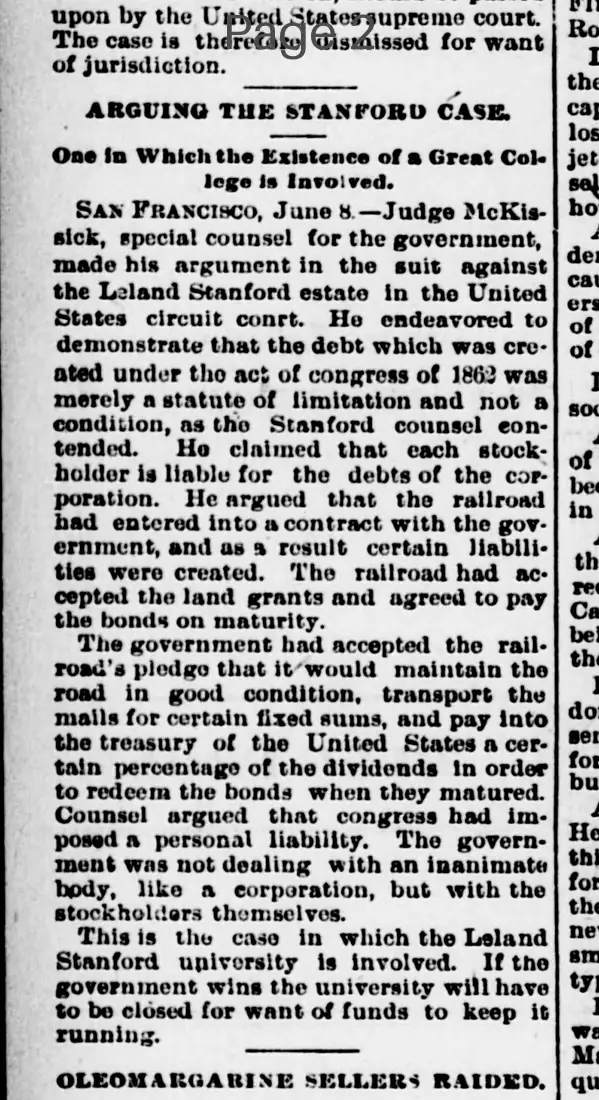
One in Which the Existence of a Great College is Involved.
San Francisco, June 8. - Judge McKisick, special counsel for the government, made his argument in the suit against the Leland Stanford estate in the United States circuit court. He endeavored to demonstrate that the debt which was created under the act of congress of 1862 was merely a statute of limitation and not a condition, as the Stanford counsel contended. He claimed that each stockholder is liable for the debts of the corporation. He argued that the railroad had entered into a contract with the government, and as a result certain liabilities were created. The railroad had accepted the land grants and agreed to pay the bonds on maturity.
The government had accepted the railroad's pledge that it would maintain the road in good condition, transport the mails for certain fixed sums, and pay into the treasury of the United States a certain percentage of the dividends in order to redeem the bonds when they matured. Counsel argued that congress had imposed a personal liability. The government was not dealing with an inanimate body, like a corporation, but with the stockholders themselves.
This is the case in which the Leland Stanford university is involved. If the government wins the university will have to be closed for want of funds to keep it running.
What sub-type of article is it?
What keywords are associated?
What entities or persons were involved?
Where did it happen?
Domestic News Details
Primary Location
San Francisco
Event Date
June 8
Key Persons
Outcome
if the government wins the university will have to be closed for want of funds to keep it running.
Event Details
Judge McKisick, special counsel for the government, made his argument in the suit against the Leland Stanford estate in the United States circuit court. He endeavored to demonstrate that the debt which was created under the act of congress of 1862 was merely a statute of limitation and not a condition, as the Stanford counsel contended. He claimed that each stockholder is liable for the debts of the corporation. He argued that the railroad had entered into a contract with the government, and as a result certain liabilities were created. The railroad had accepted the land grants and agreed to pay the bonds on maturity. The government had accepted the railroad's pledge that it would maintain the road in good condition, transport the mails for certain fixed sums, and pay into the treasury of the United States a certain percentage of the dividends in order to redeem the bonds when they matured. Counsel argued that congress had imposed a personal liability. The government was not dealing with an inanimate body, like a corporation, but with the stockholders themselves. This is the case in which the Leland Stanford university is involved.