Thank you for visiting SNEWPapers!
Sign up free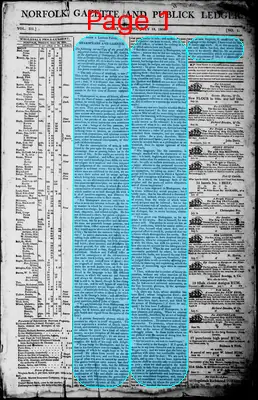
Norfolk Gazette And Publick Ledger
Norfolk, Virginia
What is this article about?
David Garrick's panegyrical oration at the Shakespeare Jubilee in Stratford-upon-Avon praises Shakespeare as the supreme poet of human nature, emphasizing his realistic portrayal of passions, originality, moral insights, and the delight derived from his works, concluding with reflections on mortality and the transience of fame.
Merged-components note: Merged sequential components continuing the same essay on Shakespeare and Garrick.
Clipping
OCR Quality
Full Text
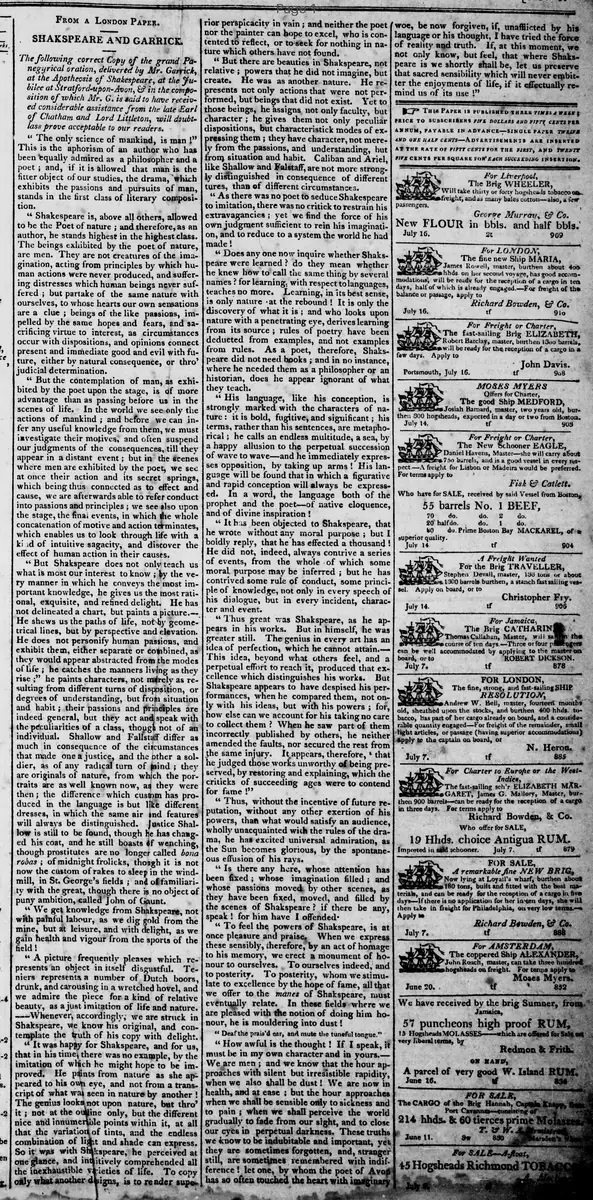
SHAKSPEARE AND GARRICK
The following correct Copy of the grand panegyrical oration, delivered by Mr. Garrick, at the Apotheosis of Shakespeare, at the Festival Jubilee at Stratford-upon-Avon, & in the composition of which Mr. G. is said to have received considerable assistance from the late Earl of Chatham and Lord Littleton, will doubtless prove acceptable to our readers.
“ The only science of mankind, is man!
This is the aphorism of an author who has been equally admired as a philosopher and a poet; and, if it is allowed that man is the fitter object of our studies, the drama, which exhibits the passions and pursuits of man, stands in the first class of literary composition.
Shakespeare is, above all others, allowed to be the Poet of nature: and therefore, as an author, he stands highest in the highest class.
The beings exhibited by the poet of nature, are men. They are not creatures of the imagination, acting from principles by which human actions were never produced, and suffering distresses which human beings never suffered; but partake of the same nature with ourselves, to whose hearts our own sensations are a clue; beings of the like passions, impelled by the same hopes and fears, and sacrificing virtue to interest, as circumstances occur with dispositions, and opinions connect present and immediate good and evil with future, either by natural consequence, or thro' judicial determination.
But the contemplation of man, as exhibited by the poet upon the stage, is of more advantage than as passing before us in the scenes of life. In the world we see only the actions of mankind; and before we can infer any useful knowledge from them, we must investigate their motives, and often suspend our judgments of the consequences, till they appear in a distant event; but in the scenes where men are exhibited by the poet, we see at once their action and its secret springs, which being thus connected as to effect and cause, we are afterwards able to refer conduct into passions and principles; we see also upon the stage, the final events, in which the whole concatenation of motive and action terminates, which enables us to look through life with a kind of intuitive sagacity, and discover the effect of human action in their causes.
But Shakspeare does not only teach us what is most our interest to know; by the very manner in which he conveys the most important knowledge, he gives us the most rational, exquisite, and refined delight. He has not delineated a chart, but paints a picture.–– He shews us the paths of life, not by geometrical lines, but by perspective and elevation.
He does not personify human passions, and exhibit them, either separate or combined, as they would appear abstracted from the modes of life; he catches the manners living as they rise; he paints characters, not merely as resulting from different turns of disposition, or degrees of understanding, but from situation and habit; their passions and principles are indeed general, but they act and speak with the peculiarities of a class, though not of an individual. Shallow and Falstaff differ as much in consequence of the circumstances that made one a justice, and the other a soldier, as of any radical turn of mind; they are originals of nature, from which the portraits are as well known now, as they were then; the difference which custom has produced in the language is but like different dresses, in which the same air and features will always be distinguished. Justice Shallow is still to be found, though he has changed his coat, and he still boasts of wenching, though prostitutes are no longer called bona robas; of midnight frolicks, though it is not now the custom of rakes to sleep in the wind-mill, in St. George's fields; and of familiarity with the great, though there is no object of puny ambition, called John of Gaunt.
We get knowledge from Shakspeare, not with painful labour, as we dig gold from the mine, but at leisure, and with delight, as we gain health and vigour from the sports of the field!
A picture frequently pleases which represents an object in itself disgustful. Teniers represents a number of Dutch boors, drunk, and carousing in a wretched hovel, and we admire the piece for a kind of relative beauty, as a just imitation of life and nature.–– Whenever, accordingly, we are struck in Shakspeare, we know his original, and contemplate the truth of his copy with delight.
It was happy for Shakspeare, and for us, that in his time, there was no example, by the imitation of which he might hope to be improved. He paints from nature as she appeared to his own eye, and not from a transcript of what was seen in nature by another!
The genius looks not upon nature, but thro' it; not at the outline only, but the different nice and innumerable points within it, at all that the variation of tints, and the endless combination of light and shade can express.
So it was with Shakspeare, he perceived at one glance, and intuitively comprehended all the inexhaustible varieties of life. To copy only what another designs, is to render superior perspicacity in vain; and neither the poet nor the painter can hope to excel, who is contented to reflect, or to seek for nothing in nature which others have not found.
But there are beauties in Shakspeare, not relative; powers that he did not imagine, but create. He was as another nature. He represents not only actions that were not performed, but beings that did not exist. Yet to those beings, he assigns not only faculty, but character; he gives them not only peculiar dispositions, but characteristick modes of expressing them; they have character, not merely from the passions, and understanding, but from situation and habit. Caliban and Ariel, like Shallow and Falstaff, are not more strongly distinguished in consequence of different features, than of different circumstances.
As there was no poet to seduce Shakespeare to imitation, there was no critick to restrain his extravagancies; yet we find the force of his own judgment sufficient to rein his imagination, and to reduce to a system the world he had made!
Does any one now inquire whether Shakspeare were learned? do they mean whether he knew how to call the same thing by several names? for learning, with respect to languages, teaches no more. Learning, in its best sense, is only nature at the rebound! It is only the discovery of what it is; and who looks upon nature with a penetrating eye, derives learning from its source; rules of poetry have been deducted from examples, and not examples from rules. As a poet, therefore, Shakspeare did not need books; and in no instance, where he needed them as a philosopher or an historian, does he appear ignorant of what they teach.
His language, like his conception, is strongly marked with the characters of nature: it is bold, fugitive, and significant; his terms, rather than his sentences, are metaphorical; he calls an endless multitude, a sea, by a happy allusion to the perpetual succession of wave to wave––and he immediately expresses opposition, by taking up arms! His language will be found that in which a figurative and rapid conception will always be expressed. In a word, the language both of the prophet and the poet––of native eloquence. and of divine inspiration!
It has been objected to Shakspeare, that he wrote without any moral purpose; but I boldly reply, that he has effected a thousand! He did not, indeed, always contrive a series of events, from the whole of which some moral purpose may be inferred: but he has contrived some rule of conduct, some principle of knowledge, not only in every speech of his dialogue, but in every incident, character and event.
Thus great was Shakspeare, as he appears in his works. But in himself, he was greater still. The genius in every art has an idea of perfection, which he cannot attain.–– This idea, beyond what others feel, and a perpetual effort to reach it, produced that excellence which distinguishes his works. But Shakspeare appears to have despised his performances, when he compared them, not only with his ideas, but with his powers; for, how else can we account for his taking no care to collect them? When he saw part of them incorrectly published by others, he neither amended the faults, nor secured the rest from the same injury. It appears, therefore, that he judged those works unworthy of being preserved, by restoring and explaining, which the criticks of succeeding ages were to contend for fame!
Thus, without the incentive of future reputation, without any other exertion of his powers, than what would satisfy an audience, wholly unacquainted with the rules of the drama, he has excited universal admiration, as the Sun becomes glorious, by the spontaneous effusion of his rays.
Is there any here, whose attention has been fixed; whose imagination filled; and whose passions moved by other scenes, as they have been fixed, moved, and filled by the scenes of Shakspeare? if there be any, speak! for him have I offended:
To feel the powers of Shakspeare, is at once pleasure and praise. When we express these sensibly, therefore, by an act of homage to his memory, we erect a monument of honour to ourselves. To ourselves indeed, and to posterity. To posterity, whom we stimulate to excellence by the hope of fame, all that we offer to the manes of Shakspeare, must eventually relate. In these fields where we are pleased with the notion of doing him honour, he is mouldering into dust!
Deaf the prais'd ear, and mute the tuneful tongue.
How awful is the thought! If I speak, it must be in my own character and in yours.–– We are men; and we know that the hour approaches with silent but irresistible rapidity, when we also shall be dust! We are now in health, and at ease; but the hour approaches when we shall be sensible only to sickness and to pain; when we shall perceive the world gradually to fade from our sight, and to close our eyes in perpetual darkness. These truths we know to be indubitable and important, yet they are sometimes forgotten, and, stranger still, are sometimes remembered with indifference! let one, by whom the poet of Avon has so often touched the heart with imaginary woe, be now forgiven, if, unaflicted by his language or his thought, I have tried the force of reality and truth. If, at this moment, we not only know, but feel, that where Shakspeare is we shortly shall be, let us preserve that sacred sensibility which will never embitter the enjoyments of life, if it effectually remind us of its use!"
What sub-type of article is it?
What themes does it cover?
What keywords are associated?
What entities or persons were involved?
Literary Details
Title
Shakspeare And Garrick
Author
Mr. Garrick, With Assistance From The Late Earl Of Chatham And Lord Littleton
Subject
Delivered At The Apotheosis Of Shakespeare, At The Festival Jubilee At Stratford Upon Avon
Form / Style
Panegyrical Oration In Prose
Key Lines