Thank you for visiting SNEWPapers!
Sign up free
Letter to Editor
June 14, 1797
Gazette Of The United States, & Philadelphia Daily Advertiser
Philadelphia, Philadelphia County, Pennsylvania
What is this article about?
W.W. Burrows recounts a dispute with Wilson Hunt over a reported challenge, defends against accusations of cowardice after Hunt published a letter branding him so, and details failed duel attempts due to Hunt's reliance on civil authority, arguing the epithet applies to Hunt instead.
Clipping
OCR Quality
85%
Good
Full Text
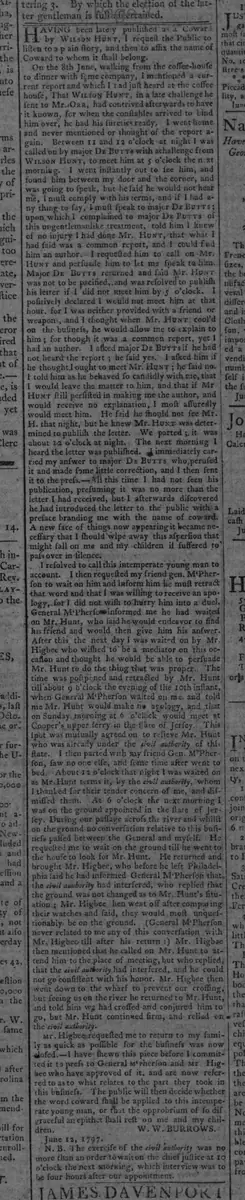
HAVING been lately abused, come listen to a plain story, and then to fix the name of Coward to whom it shall belong.
On the 8th June, walking from the coffee-house to dinner with some company, I mentioned a current report and which I had just heard at the coffee house, That Wilson Hunt, in a late challenge he sent to Mr. Oar. had contrived afterwards to have it known, for when the constables arrived to bind him over, he had his sureties ready. I went home and never mentioned or thought of the report again. Between 11 and 12 o'clock at night I was called on by major De Burrs with a challenge from Wilson Hunt, to meet him at 5 o'clock the next morning. I went instantly out to see him, and found him between my door and the corner, and was going to speak, but he said he would not hear me, I must comply with his terms, and if I had anything to say, I must speak to major De Burrs; upon which I complained to major De Burrs of this ungentlemanlike treatment, told him I knew of no injury I had done Mr. Hunt, that what I had said was a common report, and could find him an author. I requested him to call on Mr. Hunt and persuade him to let me speak to him.
Major De Burrs returned and said Mr. Hunt was not to be pacified, and was resolved to publish his letter if I did not meet him by 5 o'clock. I positively declared I would not meet him at that hour, for I was neither provided with a friend or weapons, and I thought when Mr. Hunt cooled on the business, he would allow me to explain to him; for though it was a common report, yet I had an author. I asked major De Burrs if he had not heard the report; he said yes. I asked him if he thought, I ought to meet Mr. Hunt; he said no. I told him as he behaved so candidly with me, that I would leave the matter to him, and that if Mr. Hunt still persisted in making me the author, and would receive no explanation, I most assuredly would meet him. He said he should not see Mr. H. that night, but he knew Mr. Hunt was determined to publish the letter. We parted; it was about 12 o'clock at night. The next morning I heard the letter was published. I immediately carried my answer to major De Burrs who perused it and made some little correction, and I then sent it to the press. All this time I had not seen his publication, presuming it was no more than the letter. I had received, but I afterwards discovered he had introduced the letter to the public with a preface branding me with the name of coward.
A new face of things now appearing it became necessary that I should wipe away this aspersion that might fall on me and my children if suffered to pass over in silence.
I resolved to call this intemperate young man to account. I then requested my friend gen. M'Pherson to wait on him and inform him he must retract that word and that I was willing to receive an apology, for I did not wish to hurry him into a duel.
General M'Pherson informed me he had waited on Mr. Hunt, who said he would endeavor to find his friend and would then give him his answer.
After this the next day I was waited on by Mr. Higbee who wished to be a mediator on this occasion and thought he would be able to persuade Mr. Hunt to do the thing that was proper. The time was postponed and retracted by Mr. Hunt till about 9 o'clock the evening of the 10th instant, when General M'Pheron waited on me. and told me Mr. Hunt would make no apology, and that on Sunday morning at 6 o'clock would meet at Cooper's upper ferry in the state of Jersey. This spot was mutually agreed on to relieve Mr. Hunt who was already under the civil authority of this state. I then parted with my friend Gen. M'Pheron, saw no one else, and some time after went to bed. About 12 o'clock that night I was waited on as Mr. Hunt terms it, by the civil authority, whom I thanked for their tender concern of me, and dismissed them. At 6 o'clock the next morning I was on the ground appointed in the state of Jersey. During our passage across the river and while on the ground no conversation relative to this business passed between the General and myself. He requested me to wait on the ground till he went to the house to look for Mr. Hunt. He returned and brought Mr. Higbee, who before he left Philadelphia said he had informed General M Pheron that the civil authority had interfered, who replied that the ground was not changed as to Mr. Hunt's situation; Mr. Higbee then went off after comparing their watches and said, they would most unquestionably. be on the ground. (General M'Pheron never related to me any of this conversation with Mr. Higbee till after his return :) Mr. Higbee then mentioned that he called on Mr, Hunt to attend him to the place of meeting, but who replied, that the civil authority had interfered, and he could not go consistent with his honor. Mr. Higbee then went down to the wharf to prevent our crossing, but seeing us on the river he returned to Mr. Hunt, and told him we had crossed and conjured him to go, but Mr. Hunt continued firm, and relied on the civil authority.
Mr. Higbee requested me to return to my family as quick as possible for the business was now closed.—I have shown this piece before I committed it to press to General M'Pheron and Mr Higbee who have approved of it, and are now referred to as to what relates to the part they took in this business. The public will then decide whether the word coward shall be applied to this intemperate young man, or that the opprobrium of so disgraceful an epithet shall rest on me and my children.
W.W. BURROWS.
June 12, 1797.
N. B. The exercise of the civil authority was no more than an order to wait on the chief justice at 10 o'clock the next morning, which interview was to be four hours after our appointment.
On the 8th June, walking from the coffee-house to dinner with some company, I mentioned a current report and which I had just heard at the coffee house, That Wilson Hunt, in a late challenge he sent to Mr. Oar. had contrived afterwards to have it known, for when the constables arrived to bind him over, he had his sureties ready. I went home and never mentioned or thought of the report again. Between 11 and 12 o'clock at night I was called on by major De Burrs with a challenge from Wilson Hunt, to meet him at 5 o'clock the next morning. I went instantly out to see him, and found him between my door and the corner, and was going to speak, but he said he would not hear me, I must comply with his terms, and if I had anything to say, I must speak to major De Burrs; upon which I complained to major De Burrs of this ungentlemanlike treatment, told him I knew of no injury I had done Mr. Hunt, that what I had said was a common report, and could find him an author. I requested him to call on Mr. Hunt and persuade him to let me speak to him.
Major De Burrs returned and said Mr. Hunt was not to be pacified, and was resolved to publish his letter if I did not meet him by 5 o'clock. I positively declared I would not meet him at that hour, for I was neither provided with a friend or weapons, and I thought when Mr. Hunt cooled on the business, he would allow me to explain to him; for though it was a common report, yet I had an author. I asked major De Burrs if he had not heard the report; he said yes. I asked him if he thought, I ought to meet Mr. Hunt; he said no. I told him as he behaved so candidly with me, that I would leave the matter to him, and that if Mr. Hunt still persisted in making me the author, and would receive no explanation, I most assuredly would meet him. He said he should not see Mr. H. that night, but he knew Mr. Hunt was determined to publish the letter. We parted; it was about 12 o'clock at night. The next morning I heard the letter was published. I immediately carried my answer to major De Burrs who perused it and made some little correction, and I then sent it to the press. All this time I had not seen his publication, presuming it was no more than the letter. I had received, but I afterwards discovered he had introduced the letter to the public with a preface branding me with the name of coward.
A new face of things now appearing it became necessary that I should wipe away this aspersion that might fall on me and my children if suffered to pass over in silence.
I resolved to call this intemperate young man to account. I then requested my friend gen. M'Pherson to wait on him and inform him he must retract that word and that I was willing to receive an apology, for I did not wish to hurry him into a duel.
General M'Pherson informed me he had waited on Mr. Hunt, who said he would endeavor to find his friend and would then give him his answer.
After this the next day I was waited on by Mr. Higbee who wished to be a mediator on this occasion and thought he would be able to persuade Mr. Hunt to do the thing that was proper. The time was postponed and retracted by Mr. Hunt till about 9 o'clock the evening of the 10th instant, when General M'Pheron waited on me. and told me Mr. Hunt would make no apology, and that on Sunday morning at 6 o'clock would meet at Cooper's upper ferry in the state of Jersey. This spot was mutually agreed on to relieve Mr. Hunt who was already under the civil authority of this state. I then parted with my friend Gen. M'Pheron, saw no one else, and some time after went to bed. About 12 o'clock that night I was waited on as Mr. Hunt terms it, by the civil authority, whom I thanked for their tender concern of me, and dismissed them. At 6 o'clock the next morning I was on the ground appointed in the state of Jersey. During our passage across the river and while on the ground no conversation relative to this business passed between the General and myself. He requested me to wait on the ground till he went to the house to look for Mr. Hunt. He returned and brought Mr. Higbee, who before he left Philadelphia said he had informed General M Pheron that the civil authority had interfered, who replied that the ground was not changed as to Mr. Hunt's situation; Mr. Higbee then went off after comparing their watches and said, they would most unquestionably. be on the ground. (General M'Pheron never related to me any of this conversation with Mr. Higbee till after his return :) Mr. Higbee then mentioned that he called on Mr, Hunt to attend him to the place of meeting, but who replied, that the civil authority had interfered, and he could not go consistent with his honor. Mr. Higbee then went down to the wharf to prevent our crossing, but seeing us on the river he returned to Mr. Hunt, and told him we had crossed and conjured him to go, but Mr. Hunt continued firm, and relied on the civil authority.
Mr. Higbee requested me to return to my family as quick as possible for the business was now closed.—I have shown this piece before I committed it to press to General M'Pheron and Mr Higbee who have approved of it, and are now referred to as to what relates to the part they took in this business. The public will then decide whether the word coward shall be applied to this intemperate young man, or that the opprobrium of so disgraceful an epithet shall rest on me and my children.
W.W. BURROWS.
June 12, 1797.
N. B. The exercise of the civil authority was no more than an order to wait on the chief justice at 10 o'clock the next morning, which interview was to be four hours after our appointment.
What sub-type of article is it?
Persuasive
Provocative
Reflective
What themes does it cover?
Morality
Crime Punishment
What keywords are associated?
Duel Challenge
Coward Accusation
Wilson Hunt
Honor Defense
Civil Authority
Cooper's Ferry
Public Vindication
What entities or persons were involved?
W.W. Burrows.
The Public
Letter to Editor Details
Author
W.W. Burrows.
Recipient
The Public
Main Argument
the writer details the sequence of events in a dispute with wilson hunt to demonstrate that he acted honorably and that hunt, by backing out of the duel and relying on civil authority, deserves the label of coward instead.
Notable Details
Recounts Mentioning A Report About Hunt's Challenge To Mr. Oar.
Hunt Sends Challenge Via Major De Burrs And Publishes Letter Calling Burrows A Coward.
Burrows Seeks Apology Via General M'pherson; Hunt Refuses.
Duel Arranged At Cooper's Upper Ferry But Hunt Fails To Appear, Citing Civil Authority.
Piece Approved By General M'pheron And Mr. Higbee.