Thank you for visiting SNEWPapers!
Sign up free
Story
January 29, 1957
Atlanta Daily World
Atlanta, Fulton County, Georgia
What is this article about?
Article by Earl J. Morris explores how African Moors civilized Spain from 711-1492 A.D., introducing culture, education, and manners that persist in Spanish and Mexican traditions, contrasting with Spanish colonialism in Mexico. Ties to modern rock 'n' roll fad invading Mexico.
Clipping
OCR Quality
88%
Good
Full Text
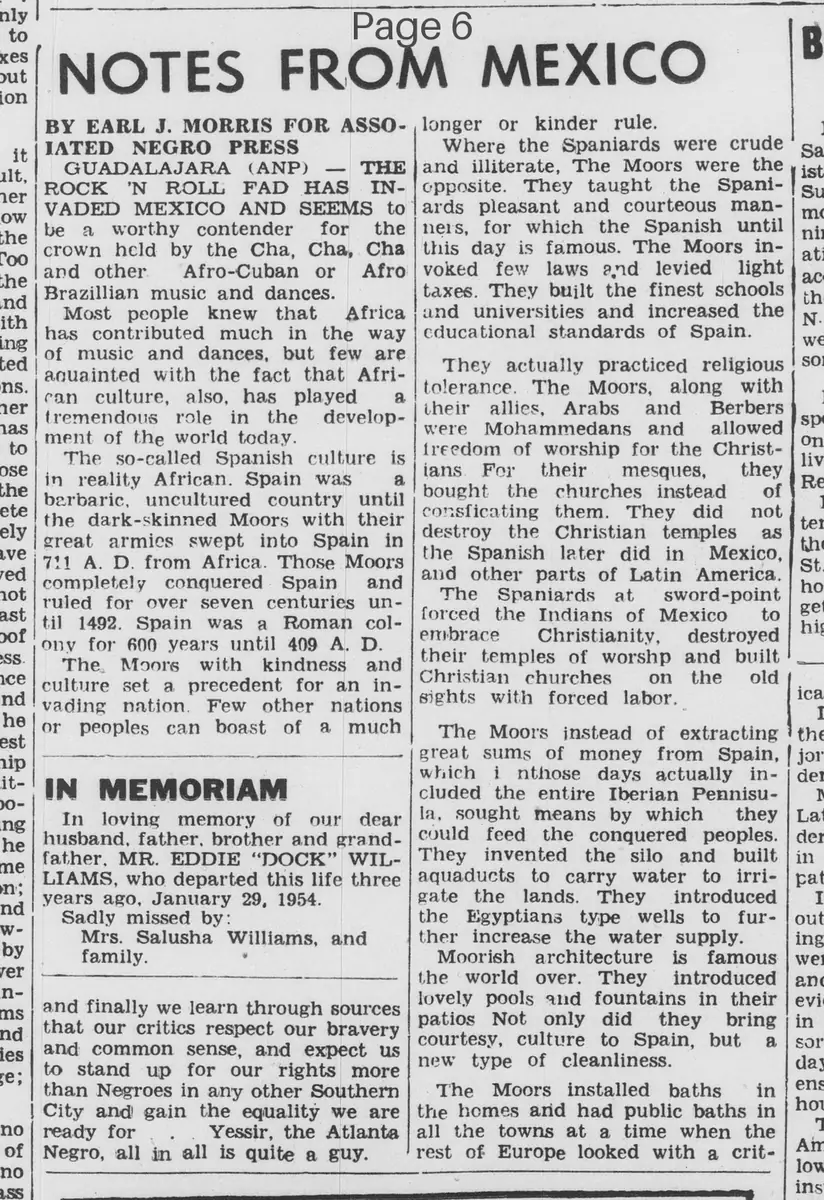
NOTES FROM MEXICO
BY EARL J. MORRIS FOR ASSOCIATED NEGRO PRESS
GUADALAJARA (ANP) THE ROCK 'N ROLL FAD HAS INVADED MEXICO AND SEEMS to be a worthy contender for the crown held by the Cha. Cha, Cha and other Afro-Cuban or Afro-Brazilian music and dances.
Most people knew that Africa has contributed much in the way of music and dances, but few are acquainted with the fact that African culture, also, has played a tremendous role in the development of the world today.
The so-called Spanish culture is in reality African. Spain was a barbaric, uncultured country until the dark-skinned Moors with their great armies swept into Spain in 711 A.D. from Africa. Those Moors completely conquered Spain and ruled for over seven centuries until 1492. Spain was a Roman colony for 600 years until 409 A.D.
The Moors with kindness and culture set a precedent for an invading nation. Few other nations or peoples can boast of a much longer or kinder rule.
Where the Spaniards were crude and illiterate. The Moors were the opposite. They taught the Spaniards pleasant and courteous manners, for which the Spanish until this day is famous. The Moors invoked few laws and levied light taxes. They built the finest schools and universities and increased the educational standards of Spain.
They actually practiced religious tolerance. The Moors, along with their allies, Arabs and Berbers were Mohammedans and allowed freedom of worship for the Christians. For their mosques, they bought the churches instead of confiscating them. They did not destroy the Christian temples as the Spanish later did in Mexico, and other parts of Latin America.
The Spaniards at sword-point forced the Indians of Mexico to embrace Christianity, destroyed their temples of worship and built Christian churches on the old sites with forced labor.
The Moors instead of extracting great sums of money from Spain, which in those days actually included the entire Iberian Peninsula, sought means by which they could feed the conquered peoples. They invented the silo and built aqueducts to carry water to irrigate the lands. They introduced the Egyptian type wells to further increase the water supply.
Moorish architecture is famous the world over. They introduced lovely pools and fountains in their patios. Not only did they bring courtesy, culture to Spain, but a new type of cleanliness.
The Moors installed baths in the homes and had public baths in all the towns at a time when the rest of Europe looked with a critical eye at bathing.
In addition the Moors enriched the Spanish language, as the majority of Spanish language students know.
Many visitors to Spain and to Latin American cities often wonder why the streets are so narrow in many instances and all the patios are within the houses.
In Sunny Spain, the Moors laid out narrow streets, so the buildings would shade them. The patios were inside for privacy and beauty and the flat top roofs you see in evidence in Mexico, Spain and Latin America, were utilized as a sort of backyard by the Moors. Today, you'll see flower pots, chickens and pigeons on the roofs of houses in Mexico and Spain.
The courteous Mexican, Latin-American or Spaniards is still following the old Moorish customs, instead of the so-called "Old Spanish Custom."
BY EARL J. MORRIS FOR ASSOCIATED NEGRO PRESS
GUADALAJARA (ANP) THE ROCK 'N ROLL FAD HAS INVADED MEXICO AND SEEMS to be a worthy contender for the crown held by the Cha. Cha, Cha and other Afro-Cuban or Afro-Brazilian music and dances.
Most people knew that Africa has contributed much in the way of music and dances, but few are acquainted with the fact that African culture, also, has played a tremendous role in the development of the world today.
The so-called Spanish culture is in reality African. Spain was a barbaric, uncultured country until the dark-skinned Moors with their great armies swept into Spain in 711 A.D. from Africa. Those Moors completely conquered Spain and ruled for over seven centuries until 1492. Spain was a Roman colony for 600 years until 409 A.D.
The Moors with kindness and culture set a precedent for an invading nation. Few other nations or peoples can boast of a much longer or kinder rule.
Where the Spaniards were crude and illiterate. The Moors were the opposite. They taught the Spaniards pleasant and courteous manners, for which the Spanish until this day is famous. The Moors invoked few laws and levied light taxes. They built the finest schools and universities and increased the educational standards of Spain.
They actually practiced religious tolerance. The Moors, along with their allies, Arabs and Berbers were Mohammedans and allowed freedom of worship for the Christians. For their mosques, they bought the churches instead of confiscating them. They did not destroy the Christian temples as the Spanish later did in Mexico, and other parts of Latin America.
The Spaniards at sword-point forced the Indians of Mexico to embrace Christianity, destroyed their temples of worship and built Christian churches on the old sites with forced labor.
The Moors instead of extracting great sums of money from Spain, which in those days actually included the entire Iberian Peninsula, sought means by which they could feed the conquered peoples. They invented the silo and built aqueducts to carry water to irrigate the lands. They introduced the Egyptian type wells to further increase the water supply.
Moorish architecture is famous the world over. They introduced lovely pools and fountains in their patios. Not only did they bring courtesy, culture to Spain, but a new type of cleanliness.
The Moors installed baths in the homes and had public baths in all the towns at a time when the rest of Europe looked with a critical eye at bathing.
In addition the Moors enriched the Spanish language, as the majority of Spanish language students know.
Many visitors to Spain and to Latin American cities often wonder why the streets are so narrow in many instances and all the patios are within the houses.
In Sunny Spain, the Moors laid out narrow streets, so the buildings would shade them. The patios were inside for privacy and beauty and the flat top roofs you see in evidence in Mexico, Spain and Latin America, were utilized as a sort of backyard by the Moors. Today, you'll see flower pots, chickens and pigeons on the roofs of houses in Mexico and Spain.
The courteous Mexican, Latin-American or Spaniards is still following the old Moorish customs, instead of the so-called "Old Spanish Custom."
What sub-type of article is it?
Historical Event
Curiosity
What themes does it cover?
Moral Virtue
Social Manners
What keywords are associated?
Moorish Influence
African Culture
Spanish History
Cultural Contributions
Religious Tolerance
Mexican Customs
What entities or persons were involved?
Moors
Spaniards
Earl J. Morris
Where did it happen?
Spain, Mexico, Guadalajara
Story Details
Key Persons
Moors
Spaniards
Earl J. Morris
Location
Spain, Mexico, Guadalajara
Event Date
711 A.D. To 1492
Story Details
The article discusses the profound African influence on Spanish culture through the Moorish conquest and rule of Spain from 711 A.D. to 1492, highlighting their contributions to education, manners, architecture, agriculture, and religious tolerance, contrasting with later Spanish actions in Mexico.