Thank you for visiting SNEWPapers!
Sign up free
Editorial
September 28, 1862
Daily Ohio Statesman
Columbus, Franklin County, Ohio
What is this article about?
The Democracy of Ohio, in a public address, reaffirms devotion to the Union and Constitution, criticizes abolitionists for dividing loyalties and prolonging the Civil War, opposes emancipation and confiscation as unconstitutional and harmful, condemns government corruption and executive overreach, and praises the military while demanding soldiers' voting rights.
Clipping
OCR Quality
95%
Excellent
Full Text
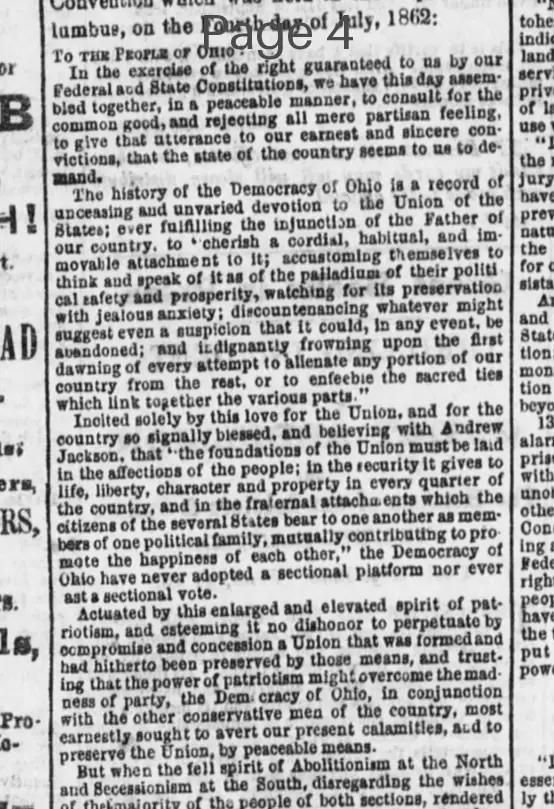
To THE PEOPLE OF OHIO:
In the exercise of the right guaranteed to us by our Federal and State Constitutions, we have this day assembled together, in a peaceable manner, to consult for the common good, and rejecting all mere partisan feeling, to give that utterance to our earnest and sincere convictions, that the state of the country seems to us to demand.
The history of the Democracy of Ohio is a record of unceasing and unvaried devotion to the Union of the States; ever fulfilling the injunction of the Father of our country, to cherish a cordial, habitual, and immovable attachment to it; accustoming themselves to think and speak of it as of the palladium of their political safety and prosperity, watching for its preservation with jealous anxiety; discountenancing whatever might suggest even a suspicion that it could, in any event, be abandoned; and indignantly frowning upon the first dawning of every attempt to alienate any portion of our country from the rest, or to enfeeble the sacred ties which link together the various parts.
Incited solely by this love for the Union, and for the country so signally blessed, and believing with Andrew Jackson, that "the foundations of the Union must be laid in the affections of the people; in the security it gives to life, liberty, character and property in every quarter of the country, and in the fraternal attachments which the citizens of the several States bear to one another as members of one political family, mutually contributing to promote the happiness of each other," the Democracy of Ohio have never adopted a sectional platform nor ever cast a sectional vote.
Actuated by this enlarged and elevated spirit of patriotism, and esteeming it no dishonor to perpetuate by compromise and concession a Union that was formed and had hitherto been preserved by those means, and trusting that the power of patriotism might overcome the madness of party, the Democracy of Ohio, in conjunction with the other conservative men of the country, most earnestly sought to avert our present calamities, and to preserve the Union by peaceable means.
A little less than a year ago, Congress, with an almost entire unanimity, solemnly declared that "Congress, banishing all feeling of mere passion and resentment, will recollect only its duty to the whole country; that this war is not waged on their part in any spirit of oppression, or for any purpose of conquest or subjugation, or purpose of overthrowing or interfering with the rights or established institutions of those States, but to defend and maintain the supremacy of the Constitution, and to preserve the Union with all the dignity, equality and rights of the several States unimpaired; and that as soon as these objects are accomplished the war ought to cease."
We need not remind you with what satisfaction this declaration was hailed in the loyal States, how it served to fill the ranks of the army, to strengthen the hands of the Government, and to infuse spirit and fortitude into the breasts of the loyal men of the south who yet clung to the hope of seeing the Union restored in all its pristine vigor and supremacy. And had there been no departure from the spirit of this declaration; had no doctrines been advanced in high or influential places subversive of the most cherished liberties guaranteed by the Constitution to the people; had there been no corruption so monstrous as to appal the nation by its magnitude, and were there no danger to our institutions to be apprehended in the future and to be carefully guarded against, it would not be necessary for us now to address you.
But the powerful and persistent efforts that have been and are yet being made to convert the war into a mere crusade against slavery; the fearful strides taken by Congress at its present session, in that direction, and the yet more alarming measure proposed and warmly advocated; the audacious attempts to overawe the President whenever he hesitated to yield to the demands of the radicals; the unmeasured abuse that has been heaped upon almost every General in the field, however meritorious, who has declined to become an emissary of abolitionism; the daily promulgation of doctrines utterly destructive of the Constitution and of civil liberty, and the incessant denunciation of every conservative man, however loyal, who does not subscribe to them; all give a warning that ought not to pass unheeded by the people, and require of all who desire to see the Constitution maintained and the Union perpetuated, an expression of their sentiments.
We, therefore, the representatives of nearly or quite two hundred thousand voters of the State of Ohio, who have as deep a stake in the welfare of the country and in the preservation of the Union, as any other equal number of men, in the exercise of our duty and constitutional rights, and with the desire of upholding instead of weakening the just powers of our Government, and anxious to unite all men, without regard to their former party associations, who agree with us in opinion, and to treat all loyal men who honestly differ from us with becoming respect, do hereby declare our own opinions and those of our constituents, as follows:
1. Resolved, That we are, as we ever have been, the devoted friends of the Constitution and the Union, and we have no sympathy with the enemies of either.
2. Resolved, That every dictate of patriotism requires that, in the terrible struggle in which we are engaged for the preservation of the Government, the loyal people of the Union should present an unbroken front; and therefore all efforts to obtain, or perpetuate party ascendency by forcing party issues upon them that necessarily tend to divide and distract them, as the Abolitionists are constantly doing, are hostile to the best interests of the country.
3. Resolved, That the Abolition party, by their denunciation of the President whenever he has manifested a conservative spirit, by their atrocious defamation of our generals who were exposing their lives for their country, and who needed and merited its hearty support, by their acts and declarations tending to promote insubordination in our armies, and a want of confidence in their commanders, and by their persistent representations of all conservative men in the loyal States, as sympathizers with the rebels, have given immense aid and comfort to the rebel cause, and encouraged them to hope for ultimate success.
4. Resolved, That we have seen with indignation the intimation of the Governor of Massachusetts, that that State will be slow in furnishing her quota of troops, unless the war be carried on for purposes of emancipation. When this nation is straining every nerve, and pouring out its blood and treasure like water, to preserve its existence, it is monstrous that a conditional Unionism that places Abolitionism above the Constitution, and the success of a party above the integrity of the Republic, should thus rear its head in high places and seek to dictate the conduct of the war.
5. Resolved, That while we would mete out merited and legal punishment to the plotters of, and leaders in, the rebellion, we are opposed to the contemplated sweeping and indiscriminate acts of confiscation and emancipation by congressional legislation or Executive proclamation because;
1st. We do not believe that such acts would be constitutional.
2d. We believe that by driving the rebels to desperation, and converting Union men at the South into rebels, they would have the effect to indefinitely prolong the war, afford a pretext for foreign intervention, and render the restoration of the Union next to, or quite impossible.
3d. Because, if practicable and carried out they would engender a feeling of bitterness between the different sections of the Union that would not be allayed for generations to come, and that would be an ever-present cause of danger and disturbance to the public peace, a source of perpetual weakness in the Government, and an ever-present incentive to foreign powers to interfere in our domestic concerns, and to promote a disruption and overthrow of the Republic.
4th. Because they would destroy in a great degree, if not entirely, for many years to come, the industrial interests of a large section of the country, and most injuriously affect the interests of the whole people.
5th. Because the immediate and indiscriminate emancipation of the slaves would be an act of inhumanity to them.
6th. Because such an emancipation would throw upon the border free States and especially upon Ohio, an immense number of negroes to compete with and undercut the white laborers of the State, and to constitute, in various ways, an almost or quite insuperable nuisance, if suffered to remain among us. And we would deem it most unjust to our gallant soldiers to see them compelled to free the negroes of the South and thereby let a flood of them in upon us to compete with these same soldiers upon their return to the peaceable pursuits of civil life.
Resolved, That entertaining these views, we cannot too strongly condemn the refusal of our General Assembly to prohibit by law, the immigration of negroes into this State.
With all due respect for the opinions of others, we think that such a measure would be unconstitutional, impolitic and unjust.
Resolved, That the unparalleled frauds and peculations upon the Government, revealed by the investigating committees, and otherwise, demand the sternest condemnation of every honest man and friend of the country, and call for the severest punishment prescribed by the laws.
Resolved, That the patriotism, courage and skill manifested by our armies has never been exceeded in the history of the world, and deserves and receives our highest admiration and gratitude.
10. Resolved, That the refusal of the General Assembly to permit our gallant soldiers in the field the right to vote, was a great and unjustifiable wrong to them that ought not to have been committed.
11. Resolved, That while we will, as heretofore, discourage all mere factious opposition to the Administration, and will continue to give our earnest support to all proper measures to put down the rebellion, and will make all the allowances that the necessities of the times require of good citizens, we protest against all violations of the Constitution.
12. Resolved, That we hold sacred, as we do all other parts of that instrument, the following provisions of the Constitution of the United States:
"The trial of all crimes, except in cases of impeachment, shall be by jury; and such trial shall be held in the State where said crimes shall have been committed."
"Congress shall make no law respecting an establishment of religion, or prohibiting the free exercise thereof; or abridging the freedom of speech, or of the press; or the right of the people peaceably to assemble, and to petition the Government for a redress of grievances."
"The powers not delegated to the United States by the Constitution, nor prohibited by it to the States, are reserved to the States respectively, or to the people."
The right of the people to be secure in their persons, houses, papers and effects against unreasonable searches and seizures, shall not be violated, and no warrants shall issue but upon probable cause, supported by oath or affirmation, and particularly describing the place to be searched and the persons and things to be seized.
"No person shall be held to answer for a capital or otherwise infamous crime, unless on a presentment or indictment of a grand jury, except in cases arising in the land and naval forces, or in the militia, when in actual service, in time of war and public danger; nor shall any person be subject for the same offense to be twice put in jeopardy of life or limb; nor shall be compelled in any criminal case to be a witness against himself, nor be deprived of life, liberty, or property, without due process of law; nor shall private property be taken for public use without just compensation."
"In all criminal prosecutions the accused shall enjoy the right to a speedy and public trial by an impartial jury of the State and district wherein the crime shall have been committed, which district shall have been previously ascertained by law; and to be informed of the nature and cause of the accusation; to be confronted with the witnesses against him; to have compulsory process for obtaining witnesses in his favor, and to have the assistance of counsel for his defense."
And we utterly condemn and denounce the repeated and gross violation by the Executive of the United States, of the said rights thus secured by the Constitution; and we also utterly repudiate and condemn the monstrous dogma that in time of war the Constitution is suspended, or its powers in any respect enlarged beyond the letter and true meaning of that instrument.
13. Resolved. That we view with indignation and alarm the illegal and unconstitutional seizure and imprisonment, for alleged political offenses, of our citizens without judicial process in States where such process is unobstructed, but by Executive order by telegraph or otherwise, and call upon all who uphold the Union, the Constitution and the laws, to unite with us in denouncing and repelling such flagrant violation of the State and Federal Constitutions and tyrannical infraction of the rights and liberties of American citizens; and that the people of this State cannot safely and will not submit to have the freedom of speech and freedom of the press, the two great and essential bulwarks of civil liberty put down by unwarranted and despotic exertions of power.
In the exercise of the right guaranteed to us by our Federal and State Constitutions, we have this day assembled together, in a peaceable manner, to consult for the common good, and rejecting all mere partisan feeling, to give that utterance to our earnest and sincere convictions, that the state of the country seems to us to demand.
The history of the Democracy of Ohio is a record of unceasing and unvaried devotion to the Union of the States; ever fulfilling the injunction of the Father of our country, to cherish a cordial, habitual, and immovable attachment to it; accustoming themselves to think and speak of it as of the palladium of their political safety and prosperity, watching for its preservation with jealous anxiety; discountenancing whatever might suggest even a suspicion that it could, in any event, be abandoned; and indignantly frowning upon the first dawning of every attempt to alienate any portion of our country from the rest, or to enfeeble the sacred ties which link together the various parts.
Incited solely by this love for the Union, and for the country so signally blessed, and believing with Andrew Jackson, that "the foundations of the Union must be laid in the affections of the people; in the security it gives to life, liberty, character and property in every quarter of the country, and in the fraternal attachments which the citizens of the several States bear to one another as members of one political family, mutually contributing to promote the happiness of each other," the Democracy of Ohio have never adopted a sectional platform nor ever cast a sectional vote.
Actuated by this enlarged and elevated spirit of patriotism, and esteeming it no dishonor to perpetuate by compromise and concession a Union that was formed and had hitherto been preserved by those means, and trusting that the power of patriotism might overcome the madness of party, the Democracy of Ohio, in conjunction with the other conservative men of the country, most earnestly sought to avert our present calamities, and to preserve the Union by peaceable means.
A little less than a year ago, Congress, with an almost entire unanimity, solemnly declared that "Congress, banishing all feeling of mere passion and resentment, will recollect only its duty to the whole country; that this war is not waged on their part in any spirit of oppression, or for any purpose of conquest or subjugation, or purpose of overthrowing or interfering with the rights or established institutions of those States, but to defend and maintain the supremacy of the Constitution, and to preserve the Union with all the dignity, equality and rights of the several States unimpaired; and that as soon as these objects are accomplished the war ought to cease."
We need not remind you with what satisfaction this declaration was hailed in the loyal States, how it served to fill the ranks of the army, to strengthen the hands of the Government, and to infuse spirit and fortitude into the breasts of the loyal men of the south who yet clung to the hope of seeing the Union restored in all its pristine vigor and supremacy. And had there been no departure from the spirit of this declaration; had no doctrines been advanced in high or influential places subversive of the most cherished liberties guaranteed by the Constitution to the people; had there been no corruption so monstrous as to appal the nation by its magnitude, and were there no danger to our institutions to be apprehended in the future and to be carefully guarded against, it would not be necessary for us now to address you.
But the powerful and persistent efforts that have been and are yet being made to convert the war into a mere crusade against slavery; the fearful strides taken by Congress at its present session, in that direction, and the yet more alarming measure proposed and warmly advocated; the audacious attempts to overawe the President whenever he hesitated to yield to the demands of the radicals; the unmeasured abuse that has been heaped upon almost every General in the field, however meritorious, who has declined to become an emissary of abolitionism; the daily promulgation of doctrines utterly destructive of the Constitution and of civil liberty, and the incessant denunciation of every conservative man, however loyal, who does not subscribe to them; all give a warning that ought not to pass unheeded by the people, and require of all who desire to see the Constitution maintained and the Union perpetuated, an expression of their sentiments.
We, therefore, the representatives of nearly or quite two hundred thousand voters of the State of Ohio, who have as deep a stake in the welfare of the country and in the preservation of the Union, as any other equal number of men, in the exercise of our duty and constitutional rights, and with the desire of upholding instead of weakening the just powers of our Government, and anxious to unite all men, without regard to their former party associations, who agree with us in opinion, and to treat all loyal men who honestly differ from us with becoming respect, do hereby declare our own opinions and those of our constituents, as follows:
1. Resolved, That we are, as we ever have been, the devoted friends of the Constitution and the Union, and we have no sympathy with the enemies of either.
2. Resolved, That every dictate of patriotism requires that, in the terrible struggle in which we are engaged for the preservation of the Government, the loyal people of the Union should present an unbroken front; and therefore all efforts to obtain, or perpetuate party ascendency by forcing party issues upon them that necessarily tend to divide and distract them, as the Abolitionists are constantly doing, are hostile to the best interests of the country.
3. Resolved, That the Abolition party, by their denunciation of the President whenever he has manifested a conservative spirit, by their atrocious defamation of our generals who were exposing their lives for their country, and who needed and merited its hearty support, by their acts and declarations tending to promote insubordination in our armies, and a want of confidence in their commanders, and by their persistent representations of all conservative men in the loyal States, as sympathizers with the rebels, have given immense aid and comfort to the rebel cause, and encouraged them to hope for ultimate success.
4. Resolved, That we have seen with indignation the intimation of the Governor of Massachusetts, that that State will be slow in furnishing her quota of troops, unless the war be carried on for purposes of emancipation. When this nation is straining every nerve, and pouring out its blood and treasure like water, to preserve its existence, it is monstrous that a conditional Unionism that places Abolitionism above the Constitution, and the success of a party above the integrity of the Republic, should thus rear its head in high places and seek to dictate the conduct of the war.
5. Resolved, That while we would mete out merited and legal punishment to the plotters of, and leaders in, the rebellion, we are opposed to the contemplated sweeping and indiscriminate acts of confiscation and emancipation by congressional legislation or Executive proclamation because;
1st. We do not believe that such acts would be constitutional.
2d. We believe that by driving the rebels to desperation, and converting Union men at the South into rebels, they would have the effect to indefinitely prolong the war, afford a pretext for foreign intervention, and render the restoration of the Union next to, or quite impossible.
3d. Because, if practicable and carried out they would engender a feeling of bitterness between the different sections of the Union that would not be allayed for generations to come, and that would be an ever-present cause of danger and disturbance to the public peace, a source of perpetual weakness in the Government, and an ever-present incentive to foreign powers to interfere in our domestic concerns, and to promote a disruption and overthrow of the Republic.
4th. Because they would destroy in a great degree, if not entirely, for many years to come, the industrial interests of a large section of the country, and most injuriously affect the interests of the whole people.
5th. Because the immediate and indiscriminate emancipation of the slaves would be an act of inhumanity to them.
6th. Because such an emancipation would throw upon the border free States and especially upon Ohio, an immense number of negroes to compete with and undercut the white laborers of the State, and to constitute, in various ways, an almost or quite insuperable nuisance, if suffered to remain among us. And we would deem it most unjust to our gallant soldiers to see them compelled to free the negroes of the South and thereby let a flood of them in upon us to compete with these same soldiers upon their return to the peaceable pursuits of civil life.
Resolved, That entertaining these views, we cannot too strongly condemn the refusal of our General Assembly to prohibit by law, the immigration of negroes into this State.
With all due respect for the opinions of others, we think that such a measure would be unconstitutional, impolitic and unjust.
Resolved, That the unparalleled frauds and peculations upon the Government, revealed by the investigating committees, and otherwise, demand the sternest condemnation of every honest man and friend of the country, and call for the severest punishment prescribed by the laws.
Resolved, That the patriotism, courage and skill manifested by our armies has never been exceeded in the history of the world, and deserves and receives our highest admiration and gratitude.
10. Resolved, That the refusal of the General Assembly to permit our gallant soldiers in the field the right to vote, was a great and unjustifiable wrong to them that ought not to have been committed.
11. Resolved, That while we will, as heretofore, discourage all mere factious opposition to the Administration, and will continue to give our earnest support to all proper measures to put down the rebellion, and will make all the allowances that the necessities of the times require of good citizens, we protest against all violations of the Constitution.
12. Resolved, That we hold sacred, as we do all other parts of that instrument, the following provisions of the Constitution of the United States:
"The trial of all crimes, except in cases of impeachment, shall be by jury; and such trial shall be held in the State where said crimes shall have been committed."
"Congress shall make no law respecting an establishment of religion, or prohibiting the free exercise thereof; or abridging the freedom of speech, or of the press; or the right of the people peaceably to assemble, and to petition the Government for a redress of grievances."
"The powers not delegated to the United States by the Constitution, nor prohibited by it to the States, are reserved to the States respectively, or to the people."
The right of the people to be secure in their persons, houses, papers and effects against unreasonable searches and seizures, shall not be violated, and no warrants shall issue but upon probable cause, supported by oath or affirmation, and particularly describing the place to be searched and the persons and things to be seized.
"No person shall be held to answer for a capital or otherwise infamous crime, unless on a presentment or indictment of a grand jury, except in cases arising in the land and naval forces, or in the militia, when in actual service, in time of war and public danger; nor shall any person be subject for the same offense to be twice put in jeopardy of life or limb; nor shall be compelled in any criminal case to be a witness against himself, nor be deprived of life, liberty, or property, without due process of law; nor shall private property be taken for public use without just compensation."
"In all criminal prosecutions the accused shall enjoy the right to a speedy and public trial by an impartial jury of the State and district wherein the crime shall have been committed, which district shall have been previously ascertained by law; and to be informed of the nature and cause of the accusation; to be confronted with the witnesses against him; to have compulsory process for obtaining witnesses in his favor, and to have the assistance of counsel for his defense."
And we utterly condemn and denounce the repeated and gross violation by the Executive of the United States, of the said rights thus secured by the Constitution; and we also utterly repudiate and condemn the monstrous dogma that in time of war the Constitution is suspended, or its powers in any respect enlarged beyond the letter and true meaning of that instrument.
13. Resolved. That we view with indignation and alarm the illegal and unconstitutional seizure and imprisonment, for alleged political offenses, of our citizens without judicial process in States where such process is unobstructed, but by Executive order by telegraph or otherwise, and call upon all who uphold the Union, the Constitution and the laws, to unite with us in denouncing and repelling such flagrant violation of the State and Federal Constitutions and tyrannical infraction of the rights and liberties of American citizens; and that the people of this State cannot safely and will not submit to have the freedom of speech and freedom of the press, the two great and essential bulwarks of civil liberty put down by unwarranted and despotic exertions of power.
What sub-type of article is it?
Constitutional
War Or Peace
Partisan Politics
What keywords are associated?
Union Preservation
Constitutional Rights
Anti Abolition
Civil War
Democracy Ohio
Emancipation Opposition
Executive Overreach
What entities or persons were involved?
Democracy Of Ohio
Andrew Jackson
Abolition Party
President
Governor Of Massachusetts
Congress
General Assembly Of Ohio
Editorial Details
Primary Topic
Defense Of Union And Constitution Against Abolitionist Radicalism During Civil War
Stance / Tone
Conservative Unionist Opposition To Emancipation And Executive Overreach
Key Figures
Democracy Of Ohio
Andrew Jackson
Abolition Party
President
Governor Of Massachusetts
Congress
General Assembly Of Ohio
Key Arguments
Devoted To Constitution And Union Without Sectionalism
Abolitionists Divide Loyalists And Aid Rebels
Oppose Emancipation And Confiscation As Unconstitutional And Prolonging War
Condemn Government Frauds And Corruption
Demand Soldiers' Voting Rights
Protest Violations Of Constitutional Rights Like Habeas Corpus And Free Speech
Criticize Conditional Support For War Based On Emancipation