Thank you for visiting SNEWPapers!
Sign up free
The Virginia Gazette
Richmond, Williamsburg, Richmond County, Virginia
What is this article about?
Excerpt from Fog's Journal No. 411 describing Venice's canals and gondolas, aristocratic government led by the Doge as a figurehead, haughty nobles in three classes, customs like limited marriages to preserve wealth, veneration of St. Mark, religious hypocrisy, liberty attracting exiles like Aretino, and the prominence of courtesans.
Merged-components note: This is a single literary excerpt from Fog's Journal about Venice, continued across pages 2 and 3. The second part was mislabeled as foreign_news but is part of the same narrative piece.
Clippings
1 of 2
OCR Quality
Full Text
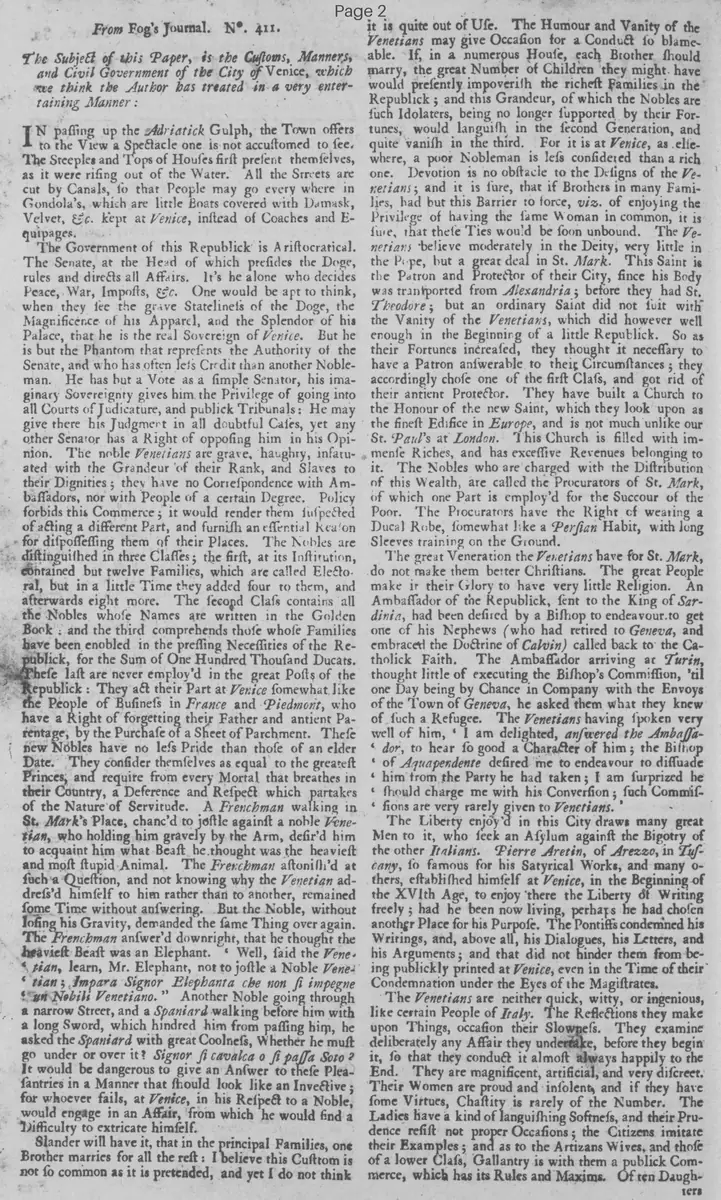
The Subject of this Paper, is the Customs, Manners, and Civil Government of the City of Venice, which methinks the Author has treated in a very entertaining Manner:
Passing up the Adriatick Gulf, the Town offers to the View a Spectacle one is not accustomed to see. The Steeples and Tops of Houses first present themselves, as it were rising out of the Water. All the Streets are cut by Canals, so that People may go every where in Gondolas, which are little Boats covered with Damask, Velvet, &c. kept at Venice, instead of Coaches and Equipages.
The Government of this Republick is Aristocratical. The Senate, at the Head of which presides the Doge, rules and directs all Affairs. 'Tis he alone who decides Peace, War, Imports, &c. One would be apt to think, when they see the grave Stateliness of the Doge, the Magnificence of his Apparel, and the Splendor of his Palace, that he is the real Sovereign of Venice. But he is but the Phantom that represents the Authority of the Senate, and who has often less Credit than another Nobleman.
He has but a Vote as a simple Senator, his imaginary Sovereignty gives him the Privilege of going into all Courts of Judicature, and publick Tribunals: He may give there his Judgment in all doubtful Cases, yet any other Senator has a Right of opposing him in his Opinion. The noble Venetians are grave, haughty, infatuated with the Grandeur of their Rank, and Slaves to their Dignities; they have no Correspondence with Ambassadors, nor with People of a certain Degree. Policy forbids this Commerce; it would render them suspected of acting a different Part, and furnish an essential Reason for disposing them of their Places. The Nobles are distinguished in three Classes; the first, at its Institution, contained but twelve Families, which are called Electoral, but in a little Time they added four to them, and afterwards eight more. The second Class contains all the Nobles whose Names are written in the Golden Book: and the third comprehends those whose Families have been ennobled in the pressing Necessities of the Republick, for the Sum of One Hundred Thousand Ducats. These last are never employ'd in the great Posts of the Republick: They act their Part at Venice somewhat like the People of Business in France and Piedmont, who have a Right of forgetting their Father and antient Parentage, by the Purchase of a Sheet of Parchment. These new Nobles have no less Pride than those of an elder Date. They consider themselves as equal to the greatest Princes; and require from every Mortal that breathes in their Country, a Deference and Respect which partakes of the Nature of Servitude. A Frenchman walking in St. Mark's Place, chanc'd to jostle against a noble Venetian, who holding him gravely by the Arm, desir'd him to acquaint him what Beast he thought was the heaviest and most stupid Animal. The Frenchman astonish'd at such a Question, and not knowing why the Venetian address'd himself to him rather than to another, remained some Time without answering. But the Noble, without losing his Gravity, demanded the same Thing over again. The Frenchman answer'd downright, that he thought the heaviest Beast was an Elephant. Well, said the Venetian, learn, Mr. Elephant, not to jostle a Noble Venetian; Impara Signor Elephanta che non si impenge con Nobili Venetiano.
Another Noble going through a narrow Street, and a Spaniard walking before him with a long Sword, which hindred him from passing him, he asked the Spaniard with great Coolness, Whether he must go under or over it? Signor i cavalca o i pasa Soto.
It would be dangerous to give an Answer to these Pleasantries in a Manner that should look like an Invective; for whoever fails, at Venice, in his Respect to a Noble, would engage in an Affair, from which he would find a Difficulty to extricate himself.
Slander will have it, that in the principal Families, one Brother marries for all the rest: I believe this Custom is not so common as it is pretended, and yet I do not think it is quite out of Use. The Humour and Vanity of the Venetians may give Occasion for a Conduct so blameable. If, in a numerous House, each Brother should marry, the great Number of Children they might have would presently impoverish the richest Families in the Republick; and this Grandeur, of which the Nobles are such Idolaters, being no longer supported by their Fortunes, would languish in the second Generation, and quite vanish in the third. For it is at Venice, as elsewhere, a poor Nobleman is less considered than a rich one. Devotion is no obstacle to the Designs of the Venetians; and it is sure, that if Brothers in many Families, had but this Barrier to force, viz. of enjoying the Privilege of having the same Woman in common, it is sure, that these Ties would be soon unbound. The Venetians believe moderately in the Deity, very little in the Pope, but a great deal in St. Mark. This Saint is the Patron and Protector of their City, since his Body was transported from Alexandria; before they had St. Theodore; but an ordinary Saint did not suit with the Vanity of the Venetians, which did however well enough in the Beginning of a little Republick. So as their Fortunes increased, they thought it necessary to have a Patron answerable to their Circumstances; they accordingly chose one of the first Class, and got rid of their antient Protector. They have built a Church to the Honour of the new Saint, which they look upon as the finest Edifice in Europe, and is not much unlike our St. Paul's at London. This Church is filled with immense Riches, and has excessive Revenues belonging to it. The Nobles who are charged with the Distribution of this Wealth, are called the Procurators of St. Mark, of which one Part is employ'd for the Succour of the Poor. The Procurators have the Right of wearing a Ducal Robe, somewhat like a Persian Habit, with long Sleeves training on the Ground.
The great Veneration the Venetians have for St. Mark, do not make them better Christians. The great People make it their Glory to have very little Religion. An Ambassador of the Republick, sent to the King of Sardinia, had been desired by a Bishop to endeavour to get one of his Nephews (who had retired to Geneva, and embraced the Doctrine of Calvin) called back to the Catholick Faith. The Ambassador arriving at Turin thought little of executing the Bishop's Commission, 'til one Day being by Chance in Company with the Envoys of the Town of Geneva, he asked them what they knew of such a Refugee. The Venetians having spoken very well of him, I am delighted, answered the Ambassador, to hear so good a Character of him; the Bishop of Aquapendente desired me to endeavour to dissuade him from the Party he had taken; I am surprised he should charge me with his Conversion; such Commissions are very rarely given to Venetians.
The Liberty enjoy'd in this City draws many great Men to it, who seek an Asylum against the Bigotry of the other Italians. Pierre Aretin, of Arezzo, in Tuscany, so famous for his Satyrical Works, and many others, established himself at Venice, in the Beginning of the XVIth Age, to enjoy there the Liberty of Writing freely; had he been now living, perhaps he had chosen another Place for his Purpose. The Pontiffs condemned his Writings, and, above all, his Dialogues, his Letters, and his Arguments: and that did not hinder them from being publickly printed at Venice, even in the Time of their Condemnation under the Eyes of the Magistrates.
The Venetians are neither quick, witty, or ingenious, like certain People of Italy. The Reflections they make upon Things, occasion their Slowness. They examine deliberately any Affair they undertake, before they begin it, so that they conduct it almost always happily to the End. They are magnificent, artificial, and very discreet. Their Women are proud and insolent, and if they have some Virtues, Chastity is rarely of the Number. The Ladies have a kind of languishing Softness, and their Prudence rests not proper Occasions: the Citizens imitate their Examples; and as to the Artizans Wives, and those of a lower Class, Gallantry is with them a publick Commerce, which has its Rules and Maxims. Of ten Daughters
There are nine, I dare say, whose Mothers and Aunts drive a Market for them, and agree a long Time beforehand for the Price of their Virginity, when they shall attain to a certain Age, on Condition of 100 or 200 Ducats, in order, say they, to have wherewithal to marry them. A Mother, who had dealt in this Manner with a Foreign Gentleman for 200 Ducats for her Daughter, seeing that he always deferred it on Pretence of her not being of ripe Age, and tired with Delays, went one Day to know his last Resolution. Sir, said he to him, be so good as to resolve immediately, for the Reverend Father Preacher, naming his Name, Preacher at one of the first Convents of Venice, has already made me a reasonable Offer. The Gentleman, who perhaps was glad enough to get off his Bargain, and regretted the 200 Ducats which he was to give, consented that the Contract should pass to the Reverend Father; which was finished in all its Forms. Besides these particular Contracts, there are in Venice an astonishing Number of Courtesans. They enjoy a full Liberty, and often come to acquire a great Consideration among the People. They go to the Convents, and visit the Sisters of those Gentlemen they are in Commerce with, and receive from them very kind Caresses, which is always followed by Presents of Sweetmeats and Agnus Dei; for the Courtesans of Venice are as devout as those of Rome. They fast on Fridays and Saturdays; they have great Respect for some Saint, under whose Protection they put themselves, and very piously perform the Functions of their Calling. There is nothing so amusing for a Philosopher, or a Man who makes Use of his Reason, as to take a Turn in the Walks at Nine at Night in the Street called Serene, at Rome; they will see there 200 Women sitting at the Doors of their Houses, who attend their good Fortune with great Tranquility. When a Person thinks fit to purchase a dear Repentance, he chooses among all those Beauties the Sultana, to whom he gives the Handkerchief, and She conducts him into her Apartment. The Chambers of these Priestesses of Venus are all built pretty much after the same Manner, level with the Street, furnished with a Bed and white Curtains, with a Table, three wooden Chairs, and an Image of a Madonna; before whom burns a Lamp that gives a Light in the Room. Before Matters are push'd to Extremity, She draws a Curtain to veil the Image, that it may not perceive what passes. When all is finished, the Picture is uncovered again; and if the Mistress of the House has tolerable good Practice, the Madonna will be covered and uncovered ten Times in a Day.
What sub-type of article is it?
What themes does it cover?
What keywords are associated?
What entities or persons were involved?
Literary Details
Title
The Customs, Manners, And Civil Government Of The City Of Venice
Author
From Fog's Journal
Form / Style
Prose Essay With Satirical Anecdotes
Key Lines