Thank you for visiting SNEWPapers!
Sign up free
Staunton Spectator, And General Advertiser
Staunton, Virginia
What is this article about?
William from Danbury, Conn., reports on his 1835 experiment with ruta baga turnips yielding 100 bushels from 80 rods of gravelly loam, using manure and transplanting, and potatoes yielding 90 bushels from 1/4 acre, comparing manure favorably to plaster. He recommends focused cultivation.
Clipping
OCR Quality
Full Text
RUTA BAGA AND POTATOES.
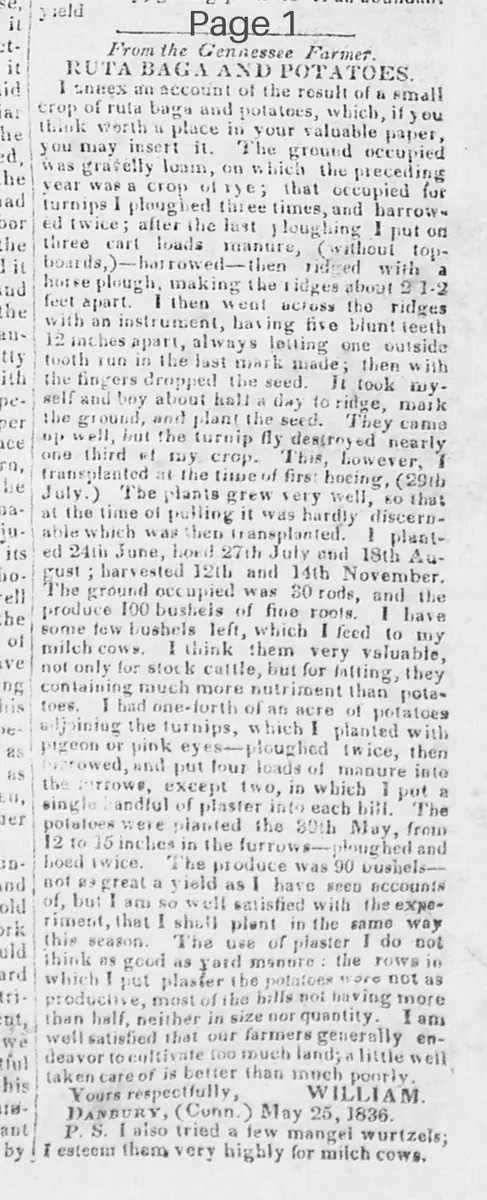
I annex an account of the result of a small crop of ruta baga and potatoes, which, if you think worth a place in your valuable paper, you may insert it. The ground occupied was gravelly loam, on which the preceding year was a crop of rye; that occupied for turnips I ploughed three times, and harrowed twice; after the last ploughing I put on three cart loads manure, (without top-boards,)—harrowed—then ridged with a horse plough, making the ridges about 2 1-2 feet apart. I then went across the ridges with an instrument, having five blunt teeth 12 inches apart, always letting one outside tooth run in the last mark made; then with the fingers dropped the seed. It took myself and boy about half a day to ridge, mark the ground, and plant the seed. They came up well, but the turnip fly destroyed nearly one third of my crop. This, however, I transplanted at the time of first hoeing, (29th July.) The plants grew very well, so that at the time of pulling it was hardly discernible which were then transplanted. I planted 24th June, hoed 27th July and 18th August; harvested 12th and 14th November. The ground occupied was 80 rods, and the produce 100 bushels of fine roots. I have some few bushels left, which I feed to my milch cows. I think them very valuable, not only for stock cattle, but for fatting, they containing much more nutriment than potatoes. I had one-fourth of an acre of potatoes adjoining the turnips, which I planted with pigeon or pink eyes—ploughed twice, then hoed, and put four loads of manure into the furrows, except two, in which I put a single handful of plaster into each hill. The potatoes were planted the 30th May, from 12 to 15 inches in the furrows—ploughed and hoed twice. The produce was 90 bushels—not as great a yield as I have seen accounts of, but I am so well satisfied with the experiment, that I shall plant in the same way this season. The use of plaster I do not think as good as yard manure: the rows in which I put plaster the potatoes were not as productive, most of the hills not having more than half, neither in size nor quantity. I am well satisfied that our farmers generally endeavor to cultivate too much land; a little well taken care of is better than much poorly.
Yours respectfully,
WILLIAM.
DANBURY, (Conn.) May 25, 1836.
P. S. I also tried a few mangel wurtzels; I esteem them very highly for milch cows.
What sub-type of article is it?
What keywords are associated?
What entities or persons were involved?
Where did it happen?
Domestic News Details
Primary Location
Danbury, Conn.
Event Date
Planted 24th June And 30th May 1835; Harvested 12th And 14th November 1835; Reported May 25, 1836
Key Persons
Outcome
100 bushels ruta baga from 80 rods; 90 bushels potatoes from 1/4 acre; turnip fly destroyed one third, transplanted successfully; manure better than plaster
Event Details
Account of cultivating ruta baga turnips on gravelly loam after rye crop: ploughed three times, harrowed twice, manured, ridged, marked, planted by hand; hoed twice, transplanted after fly damage; also potatoes with manure in furrows except two with plaster; advises concentrated cultivation over extensive poor care.