Thank you for visiting SNEWPapers!
Sign up free
The New Orleans Daily Democrat
New Orleans, Orleans County, Louisiana
What is this article about?
New York Herald publishes prohibited Russian map of Central Asia exaggerating invasion routes to India, including fictional River Seche (actually dry bed), sparking alarm over Russo-British tensions but exposed as error.
Clipping
OCR Quality
Full Text
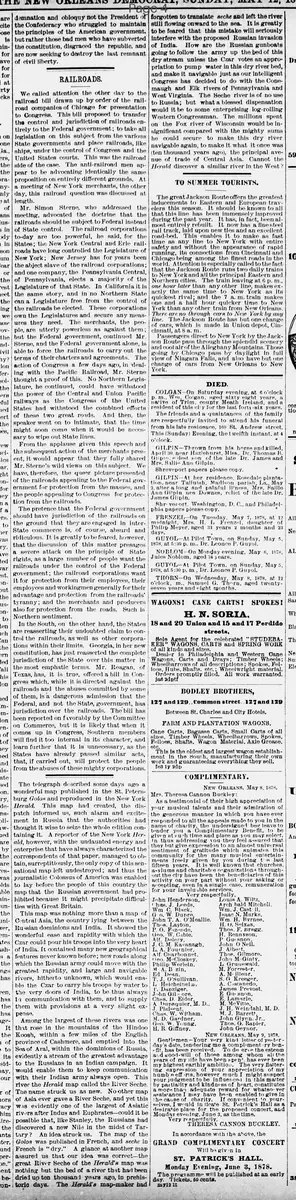
This map was nothing more than a map of Central Asia, the country lying between the Russian dominions and India. It showed the wonderful ease and rapidity with which the Czar could pour his troops into the very heart of India. It contained many new geographical features never known before; new roads along which the Russian army could move with the greatest rapidity, and large and navigable rivers, hitherto unknown, which would enable the Czar to carry his troops by water to the very doors of India, to be thus always in communication with them, and to supply them with provisions at a very slight expense.
Among the largest of these rivers was one that rose in the mountains of the Hindoo Koosh, within a few miles of the English province of Cashmere, and emptied into the Sea of Aral, within the dominions of Russia, evidently a stream of the greatest advantage to the Russians in an Indian campaign. It would enable them to keep communication with their Indian army always open. This river the Herald map called the River Seche. The name struck us as new. No other map of Asia ever gave a River Seche, and yet this was evidently one of the largest of Asiatic rivers after Indus and Euphrates—could it be possible that, like Stanley, the Russians had discovered a new Nile in the midst of Tartary? An idea struck us. The map of the Golos was published in French, and seche in French is "dry." A glance at another map assured us that our idea was correct—the great River Seche of the Herald's map was nothing but the bed of a river that had been dried up ten thousand years ago, in prehistoric days. The Herald's map-maker had forgotten to translate seche and left the river still flowing onward to the sea. It is greatly to be feared that this mistake will seriously interfere with the proposed Russian invasion of India. How are the Russian gunboats going to follow the army up the bed of this dry stream unless the Czar votes an appropriation to pump water in this dry river bed, and make it navigable just as our intelligent Congress has decided to do with the Conemaugh and Elk rivers of Pennsylvania and West Virginia. The Seche river is of no use to Russia; but what a blessed dispensation would it be to some enterprising log-rolling Western Congressman. The millions spent on the Fox river of Wisconsin would be insignificant compared with the mighty sums he could secure to make this dry river navigable again, to make it what it once was (ten thousand years ago), the principal avenue of trade of Central Asia. Cannot the Herald discover a similar river in the West?
What sub-type of article is it?
What keywords are associated?
Where did it happen?
Foreign News Details
Primary Location
Central Asia
Outcome
the map's depiction of a navigable river seche was a mistake; it is actually a dry river bed from prehistoric times, rendering it useless for russian invasion plans.
Event Details
A map published in the St. Petersburg Golos and reproduced in the New York Herald showed easy Russian troop movements into India via new roads and unknown rivers, including the River Seche rising in the Hindoo Koosh mountains and emptying into the Sea of Aral. The map alarmed Russia, leading to seizure of editions, but a Herald reporter obtained a copy. The River Seche name derives from French 'seche' meaning dry, revealing it as a long-dried-up river bed.