Thank you for visiting SNEWPapers!
Sign up free
Editorial
March 12, 1806
Norfolk Gazette And Publick Ledger
Norfolk, Virginia
What is this article about?
The Richmond Enquirer responds to criticisms from New York papers (American Citizen and Evening Post) for commenting on New York party coalitions and Aaron Burr's ambitions, denying meddling or favoritism toward Virginians for president, and urging interstate unity over rivalry.
Merged-components note: Merged long editorial from the Enquirer spanning pages 2 and 3.
Clippings
1 of 2
OCR Quality
95%
Excellent
Full Text
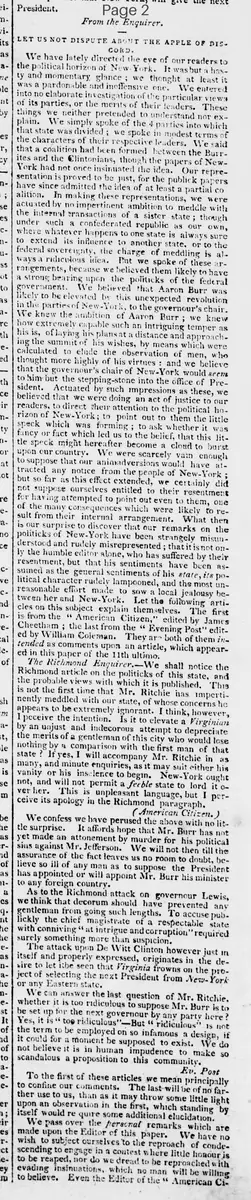
From the Enquirer.
LET US NOT DISPUTE ABOUT THE APPLE OF DISCORD.
We have lately directed the eye of our readers to the political horizon of New-York. It was but a hasty and momentary glance; we thought at least it was a pardonable and inoffensive one. We entered into no elaborate investigation of the particular views of its parties, or the merits of their leaders. These things we neither pretended to understand nor explain. We simply spoke of the 4 parties into which that state was divided; we spoke in modest terms of the characters of their respective leaders. We said that a coalition had been formed between the Burr-ites and the Clintonians, though the papers of New-York had not once insinuated the idea. Our representation is proved to be just, for the publick papers have since admitted the idea of at least a partial coalition. In making these representations, we were actuated by no impertinent ambition to meddle with the internal transactions of a sister state; though under such a confederated republic as our own, where whatever happens to one state is always sure to extend its influence to another state, or to the federal sovereignty, the charge of meddling is always a ridiculous idea. But we spoke of these arrangements, because we believed them likely to have a strong bearing upon the politicks of the federal government. We believed that Aaron Burr was likely to be elevated by this unexpected revolution in the parties of New-York, to the governor's chair. We knew the ambition of Aaron Burr: we knew how extremely capable such an intriguing temper as his is, of laying his plans at a distance and approaching the summit of his wishes, by means which were calculated to elude the observation of men, who thought more highly of his virtues: and we believe that the governor's chair of New-York would seem to him but the stepping-stone into the office of President. Actuated by such impressions as these, we believed that we were doing an act of justice to our readers, to direct their attention to the political horizon of New-York; to point out to them the little speck which was forming; to ask whether it was fancy or fact which led us to the belief, that this little speck might hereafter become a cloud to burst upon our country. We were scarcely vain enough to suppose that our animadversions would have attracted any notice from the people of New-York: but so far as this effect extended, we certainly did not suppose ourselves entitled to their resentment for having attempted to point out even to them, one of the many consequences which were likely to result from their internal arrangement. What then is our surprise to discover that our remarks on the politicks of New-York have been strangely misunderstood and rudely misrepresented; that it is not only the humble editor alone, who has suffered by their resentment, but that his sentiments have been assumed as the general sentiments of his state, its political character rudely lampooned, and the most unreasonable effort made to sow a local jealousy between her and New-York. Let the following articles on this subject explain themselves. The first is from the "American Citizen," edited by James Cheetham; the last from the "Evening Post" edited by William Coleman. They are both of them intended as comments upon an article, which appeared in this paper of the 11th ultimo
The Richmond Enquirer.—We shall notice the Richmond article on the politicks of this state, and the probable views with which it is published, 'This is not the first time that Mr. Ritchie has impertinently meddled with our state, of whose concerns he appears to be extremely ignorant. I think, however, I perceive the intention. Is it to elevate a Virginian by an unjust and indecorous attempt to depreciate the merits of a gentleman of this city who would lose nothing by a comparison with the first man of that state? If yes, I will accompany Mr. Ritchie in as many, and minute enquiries, as it may suit either his vanity or his insolence to begin. New-York ought not, and will not permit a feeble state to lord it over her. This is unpleasant language, but I perceive its apology in the Richmond paragraph.
(American Citizen.)
We confess we have perused the above with no little surprise. It affords hope that Mr. Burr has not yet made an atonement by murder for his political sins against Mr. Jefferson. We will not then till the assurance of the fact leaves us no room to doubt, believe so ill of any man as to suppose the President has appointed or will appoint Mr. Burr his minister to any foreign country.
As to the Richmond attack on governor Lewis, we think that decorum should have prevented any gentleman from going such lengths. To accuse publickly the chief magistrate of a respectable state with conniving "at intrigue and corruption" required surely something more than suspicion.
The attack upon De Witt Clinton however just in itself and properly expressed, originates in the desire to let it be seen that Virginia frowns on the project of selecting the next President from New-York or any Eastern state.
We can answer the last question of Mr. Ritchie. whether it is too ridiculous to suppose Mr. Burr is to be set up for the next governor by any party here? Yes, it is too ridiculous"—But "ridiculous" is not the term to be employed on so infamous a design, if it could for a moment be supposed to exist. We do not believe it is in human impudence to make so scandalous a proposition to this community.
Ev. Post
To the first of these articles we mean principally to confine our Comments.
The last will be of no further use to us, than as it may throw some little light upon an observation in the first, which standing itself would require some additional elucidation.
We pass over the personal remarks which are made upon the Editor of this paper. We wish to subject ourselves to the reproach of condescending to engage in a contest where little honour is to be reaped, nor do we dread to be reproached with evading insinuations, which no man will be willing to believe. Even the Editor of the "American Ci.
Citizen himself will do us the justice to believe, that in all that respects the scurrility or abuse of a public paper, we have neither the inclination nor the talents to become his competitors. But it is to the pith and marrow of this paragraph alone that we mean to confine our observations. It is the ungenerous suggestion which it offers about the politicks of Virginia, that raises it into importance. It is not the editor of one paper opposed to the editor of another; Mr. Cheetham will excuse me for saying that they are transient and trifling subjects; but it is the effort to array the feelings of New-York against the feelings of Virginia; that alone recommends it to the publick attention.
To elevate a Virginian.—elevate him to what? Is it in the general estimation of our country? To purchase a character in the south, is it necessary to pull down the reputation of the illustrious men of the north? The paragraph itself is a mysterious one—the term 'elevate' which is made use of, might justify this simple and harmless construction; but how could we reconcile to this acceptation, the charge of 'lording it' over New-York? The ambition of 'lording it' is not confined to the acquisition of fame, but of power. In what way, then does Virginia wish to exercise a power over New-York? To what office is it that we wish 'to elevate a Virginian, by an unjust and indecorous attempt to depreciate the merits of a gentleman of New-York? Let us consult Mr. Coleman's paragraph for a solution of this question. He tells us that "the attack upon De Witt Clinton originates in the desire to let it be seen that Virginia frowns on the projects of selecting the next President from New-York or any eastern state."
If this be the substance of Mr. Cheetham's insinuation, by what proof does he come forward to support it? Can he place a charge so serious as that upon incontestible documents, or does he dare to make it out by feeble inference and ungenerous innuendo?—And by innuendo from what? Has Virginia stept forward in her corporate capacity, and performed any act or made any avowal, which displayed such inordinate ambition? Has her feeble executive ever presumed to meddle with the federal government? Did her legislature at its last session either in its official authority or by private caucus, select a candidate, marshal its resolutions, or breathe a single sentiment upon the subject? Have our people expressed their wishes en masse? Has a single body among them breathed such a wish? No. It is simply the humble editor of a paper, who is erected into a political standard for his state, by the Quixotic imagination of James Cheetham.
Even he himself has not avowed that sentiment. It is collected by innuendo from a single article which he has published: an article which does not presume to nominate any candidate for the next presidential election, which does not even allude to that election, and which the author himself is now ready most solemnly to avow, was not written with any intention to disparage any man from New-York, or to elevate any man from Virginia, who might be supposed to have any pretensions to the presidential chair. But if Mr. Cheetham will still insist upon making us the trumpet of the people of Virginia, as his opponent Mr. Coleman has made us the trumpet of the President: if he must still misunderstand even our sentiments by false and ungenerous constructions of the most indirect expressions, it is necessary to declare explicitly what we do know of the sentiments of the Virginians. He has been polite enough to say that we have "impertinently meddled with (his) state, of whose concerns (we) appear to be extremely ignorant." We must retaliate upon him the reproach of ignorance, if not of impertinence. He has charged us with "an unjust and indecorous attempt to depreciate the merits of a gentleman:" but he seeks higher game; It is not against an individual only, but a whole state, that he levels his attack.
But whilst we repeat the sentiments of our state on this subject, we would wish to be heard not only by Messrs. Cheetham and Coleman; not only by the inhabitants of New-York; but by every inhabitant of the Eastern States.
Virginia is satisfied with the honour which has been already conferred upon her sons. She has already given two Presidents to the union; who at the end of the present administration, will have presided over the government 16 out of the 20 years of its existence. She is willing, nay she would be more willing to have a President from any of the other states, provided he possessed equal merit with the most meritorious of her sons. She believes that she has at least two sons, who are worthy of that office: she believes too that most of the other states would admit their pretensions without the smallest reluctance; but she is willing to waive their claims, if any of her sister states can produce a son, equally able to promote the welfare of all.
And here it is that we must take up the Eulogies which Mr. Cheetham has passed upon one of the inhabitants of New-York.
"A gentleman of this city who would lose nothing by a comparison with the first man of that state (Virginia.)"—If there really be such a man in New-Vork, certainly he will experience no opposition from Virginia. There may be such men in New York, we have no doubt, that there are such men. Some of the Virginians may perhaps know such men. But we beg Mr. Cheetham to recollect, that for our part, we "are ignorant of the concerns of his state;" and we must therefore apply to him for a little information. We must request him to name the man upon whom, were we to listen to our vanity, we should be apt to suppose he has lavished a very high eulogium. Who is that gentleman in his city, of whom he has taught us to think so highly? We will pledge ourselves to him to study that man's history. Let us only find that he is as worthy of being president as the most worthy of the Virginians, & we solemnly pledge ourselves to discard all our geographical affections, and support that man to the utmost of our feeble abilities.—But we deny that we have ever attempted to depreciate the merits of the distinguished citizen of New-York. We have asserted, and we religiously adhere to the assertion, that with the Clinton party resides the republican spirit of the state. We have said that De Witt Clinton has too large a share of influence and treasure, too large at least in proportion to the practice and observances of the Virginians: we have said that there is no man within our own state who possesses a mayoralty worth 12,000 dollars per annum, who is at the same time a member of our state senate and a member of such influential body as the New-York council of appointment, and we still adhere to the assertion.
"A feebler state" than New-York.—The thing is not worthy of a contest. Grant, that New-York is stronger than Virginia; grant that she has more square miles within her limits, more people upon her territory, and more dollars in their purse; what, let us enquire, is that to the purpose? Virginia will never repine at the prosperity of any of her sister states. She will never lament, that she is not for ever the strongest state in the union. Her ambition will be confined to the rendering of every service in her power to her country.
Away then with those jealous distinctions, that would separate us from our brethren of New-York. Our cause is their cause. "If there is to be a struggle between us, let it be which state shall be foremost in the race of mind; let this be the noble animosity kindled between us, who shall longest preserve that free constitution which is so auspicious to us both, who shall for ever be the saviour of the union."
LET US NOT DISPUTE ABOUT THE APPLE OF DISCORD.
We have lately directed the eye of our readers to the political horizon of New-York. It was but a hasty and momentary glance; we thought at least it was a pardonable and inoffensive one. We entered into no elaborate investigation of the particular views of its parties, or the merits of their leaders. These things we neither pretended to understand nor explain. We simply spoke of the 4 parties into which that state was divided; we spoke in modest terms of the characters of their respective leaders. We said that a coalition had been formed between the Burr-ites and the Clintonians, though the papers of New-York had not once insinuated the idea. Our representation is proved to be just, for the publick papers have since admitted the idea of at least a partial coalition. In making these representations, we were actuated by no impertinent ambition to meddle with the internal transactions of a sister state; though under such a confederated republic as our own, where whatever happens to one state is always sure to extend its influence to another state, or to the federal sovereignty, the charge of meddling is always a ridiculous idea. But we spoke of these arrangements, because we believed them likely to have a strong bearing upon the politicks of the federal government. We believed that Aaron Burr was likely to be elevated by this unexpected revolution in the parties of New-York, to the governor's chair. We knew the ambition of Aaron Burr: we knew how extremely capable such an intriguing temper as his is, of laying his plans at a distance and approaching the summit of his wishes, by means which were calculated to elude the observation of men, who thought more highly of his virtues: and we believe that the governor's chair of New-York would seem to him but the stepping-stone into the office of President. Actuated by such impressions as these, we believed that we were doing an act of justice to our readers, to direct their attention to the political horizon of New-York; to point out to them the little speck which was forming; to ask whether it was fancy or fact which led us to the belief, that this little speck might hereafter become a cloud to burst upon our country. We were scarcely vain enough to suppose that our animadversions would have attracted any notice from the people of New-York: but so far as this effect extended, we certainly did not suppose ourselves entitled to their resentment for having attempted to point out even to them, one of the many consequences which were likely to result from their internal arrangement. What then is our surprise to discover that our remarks on the politicks of New-York have been strangely misunderstood and rudely misrepresented; that it is not only the humble editor alone, who has suffered by their resentment, but that his sentiments have been assumed as the general sentiments of his state, its political character rudely lampooned, and the most unreasonable effort made to sow a local jealousy between her and New-York. Let the following articles on this subject explain themselves. The first is from the "American Citizen," edited by James Cheetham; the last from the "Evening Post" edited by William Coleman. They are both of them intended as comments upon an article, which appeared in this paper of the 11th ultimo
The Richmond Enquirer.—We shall notice the Richmond article on the politicks of this state, and the probable views with which it is published, 'This is not the first time that Mr. Ritchie has impertinently meddled with our state, of whose concerns he appears to be extremely ignorant. I think, however, I perceive the intention. Is it to elevate a Virginian by an unjust and indecorous attempt to depreciate the merits of a gentleman of this city who would lose nothing by a comparison with the first man of that state? If yes, I will accompany Mr. Ritchie in as many, and minute enquiries, as it may suit either his vanity or his insolence to begin. New-York ought not, and will not permit a feeble state to lord it over her. This is unpleasant language, but I perceive its apology in the Richmond paragraph.
(American Citizen.)
We confess we have perused the above with no little surprise. It affords hope that Mr. Burr has not yet made an atonement by murder for his political sins against Mr. Jefferson. We will not then till the assurance of the fact leaves us no room to doubt, believe so ill of any man as to suppose the President has appointed or will appoint Mr. Burr his minister to any foreign country.
As to the Richmond attack on governor Lewis, we think that decorum should have prevented any gentleman from going such lengths. To accuse publickly the chief magistrate of a respectable state with conniving "at intrigue and corruption" required surely something more than suspicion.
The attack upon De Witt Clinton however just in itself and properly expressed, originates in the desire to let it be seen that Virginia frowns on the project of selecting the next President from New-York or any Eastern state.
We can answer the last question of Mr. Ritchie. whether it is too ridiculous to suppose Mr. Burr is to be set up for the next governor by any party here? Yes, it is too ridiculous"—But "ridiculous" is not the term to be employed on so infamous a design, if it could for a moment be supposed to exist. We do not believe it is in human impudence to make so scandalous a proposition to this community.
Ev. Post
To the first of these articles we mean principally to confine our Comments.
The last will be of no further use to us, than as it may throw some little light upon an observation in the first, which standing itself would require some additional elucidation.
We pass over the personal remarks which are made upon the Editor of this paper. We wish to subject ourselves to the reproach of condescending to engage in a contest where little honour is to be reaped, nor do we dread to be reproached with evading insinuations, which no man will be willing to believe. Even the Editor of the "American Ci.
Citizen himself will do us the justice to believe, that in all that respects the scurrility or abuse of a public paper, we have neither the inclination nor the talents to become his competitors. But it is to the pith and marrow of this paragraph alone that we mean to confine our observations. It is the ungenerous suggestion which it offers about the politicks of Virginia, that raises it into importance. It is not the editor of one paper opposed to the editor of another; Mr. Cheetham will excuse me for saying that they are transient and trifling subjects; but it is the effort to array the feelings of New-York against the feelings of Virginia; that alone recommends it to the publick attention.
To elevate a Virginian.—elevate him to what? Is it in the general estimation of our country? To purchase a character in the south, is it necessary to pull down the reputation of the illustrious men of the north? The paragraph itself is a mysterious one—the term 'elevate' which is made use of, might justify this simple and harmless construction; but how could we reconcile to this acceptation, the charge of 'lording it' over New-York? The ambition of 'lording it' is not confined to the acquisition of fame, but of power. In what way, then does Virginia wish to exercise a power over New-York? To what office is it that we wish 'to elevate a Virginian, by an unjust and indecorous attempt to depreciate the merits of a gentleman of New-York? Let us consult Mr. Coleman's paragraph for a solution of this question. He tells us that "the attack upon De Witt Clinton originates in the desire to let it be seen that Virginia frowns on the projects of selecting the next President from New-York or any eastern state."
If this be the substance of Mr. Cheetham's insinuation, by what proof does he come forward to support it? Can he place a charge so serious as that upon incontestible documents, or does he dare to make it out by feeble inference and ungenerous innuendo?—And by innuendo from what? Has Virginia stept forward in her corporate capacity, and performed any act or made any avowal, which displayed such inordinate ambition? Has her feeble executive ever presumed to meddle with the federal government? Did her legislature at its last session either in its official authority or by private caucus, select a candidate, marshal its resolutions, or breathe a single sentiment upon the subject? Have our people expressed their wishes en masse? Has a single body among them breathed such a wish? No. It is simply the humble editor of a paper, who is erected into a political standard for his state, by the Quixotic imagination of James Cheetham.
Even he himself has not avowed that sentiment. It is collected by innuendo from a single article which he has published: an article which does not presume to nominate any candidate for the next presidential election, which does not even allude to that election, and which the author himself is now ready most solemnly to avow, was not written with any intention to disparage any man from New-York, or to elevate any man from Virginia, who might be supposed to have any pretensions to the presidential chair. But if Mr. Cheetham will still insist upon making us the trumpet of the people of Virginia, as his opponent Mr. Coleman has made us the trumpet of the President: if he must still misunderstand even our sentiments by false and ungenerous constructions of the most indirect expressions, it is necessary to declare explicitly what we do know of the sentiments of the Virginians. He has been polite enough to say that we have "impertinently meddled with (his) state, of whose concerns (we) appear to be extremely ignorant." We must retaliate upon him the reproach of ignorance, if not of impertinence. He has charged us with "an unjust and indecorous attempt to depreciate the merits of a gentleman:" but he seeks higher game; It is not against an individual only, but a whole state, that he levels his attack.
But whilst we repeat the sentiments of our state on this subject, we would wish to be heard not only by Messrs. Cheetham and Coleman; not only by the inhabitants of New-York; but by every inhabitant of the Eastern States.
Virginia is satisfied with the honour which has been already conferred upon her sons. She has already given two Presidents to the union; who at the end of the present administration, will have presided over the government 16 out of the 20 years of its existence. She is willing, nay she would be more willing to have a President from any of the other states, provided he possessed equal merit with the most meritorious of her sons. She believes that she has at least two sons, who are worthy of that office: she believes too that most of the other states would admit their pretensions without the smallest reluctance; but she is willing to waive their claims, if any of her sister states can produce a son, equally able to promote the welfare of all.
And here it is that we must take up the Eulogies which Mr. Cheetham has passed upon one of the inhabitants of New-York.
"A gentleman of this city who would lose nothing by a comparison with the first man of that state (Virginia.)"—If there really be such a man in New-Vork, certainly he will experience no opposition from Virginia. There may be such men in New York, we have no doubt, that there are such men. Some of the Virginians may perhaps know such men. But we beg Mr. Cheetham to recollect, that for our part, we "are ignorant of the concerns of his state;" and we must therefore apply to him for a little information. We must request him to name the man upon whom, were we to listen to our vanity, we should be apt to suppose he has lavished a very high eulogium. Who is that gentleman in his city, of whom he has taught us to think so highly? We will pledge ourselves to him to study that man's history. Let us only find that he is as worthy of being president as the most worthy of the Virginians, & we solemnly pledge ourselves to discard all our geographical affections, and support that man to the utmost of our feeble abilities.—But we deny that we have ever attempted to depreciate the merits of the distinguished citizen of New-York. We have asserted, and we religiously adhere to the assertion, that with the Clinton party resides the republican spirit of the state. We have said that De Witt Clinton has too large a share of influence and treasure, too large at least in proportion to the practice and observances of the Virginians: we have said that there is no man within our own state who possesses a mayoralty worth 12,000 dollars per annum, who is at the same time a member of our state senate and a member of such influential body as the New-York council of appointment, and we still adhere to the assertion.
"A feebler state" than New-York.—The thing is not worthy of a contest. Grant, that New-York is stronger than Virginia; grant that she has more square miles within her limits, more people upon her territory, and more dollars in their purse; what, let us enquire, is that to the purpose? Virginia will never repine at the prosperity of any of her sister states. She will never lament, that she is not for ever the strongest state in the union. Her ambition will be confined to the rendering of every service in her power to her country.
Away then with those jealous distinctions, that would separate us from our brethren of New-York. Our cause is their cause. "If there is to be a struggle between us, let it be which state shall be foremost in the race of mind; let this be the noble animosity kindled between us, who shall longest preserve that free constitution which is so auspicious to us both, who shall for ever be the saviour of the union."
What sub-type of article is it?
Partisan Politics
What keywords are associated?
New York Politics
Aaron Burr Ambition
Presidential Selection
State Coalitions
Interstate Rivalry
Editorial Dispute
Political Unity
Virginia Sentiments
What entities or persons were involved?
Aaron Burr
De Witt Clinton
James Cheetham
William Coleman
Virginia
New York
Thomas Ritchie
Editorial Details
Primary Topic
Response To New York Criticism On Political Commentary And State Ambitions
Stance / Tone
Defensive And Conciliatory, Promoting National Unity
Key Figures
Aaron Burr
De Witt Clinton
James Cheetham
William Coleman
Virginia
New York
Thomas Ritchie
Key Arguments
Previous Comments On New York Parties Aimed To Inform On Federal Implications, Not Meddle
Denial Of Intent To Elevate Virginians By Depreciating New Yorkers
Virginia Satisfied With Past Presidencies And Open To Qualified Candidates From Other States
Criticism Of New York Editors For Sowing Interstate Jealousy Via Innuendo
Pledge To Support A Worthy New York Presidential Candidate
Rejection Of State Power Struggles, Emphasis On Shared Republican Cause
Burr's Ambition Poses National Risk Via New York Governorship