Thank you for visiting SNEWPapers!
Sign up free
The New Hampshire Gazette
Portsmouth, Rockingham County, New Hampshire
What is this article about?
Article from Cambridge, March 31, 1761, describes the rare Transit of Venus across the Sun on June 6, 1761, its historical significance since 1639 observation by Horrocks, predictions by Kepler, global observation efforts by princes amid wars, and its scientific value in determining solar distance. Notes invisibility in most of America due to timing.
Clipping
OCR Quality
Full Text
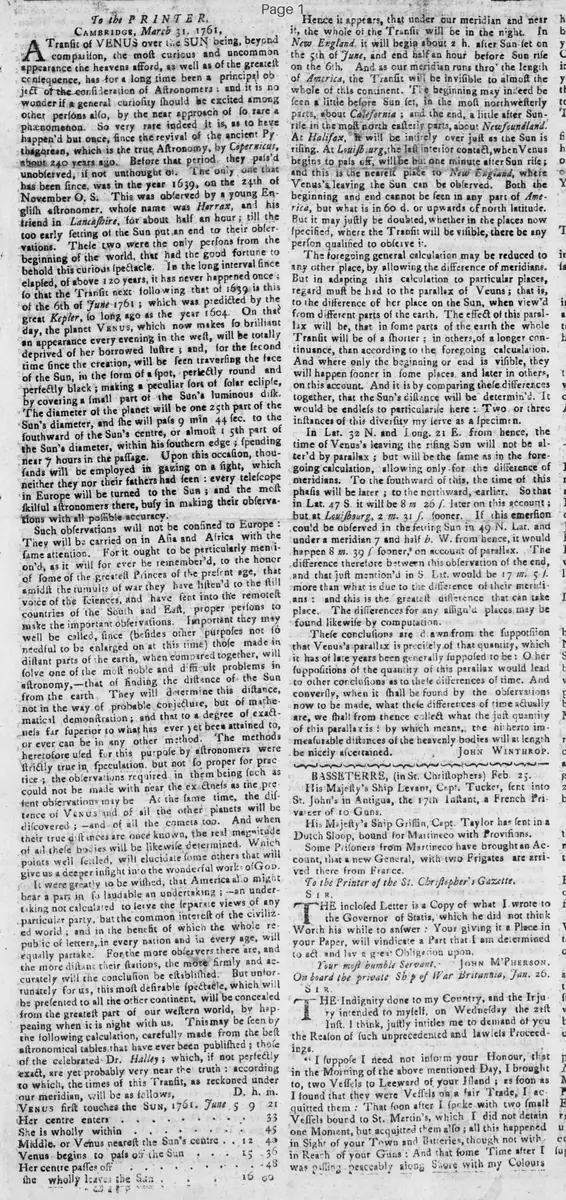
Transit of VENUS over the SUN being, beyond comparison, the most curious and uncommon appearance the heavens afford, as well as of the greatest consequence, has for a long time been a principal object of the consideration of Astronomers: and it is no wonder if a general curiosity should be excited among other persons also, by the near approach of so rare a phenomenon. So very rare indeed it is, as to have happened but once, since the revival of the ancient Pythagorean, which is the true Astronomy, by Copernicus, about 240 years ago. Before that period, they passed unobserved, if not unthought of. The only one that has been since, was in the year 1639, on the 24th of November O. S. This was observed by a young English astronomer, whose name was Horrocks, and his friend in Lancashire, for about half an hour; till the too early setting of the Sun put an end to their observations. These two were the only persons from the beginning of the world, that had the good fortune to behold this curious spectacle. In the long interval since elapsed, of above 120 years, it has never happened once: so that the Transit next following that of 1639 is this of the 6th of June 1761; which was predicted by the great Kepler, so long ago as the year 1604. On that day, the planet Venus, which now makes so brilliant an appearance every evening in the west, will be totally deprived of her borrowed lustre; and, for the second time since the creation, will be seen traversing the face of the Sun, in the form of a spot, perfectly round and perfectly black; making a peculiar sort of solar eclipse, by covering a small part of the Sun's luminous disk. The diameter of the planet will be one 12th part of the Sun's diameter, and he will pass 9 min 44 sec. southward of the Sun's centre, or almost 1/5th part of the Sun's diameter, within his southern edge; spending near 7 hours in the passage. Upon this occasion, thousands will be turned to the Sun; and the most skilful astronomers there, by their making their observations with all possible accuracy. They will be carried on in Asia and Africa with the same attention. For it ought to be particularly mentioned, as it will for ever be remembered, to the honor of some of the greatest Princes of the present age, that amidst the tumults of war they have listened to the still voice of the sciences, and have sent into the remotest countries of the South and East, proper persons to make the important observations. Important they may well be called, since (besides other purposes not needful to be enlarged on at this time) those made in distant parts of the earth, when compared together, will solve one of the most noble and difficult problems in astronomy,-that of finding the distance of the Sun from the earth They will determine this distance, not in the way of probable conjecture, but of mathematical demonstration: and that to a degree of exactness far superior to what has ever yet been attained to, or ever can be in any other method. The methods heretofore used for this purpose by astronomers were strictly true in speculation, but not so proper for practice; the observations required in them being such as could not be made with near the exactness as the present. At the same time, the distance of Venus and of all the other planets will be discovered; -and of all these bodies will be likewise determined. Which their true distances are once known, the real magnitude of all the comets too. And when these points well settled, will elucidate some others that will give us a deeper insight into the wonderful works of God. It were greatly to be wished, that America also might bear a part in so laudable an undertaking; -an undertaking not calculated to serve the separate views of any particular party, but the common interest of the civilized world: and in the benefit of which the whole republic of letters, in every nation and in every age, will equally partake. For the more observers there are, and the more distant their stations, the more firmly and accurately will the conclusion be established.- But unfortunately for us, this most desirable spectacle, which will be presented to all the other continents, will be concealed from the greatest part of our western world, by happening when it is night with us. This may be seen by the following calculation, carefully made from the best astronomical tables that have ever been published; those of the celebrated Dr. Halley; which, if not perfectly exact, are yet probably very near the truth: according to which, the times of this Transit, as reckoned under our meridian, will be as follows.
D. h. m.
Venus first touches the Sun, 1761. June 5 9 21
Her centre enters 9 33
She is wholly within 9 45
Middle, or Venus nearest the Sun's centre . . 12 40
Venus begins to pass off the Sun 15 36
Her centre passes off 15 48
the wholly leaves the Sun . 16 00
Hence it appears, that under our meridian and near it, the whole of the Transit will be in the night. In New England, it will begin about 2 h. after Sun-set on the 5th of June, and end half an hour before Sun rise on the 6th. And as our meridian runs thro' the length of America, the Transit will be invisible to almost the whole of this continent. The beginning may indeed be seen a little before Sun set, in the most northwesterly parts, about California; and the end, a little after Sun-rise in the most north easterly parts, about Newfoundland. At Halifax, It will be intirely over just as the Sun is rising. At Louisburg, the last interior contact, when Venus begins to pass off, will be but one minute after Sun rise; and this is the nearest place to New England, where Venus's leaving the Sun can be observed. Both the beginning and end cannot be seen in any part of America, but what is in 60 d. or upwards of north latitude. But it may justly be doubted, whether in the places now specified, where the Transit will be visible, there be any person qualified to observe it. The foregoing general calculation may be reduced to any other place, by allowing the difference of meridians. But in adapting this calculation to particular places, regard must be had to the parallax of Venus; that is, to the difference of her place on the Sun, when view'd from different parts of the earth. The effect of this parallax will be, that in some parts of the earth the whole Transit will be of a shorter: in others, of a longer continuance, than according to the foregoing calculation. And where only the beginning or end is visible, they will happen sooner in some places, and later in others, on this account. And it is by comparing these differences together, that the Sun's distance will be determin'd. It would be endless to particularize here: Two or three instances of this diversity may serve as a specimen. In Lat. 32 N. and Long. 21 E. from hence, the time of Venus's leaving the rising Sun will not be altered by parallax; but will be the same as in the foregoing calculation, allowing only for the difference of meridians. To the southward of this, the time of this phasis will be later: to the northward, earlier. So that in Lat. 47 S. it will be 8 m 26 s. later on this account; but at Louisburg, 2 m. 31 s. sooner. If this emersion could be observed in the setting Sun in 49 N. Lat. and under a meridian 7 and half d. W. from hence, it would happen 8 m. 39 s. sooner, on account of parallax. The difference therefore between this observation of the end, and that just mention'd in S Lat. would be 17 m. 5 s. more than what is due to the difference of their meridians: and this is the greatest difference that can take place. The differences for any assigned places, may be found likewise by computation. These conclusions are drawn from the supposition that Venus's parallax is precisely of that quantity, which it has of late years been generally supposed to be: Other suppositions of the quantity of this parallax would lead to other conclusions as to these differences of time. And conversely, when it shall be found by the observations now to be made, what these differences of time actually are, we shall from thence collect what the just quantity of this parallax is: by which means, the hitherto immeasurable distances of the heavenly bodies will at length be nicely ascertained.
JOHN WINTHROP.
What sub-type of article is it?
What themes does it cover?
What keywords are associated?
What entities or persons were involved?
Where did it happen?
Story Details
Key Persons
Location
Cambridge, Global (Asia, Africa, America)
Event Date
1761 06 06
Story Details
Description of the rare Transit of Venus on June 6, 1761, predicted by Kepler in 1604, previously observed only in 1639 by Horrocks; explains astronomical importance for measuring solar distance via global observations, regrets invisibility in most of America.