Thank you for visiting SNEWPapers!
Sign up free
Vandalia Whig And Illinois Intelligencer
Vandalia, Fayette County, Illinois
What is this article about?
Biographical account of General Anthony Wayne (1745-1796), born in Pennsylvania, educated in Philadelphia, surveyor, active in colonial politics, rose to brigadier general in Continental Army, fought in key Revolutionary War battles like Brandywine, Germantown, Monmouth, and Stony Point, later commanded against Indians in Northwest Territory, securing peace treaty.
Clipping
OCR Quality
Full Text
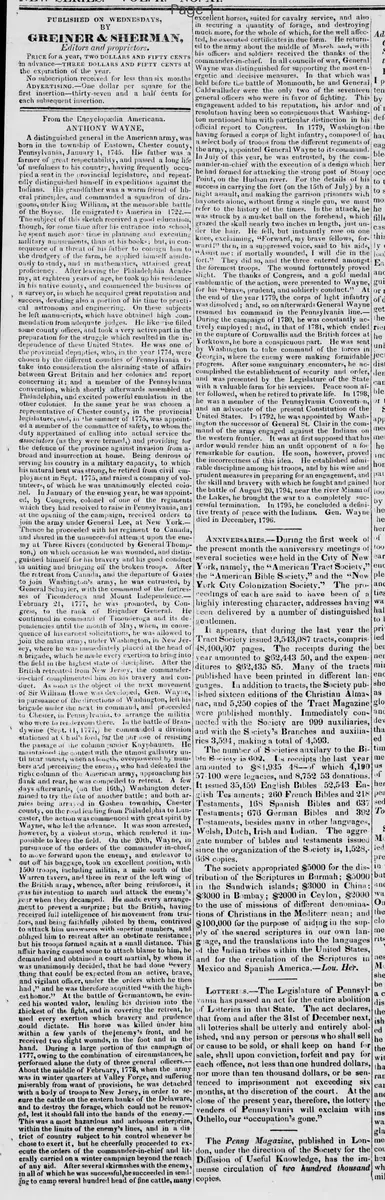
ANTHONY WAYNE,
A distinguished general in the American army, was
born in the township of Eastown, Chester county,
Pennsylvania, January 1, 1745. His father was a
farmer of great respectability, and passed a long life
of usefulness to his country, having frequently occupied a seat in the provincial legislature, and repeatedly distinguished himself in expeditions against the
Indians. His grandfather was a warm friend of liberal principles, and commanded a squadron of dragoons, under King William, at the memorable battle
of the Boyne. He emigrated to America in 1722.—
The subject of this sketch received a good education.
though, for some time after his entrance into school,
he spent much more time in planning and executing
military amusements, than at his books; but, in consequence of a threat of his father to consign him to
the drudgery of the farm, he applied himself assiduously to study, and in mathematics, attained great
proficiency. After leaving the Philadelphia Academy, at eighteen years of age, he took up his residence
in his native county, and commenced the business of
a surveyor, in which he acquired great reputation and
success, devoting also a portion of his time to practical astronomy and engineering. On these subjects
he left manuscripts, which have obtained high commendation from adequate judges. He likewise filled
some county offices, and took a very active part in the
preparation for the struggle which resulted in the independence of these United States. He was one of
the provincial deputies, who, in the year 1774, were
chosen by the different counties of Pennsylvania to
take into consideration the alarming state of affairs
between Great Britain and her colonies and report
concerning it: and a member of the Pennsylvania
convention, which shortly afterwards assembled at
Philadelphia, and excited powerful emulation in the
other colonies. In the same year he was chosen a
representative of Chester county, in the provincial
legislature, and, in the summer of 1775, was appointed a member of the committee of safety, to whom the
duty appertained of calling into actual service the
associators (as they were termed,) and providing for
the defence of the province against invasion from abroad and insurrection at home. Being desirous of
serving his country in a military capacity, to which
his natural bent was strong, he retired from civil employment in Sept. 1775, and raised a company of volunteers, of which he was unanimously elected colonel. In January of the ensuing year, he was appointed, by Congress, colonel of one of the regiments
which they had resolved to raise in Pennsylvania, and
at the opening of the campaign, received orders to
join the army under General Lee, at New York.—
Thence he proceeded with his regiment to Canada,
and shared in the unsuccessful attempt upon the enemy at Three Rivers (conducted by General Thompson,) on which occasion he was wounded, and distinguished himself for his bravery and his good conduct
in uniting and bringing off the broken troops. After
the retreat from Canada, and the departure of Gates
to join Washington's army, he was entrusted, by
General Schuyler, with the command of the fortresses of Ticonderoga and Mount Independence.—
February 21, 1777, he was promoted, by Congress,
to the rank of Brigadier General. He
continued in command of Ticonderoga and its dependencies until the month of May, when, in consequence of his earnest solicitations, he was allowed to
join the main army, under Washington, in New Jersey, where he was immediately placed at the head of
a brigade, which he made every exertion to bring into
the field in the highest state of discipline. After the
British retreated from New Jersey, the commander-in-chief complimented him on his bravery and conduct. As soon as the object of the next movement
of Sir William Howe was developed, Gen. Wayne,
in pursuance of the directions of Washington, left his
brigade under the next in command, and proceeded
to Chester, in Pennsylvania, to arrange the militia
who were to rendezvous there. In the battle of Brandywine (Sept. 11, 1777,) he commanded a division
stationed at Chadd's ford, for the purpose of resisting
the passage of the column under Knyphausen. He
maintained the contest with the utmost gallantry until near sunset, when at length, overpowered by numbers and perceiving the enemy, who had defeated the
right column of the American army, approaching his
flank and rear, he was compelled to retreat. A few
days afterwards, (on the 16th,) Washington determined to try the fate of another battle; and both armies being arrayed in Goshen township, Chester
county, on the road leading from Philadelphia to Lancaster, the action was commenced with great spirit by
Wayne, who led the advance. It was soon arrested,
however, by a violent storm, which rendered it impossible to keep the field. On the 20th, Wayne, in
pursuance of the orders of the commander-in-chief,
to move forward upon the enemy, and endeavor to
cut off his baggage, took an excellent position, with
1500 troops, including militia, a mile south of the
Warren tavern, and three in rear of the left wing of
the British army, whence, after being reinforced, it
was his intention to march and attack the enemy's
rear when they decamped. He made every arrangement to prevent a surprise; but the British, having
received full intelligence of his movement from traitors, and being faithfully piloted by them, contrived
to attack him unawares with superior numbers, and
obliged him to retreat after an obstinate resistance;
but his troops formed again at a small distance. This
affair having caused some to attach blame to him, he
demanded and obtained a court martial, by whom it
was unanimously decided, that he had done "every
thing that could be expected from an active, brave,
and vigilant officer, under the orders which he then
had," and he was therefore acquitted "with the highest honor." At the battle of Germantown, he evinced his wonted valor, leading his division into the
thickest of the fight, and in covering the retreat, he
used every exertion which bravery and prudence
could dictate. His horse was killed under him
within a few yards of the enemy's front, and he
received two slight wounds, in the foot and in the
hand. During a large portion of this campaign of
1777, owing to the combination of circumstances, he
performed alone the duty of three general officers.—
About the middle of February, 1778, when the army
was in winter quarters at Valley Forge, and suffering
miserably from want of provisions, he was detached
with a body of troops to New Jersey, in order to secure the cattle on the eastern banks of the Delaware,
and to destroy the forage, which could not be removed, lest it should fall into the hands of the enemy.—
This was a most hazardous and arduous enterprize,
within the limits of the enemy's lines, and in a district of country subject to his control whenever he
chose to exert it, but he cheerfully proceeded to execute the orders of the commander-in-chief and literally carried on a winter campaign beyond the reach
of any aid. After several skirmishes with the enemy,
in all of which he was successful, he succeeded in sending to camp several hundred head of fine cattle, many
excellent horses, suited for cavalry service, and also
in securing a quantity of forage, and destroying
much more, for the whole of which, for the well affected, he executed certificates in due form. He returned to the army about the middle of March and, with
his officers and soldiers received the thanks of the
commander-in-chief. In all councils of war, General
Wayne was distinguished for supporting the most energetic and decisive measures. In that which was
held before the battle of Monmouth, he and General
Cadwallader were the only two of the seventeen
general officers who were in favor of fighting. This
engagement added to his reputation, his ardor and
resolution having been so conspicuous that Washington mentioned him with particular distinction in his
official report to Congress. In 1779, Washington
having formed a corps of light infantry, composed of
a select body of troops from the different regiments of
the army, appointed General Wayne to its command.
In July of this year, he was entrusted, by the commander-in-chief with the execution of a design which
he had formed for attacking the strong post of Stony
Point, on the Hudson river. For the details of his
success in carrying the fort (on the 15th of July) by a
night assault, and making the garrison prisoners with
bayonets alone, without firing a single gun, we must
refer to the history of the times. In the attack, he
was struck by a musket ball on the forehead, which
grazed the skull nearly two inches in length, just under the hair. He fell, but instantly rose on one
knee, exclaiming, "Forward, my brave fellows, forward!" then, in a suppressed voice, said to his aids,
"Assist me: if mortally wounded, I will die in the
fort." They did so, and the three entered amongst
the foremost troops. The wound fortunately proved
slight. The thanks of Congress, and a gold medal
emblematic of the action, were presented to Wayne,
for his "brave, prudent, and soldierly conduct." At
the end of the year 1779, the corps of light infantry
was dissolved: and, soon afterwards General Wayne
resumed his command in the Pennsylvania line.—
During the campaign of 1780, he was constantly actively employed; and, in that of 1781, which ended
in the capture of Cornwallis and the British forces at
Yorktown, he bore a conspicuous part. He was sent
by Washington to take command of the forces in
Georgia, where the enemy were making formidable
progress. After some sanguinary encounters, he accomplished the establishment of security and order,
and was presented by the Legislature of the State
with a valuable farm for his services. Peace soon after followed, when he retired to private life. In 1788,
he was a member of the Pennsylvania Convention,
and an advocate of the present Constitution of the
United States. In 1792, he was appointed by Washington the successor of General St. Clair in the command of the army engaged against the Indians on
the western frontier. It was at first supposed that his
ardor would render him an unfit opponent of a foe
remarkable for caution. He soon, however, proved
the incorrectness of this idea. He established admirable discipline among his troops, and by his wise and
prudent measures in preparing for an engagement, and
the skill and bravery with which he fought and gained
the battle of August 20, 1794, near the river Miami of
the Lakes, he brought the war to a completely successful termination. In 1795, he concluded a definitive treaty of peace with the Indians. Gen. Wayne
died in December, 1796.
What sub-type of article is it?
What themes does it cover?
What keywords are associated?
What entities or persons were involved?
Where did it happen?
Story Details
Key Persons
Location
Pennsylvania, New York, Canada, New Jersey, Georgia, Western Frontier
Event Date
January 1, 1745 December 1796
Story Details
Anthony Wayne, born 1745 in Pennsylvania, educated and worked as surveyor, entered military service in 1775, rose to brigadier general, fought in Revolutionary War battles including Canada, Brandywine, Paoli, Germantown, Monmouth, Stony Point; acquitted by court martial; later commanded in Georgia and against Indians, winning 1794 battle and 1795 treaty; died 1796.