Thank you for visiting SNEWPapers!
Sign up free
Literary
January 16, 1922
The West Virginian
Fairmont, Marion County, West Virginia
What is this article about?
Marion Collins, an enthusiastic but inept golfer, accidentally hits a ball that strikes Harold Hemingway on the golf course, leading to their introduction. Both poor players, they bond over their shared struggles and reveal they each faked parts of the incident, culminating in romance.
Clipping
OCR Quality
95%
Excellent
Full Text
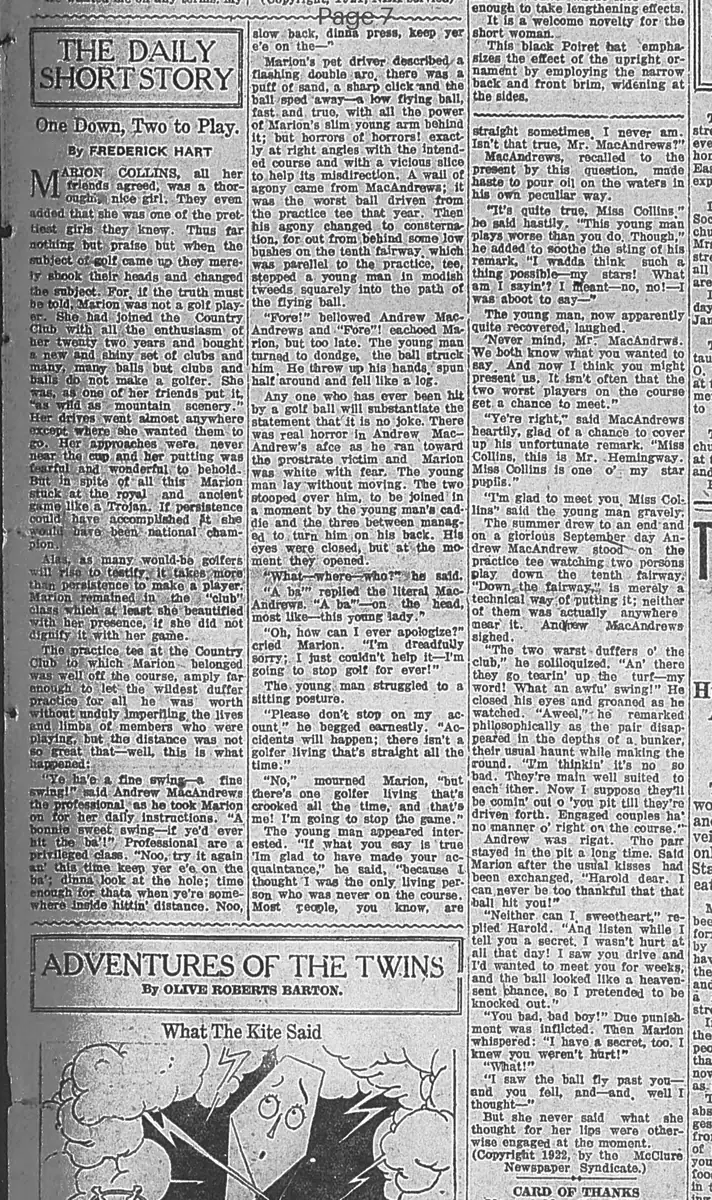
THE DAILY
SHORT STORY
One Down, Two to Play.
By FREDERICK HART
MARION COLLINS, all her friends agreed, was a thorough nice girl. They even added that she was one of the prettiest girls they knew. Thus far nothing but praise but when the subject of golf came up they merely shook their heads and changed the subject. For, if the truth must be told, Marion was not a golf player. She had joined the Country club with all the enthusiasm of her twenty two years and bought a new and shiny set of clubs and many many balls but clubs and balls do not make a golfer. She was, as one of her friends put it, "as wild as mountain scenery."
Her drives went almost anywhere except where she wanted them to go. Her approaches were never near the cup and her putting was fearful and wonderful to behold.
But in spite of all this Marion stuck at the royal and ancient game like a Trojan. If persistence could have accomplished it she would have been national champion.
Alas. As many would-be golfers will also testify. it takes more than persistence to make a player.
Marion remained in the "club" class which at least she beautified with her presence, if she did not dignify it with her game.
The practice tee at the Country Club to which Marion belonged was well off the course, amply far enough to let the wildest duffer practice for all he was worth without unduly imperiling the lives and limbs of members who were playing, but the distance was not so great that—well, this is what happened:
"Ye have a fine swing—a fine swing!" said Andrew MacAndrews the professional as he took Marion on for her daily instructions. "A bonnie sweet swing if ye'd ever hit the ball!" Professionals are a privileged class. "Noo, try it again an' this time keep yer e'e on the ball; dinna look at the hole; time enough for that when ye're somewhere inside hittin' distance. Noo, slow back, dinna press, keep yer e'e on the—"
Marion's pet driver described a flashing double arc there was a puff of sand, a sharp click and the ball sped away—a low flying ball, fast and true, with all the power of Marion's slim young arm behind it; but horrors of horrors! exactly at right angles with the intended course and with a vicious slice to help its misdirection. A wail of agony came from MacAndrews; it was the worst ball driven from the practice tee that year. Then his agony changed to consternation, for out from behind some low bushes on the tenth fairway, which was parallel to the practice tee, stepped a young man in modish tweeds squarely into the path of the flying ball.
"Fore!" bellowed Andrew MacAndrews and "Fore!" echoed Marion, but too late. The young man turned to dodge, the ball struck him. He threw up his hands spun half around and fell like a log.
Any one who has ever been hit by a golf ball will substantiate the statement that it is no joke. There was real horror in Andrew MacAndrews face as he ran toward the prostrate victim and Marion was white with fear. The young man lay without moving. The two stooped over him, to be joined in a moment by the young man's caddie and the three between managed to turn him on his back. His eyes were closed, but at the moment they opened.
"What—where—who?" he said.
"A ball," replied the literal MacAndrews. "A ball on the head, most likely this young lady."
"Oh, how can I ever apologize?" cried Marion. "I'm dreadfully sorry. I just couldn't help it. I'm going to stop golf for ever!"
The young man struggled to a sitting posture.
"Please don't stop on my account," he begged earnestly. "Accidents will happen; there isn't a golfer living that's straight all the time."
"No," mourned Marion, "but there's one golfer living that's crooked all the time, and that's me! I'm going to stop the game."
The young man appeared interested. "If what you say is true I'm glad to have made your acquaintance," he said, "because I thought I was the only living person who was never on the course. Most people, you know, are."
Straight sometimes. I never am. Isn't that true, Mr. MacAndrews?
MacAndrews, recalled to the present by this question, made haste to pour oil on the waters in his own peculiar way.
"It's quite true, Miss Collins," he said hastily. "This young man plays worse than you do. Though," he added to soothe the sting of his remark, "I wadna think such a thing possible my stars! What am I sayin'? I meant—no, no! I was about to say—"
The young man, now apparently quite recovered, laughed.
"Never mind, Mr. MacAndrews. We both know what you wanted to say. And now I think you might present us. It isn't often that the two worst players on the course get a chance to meet."
"Ye're right," said MacAndrews heartily, glad of a chance to cover up his unfortunate remark. "Miss Collins, this is Mr. Hemingway. Miss Collins is one o' my star pupils."
"I'm glad to meet you Miss Collins," said the young man gravely.
The summer drew to an end and on a glorious September day Andrew MacAndrews stood on the practice tee watching two persons play down the tenth fairway.
"Down the fairway" is merely a technical way of putting it; neither of them was actually anywhere near it. Andrew MacAndrews sighed,
"The two warst duffers o' the club," he soliloquized. "An' there they go tearin' up the turf—my word! What an awfu' swing!" He closed his eyes and groaned as he watched. "Aweel," he remarked philosophically as the pair disappeared in the depths of a bunker, their usual haunt while making the round. "I'm thinkin' it's no so bad. They're main well suited to each ither. Now I suppose they'll be comin' oul o' yon pit till they're driven forth. Engaged couples ha' no manner o' right on the course."
Andrew was right. The pair stayed in the pit a long time. Said Marion after the usual kisses had been exchanged. "Harold dear, I can never be too thankful that that ball hit you!"
"Neither can I, sweetheart," replied Harold. "And listen while I tell you a secret. I wasn't hurt at all that day! I saw you drive and I'd wanted to meet you for weeks, and the ball looked like a heaven-sent chance, so I pretended to be knocked out."
"You bad, bad boy!" Due punishment was inflicted. Then Marion whispered: "I have a secret too. I knew you weren't hurt!"
"What!"
"I saw the ball fly past you and you fell, and—and, well I thought—"
But she never said what she thought for her lips were otherwise engaged at the moment.
(Copyright 1922, by the McClure Newspaper Syndicate.)
SHORT STORY
One Down, Two to Play.
By FREDERICK HART
MARION COLLINS, all her friends agreed, was a thorough nice girl. They even added that she was one of the prettiest girls they knew. Thus far nothing but praise but when the subject of golf came up they merely shook their heads and changed the subject. For, if the truth must be told, Marion was not a golf player. She had joined the Country club with all the enthusiasm of her twenty two years and bought a new and shiny set of clubs and many many balls but clubs and balls do not make a golfer. She was, as one of her friends put it, "as wild as mountain scenery."
Her drives went almost anywhere except where she wanted them to go. Her approaches were never near the cup and her putting was fearful and wonderful to behold.
But in spite of all this Marion stuck at the royal and ancient game like a Trojan. If persistence could have accomplished it she would have been national champion.
Alas. As many would-be golfers will also testify. it takes more than persistence to make a player.
Marion remained in the "club" class which at least she beautified with her presence, if she did not dignify it with her game.
The practice tee at the Country Club to which Marion belonged was well off the course, amply far enough to let the wildest duffer practice for all he was worth without unduly imperiling the lives and limbs of members who were playing, but the distance was not so great that—well, this is what happened:
"Ye have a fine swing—a fine swing!" said Andrew MacAndrews the professional as he took Marion on for her daily instructions. "A bonnie sweet swing if ye'd ever hit the ball!" Professionals are a privileged class. "Noo, try it again an' this time keep yer e'e on the ball; dinna look at the hole; time enough for that when ye're somewhere inside hittin' distance. Noo, slow back, dinna press, keep yer e'e on the—"
Marion's pet driver described a flashing double arc there was a puff of sand, a sharp click and the ball sped away—a low flying ball, fast and true, with all the power of Marion's slim young arm behind it; but horrors of horrors! exactly at right angles with the intended course and with a vicious slice to help its misdirection. A wail of agony came from MacAndrews; it was the worst ball driven from the practice tee that year. Then his agony changed to consternation, for out from behind some low bushes on the tenth fairway, which was parallel to the practice tee, stepped a young man in modish tweeds squarely into the path of the flying ball.
"Fore!" bellowed Andrew MacAndrews and "Fore!" echoed Marion, but too late. The young man turned to dodge, the ball struck him. He threw up his hands spun half around and fell like a log.
Any one who has ever been hit by a golf ball will substantiate the statement that it is no joke. There was real horror in Andrew MacAndrews face as he ran toward the prostrate victim and Marion was white with fear. The young man lay without moving. The two stooped over him, to be joined in a moment by the young man's caddie and the three between managed to turn him on his back. His eyes were closed, but at the moment they opened.
"What—where—who?" he said.
"A ball," replied the literal MacAndrews. "A ball on the head, most likely this young lady."
"Oh, how can I ever apologize?" cried Marion. "I'm dreadfully sorry. I just couldn't help it. I'm going to stop golf for ever!"
The young man struggled to a sitting posture.
"Please don't stop on my account," he begged earnestly. "Accidents will happen; there isn't a golfer living that's straight all the time."
"No," mourned Marion, "but there's one golfer living that's crooked all the time, and that's me! I'm going to stop the game."
The young man appeared interested. "If what you say is true I'm glad to have made your acquaintance," he said, "because I thought I was the only living person who was never on the course. Most people, you know, are."
Straight sometimes. I never am. Isn't that true, Mr. MacAndrews?
MacAndrews, recalled to the present by this question, made haste to pour oil on the waters in his own peculiar way.
"It's quite true, Miss Collins," he said hastily. "This young man plays worse than you do. Though," he added to soothe the sting of his remark, "I wadna think such a thing possible my stars! What am I sayin'? I meant—no, no! I was about to say—"
The young man, now apparently quite recovered, laughed.
"Never mind, Mr. MacAndrews. We both know what you wanted to say. And now I think you might present us. It isn't often that the two worst players on the course get a chance to meet."
"Ye're right," said MacAndrews heartily, glad of a chance to cover up his unfortunate remark. "Miss Collins, this is Mr. Hemingway. Miss Collins is one o' my star pupils."
"I'm glad to meet you Miss Collins," said the young man gravely.
The summer drew to an end and on a glorious September day Andrew MacAndrews stood on the practice tee watching two persons play down the tenth fairway.
"Down the fairway" is merely a technical way of putting it; neither of them was actually anywhere near it. Andrew MacAndrews sighed,
"The two warst duffers o' the club," he soliloquized. "An' there they go tearin' up the turf—my word! What an awfu' swing!" He closed his eyes and groaned as he watched. "Aweel," he remarked philosophically as the pair disappeared in the depths of a bunker, their usual haunt while making the round. "I'm thinkin' it's no so bad. They're main well suited to each ither. Now I suppose they'll be comin' oul o' yon pit till they're driven forth. Engaged couples ha' no manner o' right on the course."
Andrew was right. The pair stayed in the pit a long time. Said Marion after the usual kisses had been exchanged. "Harold dear, I can never be too thankful that that ball hit you!"
"Neither can I, sweetheart," replied Harold. "And listen while I tell you a secret. I wasn't hurt at all that day! I saw you drive and I'd wanted to meet you for weeks, and the ball looked like a heaven-sent chance, so I pretended to be knocked out."
"You bad, bad boy!" Due punishment was inflicted. Then Marion whispered: "I have a secret too. I knew you weren't hurt!"
"What!"
"I saw the ball fly past you and you fell, and—and, well I thought—"
But she never said what she thought for her lips were otherwise engaged at the moment.
(Copyright 1922, by the McClure Newspaper Syndicate.)
What sub-type of article is it?
Prose Fiction
What themes does it cover?
Love Romance
Social Manners
What keywords are associated?
Golf
Romance
Country Club
Accident
Duffers
Short Story
What entities or persons were involved?
By Frederick Hart
Literary Details
Title
One Down, Two To Play.
Author
By Frederick Hart
Key Lines
"Please Don't Stop On My Account," He Begged Earnestly. "Accidents Will Happen; There Isn't A Golfer Living That's Straight All The Time."
"If What You Say Is True I'm Glad To Have Made Your Acquaintance," He Said, "Because I Thought I Was The Only Living Person Who Was Never On The Course."
"The Two Warst Duffers O' The Club," He Soliloquized.
"Harold Dear, I Can Never Be Too Thankful That That Ball Hit You!"
"I Have A Secret Too. I Knew You Weren't Hurt!"