Thank you for visiting SNEWPapers!
Sign up free
Norfolk Gazette And Publick Ledger
Norfolk, Virginia
What is this article about?
Extracts of letters from US Minister James Monroe in London to Secretary James Madison detailing diplomatic negotiations with British Lords Hawkesbury and Harrowby on a proposed convention to address impressment of seamen, trade regulations, treaty of 1794 expiration, and US boundaries, including the impact of the Louisiana Purchase, from March 1804 to September 1805.
Merged-components note: Direct textual continuation of diplomatic documents regarding US-British relations, negotiations, and boundaries; second component mislabeled as domestic_news but pertains to foreign policy.
Clippings
1 of 2
OCR Quality
Full Text
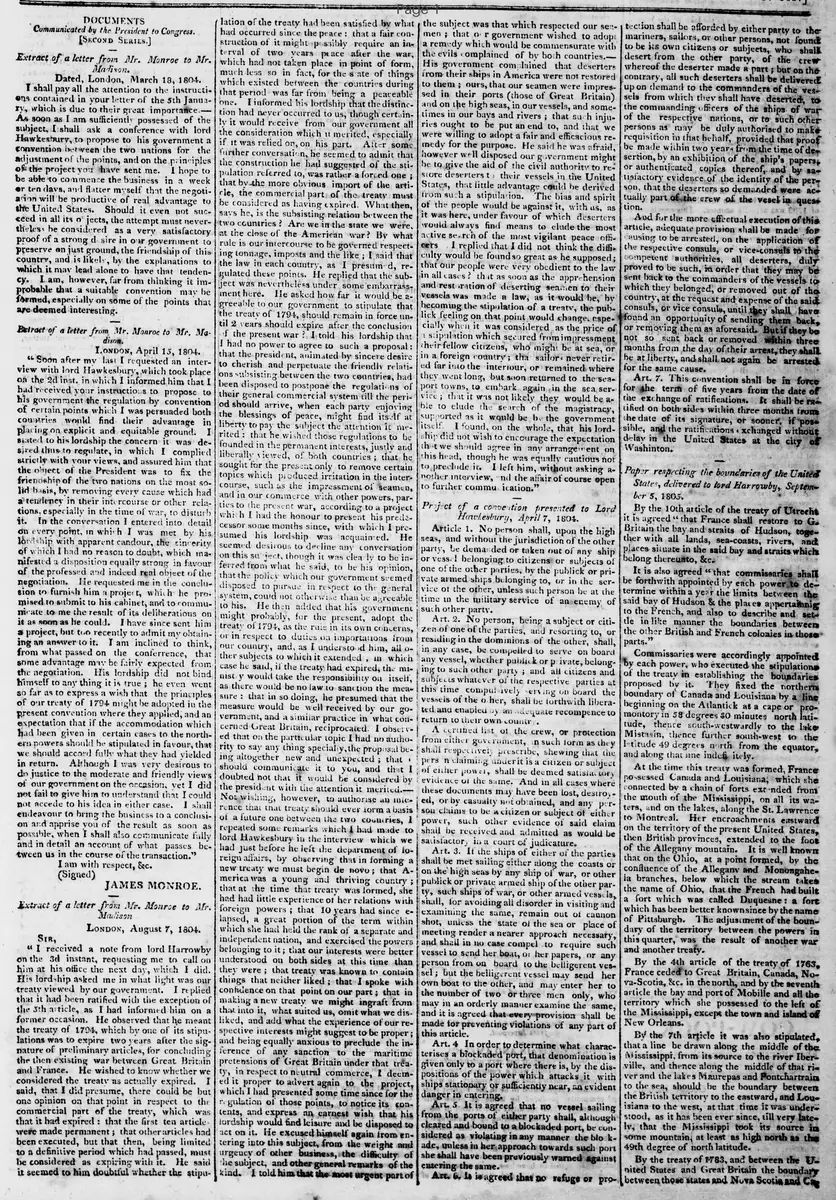
Communicated by the President to Congress.
[Second Series.]
Extract of a letter from Mr. Monroe to Mr. Madison.
Dated, London, March 18, 1804.
I shall pay all the attention to the instructions contained in your letter of the 5th January, which is due to their great importance. As soon as I am sufficiently possessed of the subject, I shall ask a conference with Lord Hawkesbury, to propose to his government a convention between the two nations for the adjustment of the points, and on the principles of the project you have sent me. I hope to be able to commence the business in a week or ten days, and flatter myself that the negotiation will be productive of real advantage to the United States. Should it even not succeed in all its objects, the attempt must nevertheless be considered as a very satisfactory proof of a strong desire in our government to preserve on just ground, the friendship of this country, and is likely, by the explanations to which it may lead alone to have that tendency. I am, however, far from thinking it improbable that a suitable convention may be formed, especially on some of the points that are deemed interesting.
Extract of a letter from Mr. Monroe to Mr. Madison.
London, April 15, 1804.
Soon after my last I requested an interview with Lord Hawkesbury, which took place on the 2d inst. in which I informed him that I had received your instructions to propose to his government the regulation by convention of certain points which I was persuaded both countries would find their advantage in placing on explicit and equitable ground. I stated to his lordship the concern it was desired thus to regulate, in which I complied strictly with your views, and assured him that the object of the President was to fix the friendship of the two nations on the most solid basis, by removing every cause which had a tendency in their intercourse or other relations, especially in the time of war, to disturb it. In the conversation I entered into detail on every point, in which I was met by his lordship with apparent candour, the sincerity of which I had no reason to doubt, which manifested a disposition equally strong in favour of the professed and indeed real object of the negotiation. He requested me in the conclusion to furnish him a project, which he promised to submit to his cabinet, and to communicate to me the result of its deliberations on it as soon as he could. I have since sent him a project, but too recently to admit my obtaining an answer to it. I am inclined to think, from what passed on the conference, that some advantage may be fairly expected from the negotiation. His lordship did not bind himself to any thing it is true; he even went so far as to express a wish that the principles of our treaty of 1794 might be adopted in the present convention where they applied, and an expectation that if the accommodation which had been given in certain cases to the northern powers should be stipulated in favour, that we should accord fully what they had yielded in return. Although I was very desirous to do justice to the moderate and friendly views of our government on the occasion, yet I did not fail to give him to understand that I could not accede to his idea in either case. I shall endeavour to bring the business to a conclusion and apprise you of the result as soon as possible, when I shall also communicate fully and in detail an account of what passes between us in the course of the transaction.
I am with respect, &c.
(Signed)
JAMES MONROE.
Extract of a letter from Mr. Monroe to Mr. Madison
London, August 7, 1804.
SIR,
I received a note from Lord Harrowby on the 3d instant, requesting me to call on him at his office the next day, which I did. His lordship asked me in what light was our treaty viewed by our government. I replied that it had been ratified with the exception of the 5th article, as I had informed him on a former occasion. He observed that he meant the treaty of 1794, which by one of its stipulations was to expire two years after the signature of preliminary articles, for concluding the then existing war between Great Britain and France. He wished to know whether we considered the treaty as actually expired. I said, that I did presume, there could be but one opinion on that point in respect to the commercial part of the treaty, which was that it had expired: that the first ten articles were made permanent; that other articles had been executed, but that then, being limited to a definitive period which had passed, must be considered as expiring with it. He said it seemed to him doubtful whether the stipulation of the treaty had been satisfied by what had occurred since the peace: that a fair construction of it might possibly require an interval of two years peace after the war, which had not taken place in point of form, much less so in fact, for the state of things which existed between the countries during that period was far from being a peaceable one. I informed his lordship that the distinction had never occurred to us, though certainly it would receive from our government all the consideration which it merited, especially if it was relied on, on his part. After some further conversation, he seemed to admit that the construction he had suggested of the stipulation referred to, was rather a forced one; that by the more obvious import of the article, the commercial part of the treaty must be considered as having expired. What then, says he, is the subsisting relation between the two countries? Are we in the state we were, at the close of the American war? By what rule is our intercourse to be governed respecting tonnage, imposts and the like: I said that the law in each country, as I presumed, regulated these points. He replied that the subject was nevertheless under some embarrassment here. He asked how far it would be agreeable to our government to stipulate that the treaty of 1794, should remain in force until 2 years should expire after the conclusion of the present war? I told his lordship that I had no power to agree to such a proposal: that the president, animated by sincere desire to cherish and perpetuate the friendly relations subsisting between the two countries, had been disposed to postpone the regulations of their general commercial system till the period should arrive, when each party enjoying the blessings of peace, might find itself at liberty to pay the subject the attention it merited: that he wished those regulations to be founded in the permanent interests, justly and liberally viewed, of both countries; that he sought for the present only to remove certain topics which produced irritation in the intercourse, such as the impressment of seamen, and in our commerce with other powers, parties to the present war, according to a project which I had the honour to present his predecessor some months since, with which I presumed his lordship was acquainted. He seemed desirous to decline any conversation on this subject, though it was clearly to be inferred from what he said, to be his opinion, that the policy which our government seemed disposed to pursue in respect to the general system, could not otherwise than be agreeable to his. He then added that his government might probably, for the present, adopt the treaty of 1794, as the rule in its own concerns, or in respect to duties on importations from our country, and, as I understood him, all other subjects to which it extended, in which case he said, if the treaty had expired, the ministry would take the responsibility on itself, as there would be no law to sanction the measure: that in so doing, he presumed that the measure would be well received by our government, and a similar practice in what concerned Great Britain, reciprocated. I observed that on the particular topic I had no authority to say any thing specially, the proposal being altogether new and unexpected; that should communicate it to you, and that I doubted not that it would be considered by the president with the attention it merited. Not wishing, however, to authorise an inference that that treaty should ever form a basis of a future one between the two countries, I repeated some remarks which I had made to Lord Hawkesbury in the interview which we had just before he left the department of foreign affairs, by observing that in forming a new treaty we must begin de novo; that America was a young and thriving country; that at the time that treaty was formed, she had had little experience of her relations with foreign powers; that 10 years had since elapsed, a great portion of the term within which she had held the rank of a separate and independent nation, and exercised the powers belonging to it; that our interests were better understood on both sides at this time than they were; that treaty was known to contain things that neither liked; that I spoke with confidence on that point on our part; that in making a new treaty we might ingraft from that into it, what suited us, omit what we disliked, and add what the experience of our respective interests might suggest to be proper; and being equally anxious to preclude the inference of any sanction to the maritime pretensions of Great Britain under that treaty, in respect to neutral commerce, I deemed it proper to advert again to the project, which I had presented some time since for the regulation of those points, to notice its contents, and express an earnest wish that his lordship would find leisure and be disposed to act on it. He excused himself again from entering into this subject, from the weight and urgency of other business, the difficulty of the subject, and other general remarks of the kind. I told him that the most urgent part of the subject was that which respected our seamen; that our government wished to adopt a remedy which would be commensurate with the evils complained of by both countries. His government complained that deserters from their ships in America were not restored to them; ours, that our seamen were impressed in their ports (those of Great Britain) and on the high seas, in our vessels, and sometimes in our bays and rivers; that such injuries ought to be put an end to, and that we were willing to adopt a fair and efficacious remedy for the purpose. He said he was afraid, however well disposed our government might be to give the aid of the civil authority to restore deserters to their vessels in the United States, that little advantage could be derived from such a stipulation. The bias and spirit of the people would be against it, with us, as it was here, under favour of which deserters would always find means to elude the most active search of the most vigilant peace officers. I replied that I did not think the difficulty would be found so great as he supposed; that our people were very obedient to the law in all cases; that as soon as the apprehension and restoration of deserting seamen to their vessels was made a law, as it would be, by becoming the stipulation of a treaty, the public feeling on that point would change, especially when it was considered as the price of a stipulation which secured from impressment their fellow citizens, who might be at sea, or in a foreign country; that sailors never retired far into the interior, or remained where they went long, but soon returned to the seaport towns, to embark again in the sea service; that it was not likely they would be able to elude the search of the magistracy, supported as it would be by the government itself. I found, on the whole, that his lordship did not wish to encourage the expectation that we should agree in any arrangement on this head, though he was equally cautious not to preclude it. I left him, without asking another interview, and the affair of course open to further communication.
Project of a convention presented to Lord Hawkesbury, April 7, 1804.
Article 1. No person shall, upon the high seas, and without the jurisdiction of the other party, be demanded or taken out of any ship or vessel belonging to citizens or subjects of one of the other parties, by the public or private armed ships belonging to, or in the service of the other, unless such person be at the time in the military service of an enemy of such other party.
Art. 2. No person, being a subject or citizen of one of the parties, and resorting to, or residing in the dominions of the other, shall, in any case, be compelled to serve on board any vessel, whether public or private, belonging to such other party; and all citizens and subjects whatever of the respective parties at this time compulsively serving on board the vessels of the other, shall be forthwith liberated and enabled by an adequate recompence to return to their own country. A certified list of the crew, or protection from either government, in such form as they shall respectively prescribe, shewing that the person claiming under it is a citizen or subject of either power, shall be deemed satisfactory evidence of the same. And in all cases where these documents may have been lost, destroyed, or by casualty not obtained, and any person claims to be a citizen or subject of either power, such other evidence of said claim shall be received and admitted as would be satisfactory, in a court of judicature.
Art. 3. If the ships of either of the parties shall be met sailing either along the coasts or on the high seas by any ship of war, or other public or private armed ship of the other party, such ships of war, or other armed vessels, shall, for avoiding all disorder in visiting and examining the same, remain out of cannon shot, unless the state of the sea or place of meeting render a nearer approach necessary, and shall in no case compel to require such vessel to send her boat, or her papers, or any person from on board to the belligerent vessel; but the belligerent vessel may send her own boat to the other, and may enter her to the number of two or three men only, who may in an orderly manner examine the same, and it is agreed that every provision shall be made for preventing violations of any part of this article.
Art. 4 In order to determine what characterises a blockaded port, that denomination is given only to a port where there is, by the dispositions of the power which attacks it with ships stationary or sufficiently near, an evident danger in entering.
Art. 5 It is agreed that no vessel sailing from the ports of either party shall, although cleared and bound to a blockaded port, be considered as violating in any manner the blockade, unless in her approach towards such port she shall have been previously warned against entering the same.
Art. 6. It is agreed that no refuge or protection shall be afforded by either party to the mariners, sailors, or other persons, not found to be its own citizens or subjects, who shall desert from the other party, of the crew whereof the deserter made a part; but on the contrary, all such deserters shall be delivered up on demand to the commanders of the vessels from which they shall have deserted, to the commanding officers of the ships of war of the respective nations, or to such other persons as may be duly authorised to make requisition in that behalf, provided that proof be made within two years from the time of desertion, by an exhibition of the ship's papers; or authenticated copies thereof, and by satisfactory evidence of the identity of the person, that the deserters so demanded were actually part of the crew of the vessel in question. And for the more effectual execution of this article, adequate provision shall be made for causing to be arrested, on the application of the respective consuls, or vice-consuls to the competent authorities, all deserters, duly proved to be such, in order that they may be sent back to the commanders of the vessels to which they belonged, or removed out of the country, at the request and expense of the said consuls, or vice consuls, until they shall have found an opportunity of sending them back, or removing them as aforesaid. But if they be not so sent back or removed within three months from the day of their arrest, they shall be at liberty, and shall not again be arrested for the same cause.
Art. 7. This convention shall be in force for the term of five years from the date of the exchange of ratifications. It shall be ratified on both sides within three months from the date of its signature, or sooner, if possible, and the ratifications exchanged without delay in the United States at the city of Washington.
Paper respecting the boundaries of the United States, delivered to Lord Harrowby, September 5, 1805.
By the 10th article of the treaty of Utrecht it is agreed that France shall restore to G. Britain the bay and straits of Hudson, together with all lands, sea-coasts, rivers, and places situate in the said bay and straits which belong thereunto, &c.
It is also agreed that commissaries shall be forthwith appointed by each power to determine within a year the limits between the said bay of Hudson & the places appertaining to the French, and also to describe and settle in like manner the boundaries between the other British and French colonies in those parts.
Commissaries were accordingly appointed by each power, who executed the stipulations of the treaty in establishing the boundaries proposed by it. They fixed the northern boundary of Canada and Louisiana by a line beginning on the Atlantic at a cape or promontory in 58 degrees 30 minutes north latitude, thence south-westwardly to the lake Mistasin, thence further south-west to the latitude 49 degrees north from the equator, and along that line indefinitely.
At the time this treaty was formed, France possessed Canada and Louisiana, which she connected by a chain of forts extended from the mouth of the Mississippi, on all its waters, and on the lakes, along the St. Lawrence to Montreal. Her encroachments eastward on the territory of the present United States, then British provinces, extended to the foot of the Allegany mountain. It is well known that on the Ohio, at a point formed by the confluence of the Allegany and Monongahela branches, below which the stream takes the name of Ohio, that the French had built a fort which was called Duquesne: a fort which has been better known since by the name of Pittsburgh. The adjustment of the boundary of the territory between the powers in this quarter, was the result of another war and another treaty.
By the 4th article of the treaty of 1763. France ceded to Great Britain, Canada, Nova-Scotia, &c. in the north, and by the seventh article the bay and port of Mobile and all the territory which she possessed to the left of the Mississippi, except the town and island of New Orleans.
By the 7th article it was also stipulated that a line be drawn along the middle of the Mississippi, from its source to the river Iberville, and thence along the middle of that river and the lakes Maurepas and Pontchartrain to the sea, should be the boundary between the British territory to the eastward, and Louisiana to the west, at that time it was understood, as it has been ever since, till very lately, that the Mississippi took its source in some mountain, at least as high north as the 49th degree of north latitude.
By the treaty of 1783, and between the United States and Great Britain the boundary between those states and Nova Scotia and Canada
Boundary is fixed by a line which is to run along the St. Croix and Highlands, bounding the southern waters of St. Lawrence, the 45th degree of latitude to the water communication between the lakes, and along that communication to the lake of the Woods, and through that lake to the northwestern point thereof; thence a due west course to the Mississippi. The line follows afterwards the course of the Mississippi to the 31st degree of north latitude.
By Mitchell's map, by which the treaty of 1783 was formed, it was evident that the northwestern point of the lake of the Woods, was at least as high north as the lat. 49. By the observations of Mr. Thompson, astronomer to the North Western company, it appears to be in lat. of 49 degrees 37 minutes. By joining then the western boundary of Canada to its northern in the lake of the Woods, and closing both there, it follows that it was the obvious intention of the ministers who negotiated the treaty, and of their respective governments, that the United States should possess all the territory lying between the lakes and the Mississippi, south of the parallel of the 49th degree of north latitude. This is confirmed by the courses which are afterwards pursued by the treaty, since they are precisely those which had been established between Great Britain and France in former treaties.
By running due west from the northwestern point of the lake of the Woods to the Mississippi, it must have been intended, according to the lights before them, to take the parallel of 49th degree of lat. as established under the treaty of Utrecht; and by pursuing thence the course of the Mississippi to the 31st degree of latitude the whole extent of the western boundary of the United States the boundary which had been established by the treaty of 1763 was actually adopted. This conclusion is further supported by the liberal spirit which terminated the war of our revolution, it having been manifestly the intention of the parties to heal, as far as could be done, the wounds which it had inflicted. Nor is it essentially weakened by the circumstance that the Mississippi is called for by the western course from the lake of the Woods, or that its navigation is stipulated in favour of both powers. Westward of the Mississippi, to the south of the 49th degree of north latitude Great Britain held then no territory. That river was her western boundary. In running west and ceding the territory of the river it was impossible not to call for it; and on the supposition that it took its source within the limits of the Hudson bay company, it was natural that it should stipulate the free navigation of the river. But in so doing it is presumed that her government respected more a delicate sense of what it might be supposed to owe to the interests of that company, than any strong motive of policy founded on the interest of Canada, or its other possessions, in that quarter. As Great Britain ceded at the same time the Floridas to Spain the navigation of the Mississippi by her subjects, if it took place, being under a foreign jurisdiction, could not fail to draw from her own territories the resources which properly belonged to them, and therefore could not be viewed in the light of a national advantage.
After the treaty of 1783, and at the time the convention in contemplation was entered into, the state of things was as is above stated. The territory which Great Britain held westward of the lake of the woods, was bounded south by the 49th degree of north lat. that which lay between the lake of the woods and the Mississippi southward of that parallel, belonged to the United States; and that which lay to the west of the Mississippi to Spain. It being, however, understood by more recent discoveries or observations that the source of the Mississippi did not extend so high north as had been supposed, and Great Britain having shewn a desire to have the boundary of the United States modified in such manner as to strike the river, an article to that effect was inserted in the late convention. But in so doing it was not the intention of the American minister or of the British minister, to do more than simply to define the American boundary. It was not contemplated by either of them, that America should convey to Great Britain any right to the territory lying westward of that line, since not a foot of it belonged to her. It was intended to leave it to Great Britain to settle the point as to such territory, or such portion of it as she might want, with Spain or rather with France, to whom it then belonged. At this period, however, certain measures respecting the Mississippi, and movements in that quarter took place, which seemed to menace the great interests of America that were dependant on the river. These excited a sensibility, acute and universal; of which in equal degree her history furnishes but few examples. They led to a discussion which terminated in a treaty with France, by which that power ceded to the United States the whole of Louisiana, as she had received it of Spain, this treaty took place on the 30th of April, 1803, twelve days only before the convention between Great Britain and the United States was signed, and some days before the adoption of such a treaty was known to the plenipotentiaries who negotiated and signed the convention.
Under such circumstances it is impossible that any right which the United States derived under that treaty could be conveyed by this convention to Great Britain, or that the ministers who formed the convention could have contemplated such an effect by it. Thus the stipulation which is contained in the 5th article of the convention has become by the cession made by the treaty, perfectly nugatory; for as Great Britain holds no territory southward of the 49th degree of north latitude, and the United States the whole of it, the line proposed by that article would run through a country which now belongs exclusively to the latter.
What sub-type of article is it?
What keywords are associated?
What entities or persons were involved?
Where did it happen?
Foreign News Details
Primary Location
London
Event Date
March 18, 1804 To September 5, 1805
Key Persons
Outcome
ongoing negotiations with no final resolution reported; proposed convention on impressment, blockades, and deserters; boundary discussions affected by louisiana purchase, rendering some stipulations nugatory.
Event Details
James Monroe reports to James Madison on diplomatic efforts in London to negotiate a convention with Britain addressing impressment of seamen, treatment of neutral vessels, blockades, deserters, expiration of the 1794 treaty, and US boundaries, including historical treaty references and the recent Louisiana cession's impact. Includes the full text of the proposed convention articles and a paper on boundaries.