Thank you for visiting SNEWPapers!
Sign up free
Editorial
October 16, 1944
The Wilmington Morning Star
Wilmington, New Hanover County, North Carolina
What is this article about?
Editorial condemns the wartime phrase 'Don't you know there's a war on?' as a stupid, insulting excuse for poor manners and suppression of free speech, praising a young woman's crockery-throwing response in a Cambridge, Massachusetts restaurant after requesting squash instead of potatoes.
Clipping
OCR Quality
98%
Excellent
Full Text
The Proper Answer
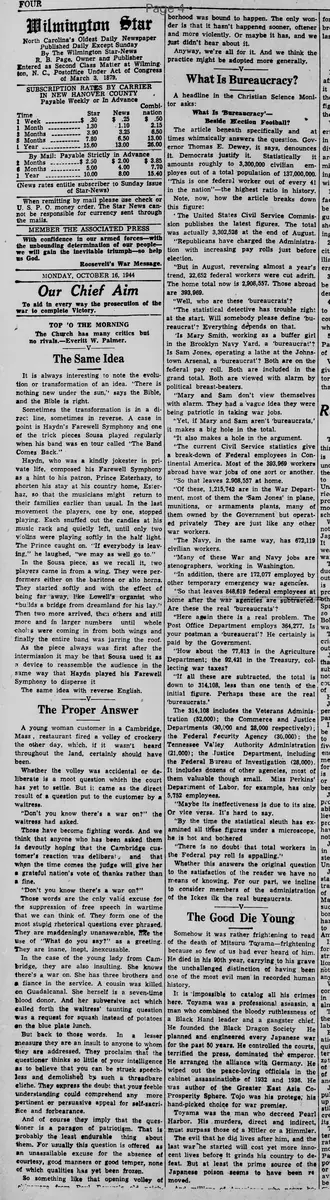
A young woman customer in a Cambridge, Mass, restaurant fired a volley of crockery the other day, which, if it wasn't heard throughout the land, certainly should have been.
Whether the volley was accidental or deliberate is a moot question which the court has yet to settle. But it came as the direct result of a question put to the customer by a waitress.
"Don't you know there's a war on?" the waitress had asked.
Those have become fighting words. And we think that anyone who has been asked them is devoutly hoping that the Cambridge customer's reaction was deliberate, and that when the time comes the judge will give her a grateful nation's vote of thanks rather than a fine.
"Don't you know there's a war on?"
Those words are the only valid excuse for the suppression of free speech in wartime that we can think of. They form one of the most stupid rhetorical questions ever phrased.
They are maddeningly unanswerable, like the use of "What do you say?" as a greeting
They are inane, inept, inexcusable.
In the case of the young lady from Cambridge, they are also insulting. She knows there's a war on. She has three brothers and fiance in the service. A cousin was killed on Guadalcanal. She herself is a seven-time blood donor. And her subversive act which called forth the waitress' taunting question was a request for squash instead of potatoes on the blue plate lunch.
But back to those words.
In a lesser measure they are an insult to anyone to whom they are addressed. They proclaim that the questioner thinks so little of your intelligence as to believe that you can be struck speechless and demolished by such a threadbare cliche. They express the doubt that your feeble understanding could comprehend any more pertinent or persuasive appeal for self-sacrifice and forbearance.
And of course they imply that the questioner is a paragon of patriotism. That is probably the least endurable thing about them. For usually this question is offered as an unassailable excuse for the absence of courtesy, good manners or good temper, none of which qualities has yet been frozen.
So something like that opening volley from the neighborhood was bound to happen. The only wonder is that it hasn't happened sooner, oftener and more violently. Or maybe it has, and we just didn't hear about it.
Anyway, we're all for it. And we think the practice might be adopted more generally.
A young woman customer in a Cambridge, Mass, restaurant fired a volley of crockery the other day, which, if it wasn't heard throughout the land, certainly should have been.
Whether the volley was accidental or deliberate is a moot question which the court has yet to settle. But it came as the direct result of a question put to the customer by a waitress.
"Don't you know there's a war on?" the waitress had asked.
Those have become fighting words. And we think that anyone who has been asked them is devoutly hoping that the Cambridge customer's reaction was deliberate, and that when the time comes the judge will give her a grateful nation's vote of thanks rather than a fine.
"Don't you know there's a war on?"
Those words are the only valid excuse for the suppression of free speech in wartime that we can think of. They form one of the most stupid rhetorical questions ever phrased.
They are maddeningly unanswerable, like the use of "What do you say?" as a greeting
They are inane, inept, inexcusable.
In the case of the young lady from Cambridge, they are also insulting. She knows there's a war on. She has three brothers and fiance in the service. A cousin was killed on Guadalcanal. She herself is a seven-time blood donor. And her subversive act which called forth the waitress' taunting question was a request for squash instead of potatoes on the blue plate lunch.
But back to those words.
In a lesser measure they are an insult to anyone to whom they are addressed. They proclaim that the questioner thinks so little of your intelligence as to believe that you can be struck speechless and demolished by such a threadbare cliche. They express the doubt that your feeble understanding could comprehend any more pertinent or persuasive appeal for self-sacrifice and forbearance.
And of course they imply that the questioner is a paragon of patriotism. That is probably the least endurable thing about them. For usually this question is offered as an unassailable excuse for the absence of courtesy, good manners or good temper, none of which qualities has yet been frozen.
So something like that opening volley from the neighborhood was bound to happen. The only wonder is that it hasn't happened sooner, oftener and more violently. Or maybe it has, and we just didn't hear about it.
Anyway, we're all for it. And we think the practice might be adopted more generally.
What sub-type of article is it?
Social Reform
Moral Or Religious
What keywords are associated?
Wartime Phrase
Free Speech
Bad Manners
Patriotism
Restaurant Incident
What entities or persons were involved?
Young Woman Customer
Waitress
Editorial Details
Primary Topic
Critique Of The Wartime Phrase 'Don't You Know There's A War On?'
Stance / Tone
Critical Of The Phrase, Supportive Of Violent Reaction Against It
Key Figures
Young Woman Customer
Waitress
Key Arguments
The Phrase Is A Stupid, Unanswerable Rhetorical Question
It Insults The Intelligence Of The Person Addressed
It Serves As An Excuse For Lack Of Courtesy And Good Manners
It Implies The Questioner Is Superior In Patriotism
It Justifies Suppression Of Free Speech In Wartime