Thank you for visiting SNEWPapers!
Sign up free
Alexandria Daily Advertiser
Alexandria, Virginia
What is this article about?
On January 20, 1808, the U.S. Senate debated a resolution by Mr. Pope to summon witnesses Elias Glover and William M'Farland to testify in the case of Senator John Smith regarding his alleged involvement in Aaron Burr's conspiracy. Mr. Adams objected, citing issues with subpoena authority, potential delays, and funding for witnesses.
Clipping
OCR Quality
Full Text
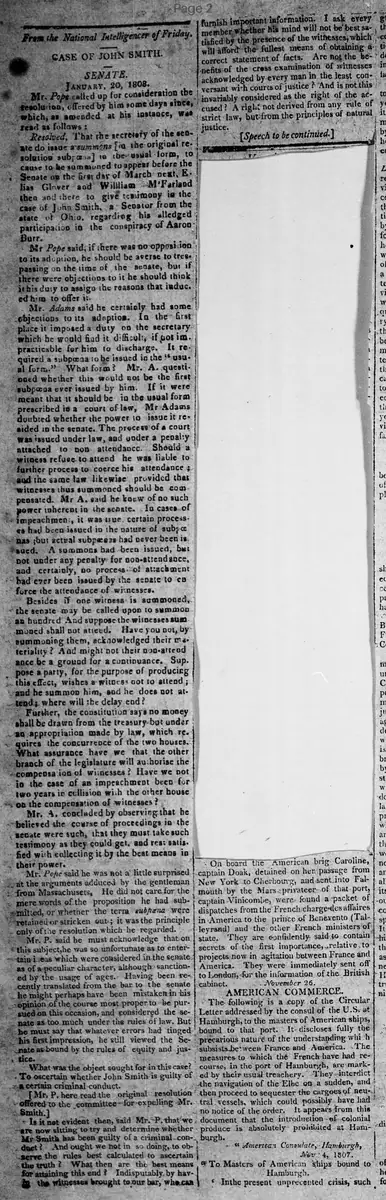
CASE OF JOHN SMITH.
SENATE.
JANUARY, 20, 1808.
Mr. Pope called up for consideration the resolution, offered by him some days since, which, as amended at his instance, was read as follows:
Resolved, That the secretary of the senate do issue a summons in the original resolution subpoena in the usual form, to cause to be summoned to appear before the Senate on the first day of March next, Elias Glover and William M'Farland then and there to give testimony in the case of John Smith, a Senator from the State of Ohio, regarding his alleged participation in the conspiracy of Aaron Burr.
Mr. Pope said; if there was no opposition to its adoption, he should be averse to trespassing on the time of the senate, but if there were objections to it he should think it his duty to assign the reasons that induced him to offer it.
Mr. Adams said he certainly had some objections to its adoption. In the first place it imposed a duty on the secretary which he would find it difficult, if not impossible, to discharge. It required a subpoena to be issued in the "usual form." What form? Mr. A. questioned whether this would not be the first subpoena ever issued by him. If it were meant that it should be in the usual form prescribed in a court of law, Mr. Adams doubted whether the power to issue it resided in the senate. The process of court was issued under law, and under a penalty attached to non attendance. Should a witness refuse to attend he was liable to further process to coerce his attendance; and the same law likewise provided that witnesses thus summoned should be compensated. Mr. A. said he knew of no such power inherent in the senate. In cases of impeachment, it was true certain processes had been issued in the nature of subpoena but actual subpoenas had never been issued. A summons had been issued, but not under any penalty for non-attendance, and certainly no process of attachment had ever been issued by the senate to enforce the attendance of witnesses.
Besides if one witness is summoned, the senate may be called upon to summon an hundred And suppose the witnesses summoned shall not attend. Have you not, by summoning them, acknowledged their materiality? And might not their non-attendance be a ground for a continuance. Suppose a party, for the purpose of producing this effect, wishes a witness not to attend; and he summons him, and he does not attend; where will the delay end?
Further, the constitution says no money shall be drawn from the treasury but under an appropriation made by law, which requires the concurrence of the two houses. What assurance have we that the other branch of the legislature will authorize the compensation of witnesses? Have we not in the case of an impeachment been for two years in collision with the other house on the compensation of witnesses?
Mr. A. concluded by observing that he believed the course of proceedings in the senate were such, that they must take such testimony as they could get, and rest satisfied with collecting it by the best means in their power.
Mr. Pope said he was not a little surprised at the arguments adduced by the gentleman from Massachusetts, He did not care for the mere words of the proposition he had submitted, or whether the term subpoena were retained or stricken out; it was the principle only of the resolution which he regarded.
Mr. P. said he must acknowledge that on this subject,he was so unfortunate as to entertain ideas which were considered in the senate as of a peculiar character, although, sanctioned by the usage of ages. Having been recently translated from the bar to the senate he might perhaps have been mistaken in his opinion of the course most proper to be pursued on this occasion, and considered the senate as too much under the rules of law. But he must say that whatever errors had tinged his first impression, he still viewed the Senate as bound by the rules of equity and justice.
What was the object sought for in this case? To ascertain whether John Smith is guilty of a certain criminal conduct.
[ Mr. P. here read the original resolution offered to the committee for expelling Mr. Smith.]
Is it not evident then, said Mr.P. that we are now sitting to try and determine whether Mr Smith has been guilty of a criminal conduct ? And ought we not in so doing, to observe the rules best calculated to ascertain the truth ? What then are the best means for attaining this end? Indisputably by having the witnesses brought to our bar, who can furnish important information. I ask every member whether his mind will not be best satisfied by the presence of the witnesses, which will afford the fullest means of obtaining a correct statement of facts. Are not the benefits of the cross examination of witnesses acknowledged by every man in the least conversant with courts of justice ? And is not this invariably considered as the right of the accused? A right not derived from any rule of strict law, but from the principles of natural justice.
His Speech to be continued.
What sub-type of article is it?
What keywords are associated?
What entities or persons were involved?
Where did it happen?
Domestic News Details
Primary Location
Senate
Event Date
January, 20, 1808
Key Persons
Outcome
debate ongoing; resolution not yet adopted; mr. pope's speech to be continued.
Event Details
Mr. Pope proposed a resolution to summon witnesses Elias Glover and William M'Farland to testify before the Senate on March 1 regarding Senator John Smith's alleged participation in Aaron Burr's conspiracy. Mr. Adams objected, arguing lack of Senate authority for subpoenas, potential for delays and non-attendance, and constitutional issues with funding witness compensation. Mr. Pope defended the resolution on principles of equity and justice, emphasizing the need for live testimony and cross-examination.