Thank you for visiting SNEWPapers!
Sign up free
Editorial
December 4, 1930
The Prison Mirror
Stillwater, Washington County, Minnesota
What is this article about?
An editorial by A.M.S. satirically contrasts traditional golf, with its fairways, hazards, and skill, against the emerging fad of miniature golf, dismissing the latter as a laughable imitation played on short indoor or lot courses with only a putter.
Clipping
OCR Quality
98%
Excellent
Full Text
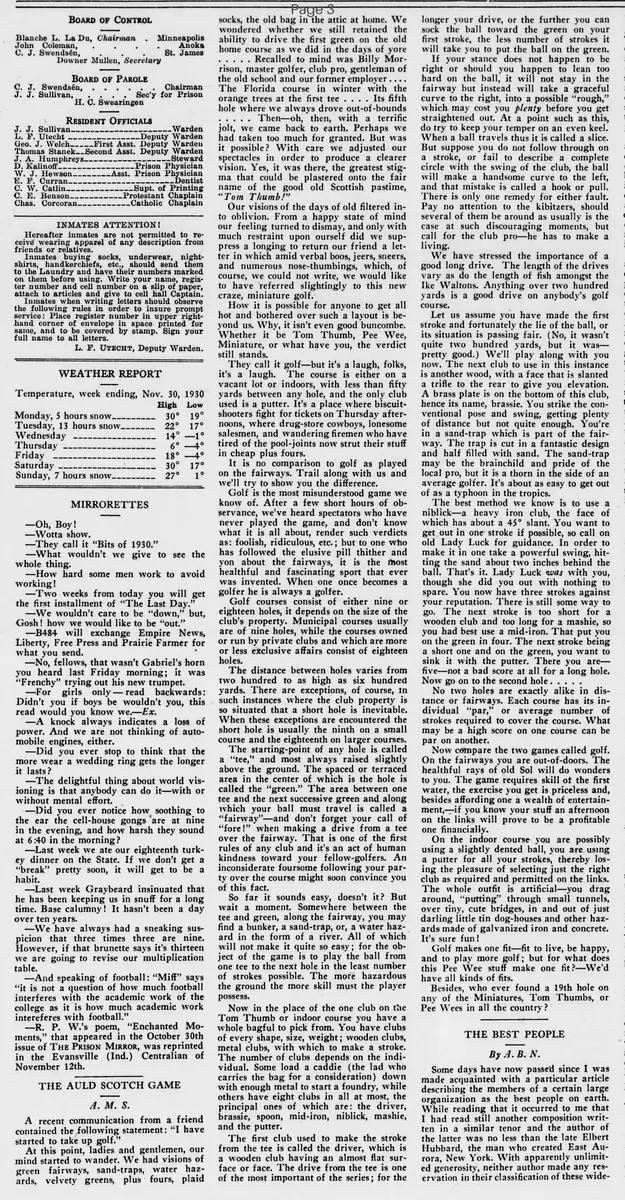
THE AULD SCOTCH GAME
A. M. S.
A recent communication from a friend contained the following statement: "I have started to take up golf."
At this point, ladies and gentlemen, our mind started to wander. We had visions of green fairways, sand-traps, water hazards, velvety greens, plus fours, plaid socks, the old bag in the attic at home. We wondered whether we still retained the ability to drive the first green on the old home course as we did in the days of yore . . . . . Recalled to mind was Billy Morrison, master golfer, club pro, gentleman of the old school and our former employer ... . The Florida course in winter with the orange trees at the first tee . . . . Its fifth hole where we always drove out-of-bounds Then-oh, then, with a terrific jolt, we came back to earth. Perhaps we had taken too much for granted. But was it possible? With care we adjusted our spectacles in order to produce a clearer vision. Yes, it was there, the greatest stigma that could be plastered onto the fair name of the good old Scottish pastime "Tom Thumb!"
Our visions of the days of old filtered into oblivion. From a happy state of mind our feeling turned to dismay, and only with much restraint upon ourself did we suppress a longing to return our friend a letter in which amid verbal boos, jeers, sneers, and numerous nose-thumbings, which, of course, we could not write, we would like to have referred slightingly to this new craze, miniature golf.
How it is possible for anyone to get all hot and bothered over such a layout is beyond us. Why, it isn't even good buncombe. Whether it be Tom Thumb, Pee Wee, Miniature, or what have you, the verdict still stands.
They call it golf—but it's a laugh, folks, it's a laugh. The course is either on a vacant lot or indoors, with less than fifty yards between any hole, and the only club used is a putter. It's a place where biscuit-shooters fight for tickets on Thursday afternoons, where drug-store cowboys, lonesome salesmen, and wandering firemen who have tired of the pool-joints now strut their stuff in cheap plus fours.
It is no comparison to golf as played on the fairways. Trail along with us and we'll try to show you the difference.
Golf is the most misunderstood game we know of. After a few short hours of observance, we've heard spectators who have never played the game, and don't know what it is all about, render such verdicts as: foolish, ridiculous, etc.; but to one who has followed the elusive pill thither and yon about the fairways. it is the most healthful and fascinating sport that ever was invented. When one once becomes a golfer he is always a golfer.
Golf courses consist of either nine or eighteen holes, it depends on the size of the club's property. Municipal courses usually are of nine holes, while the courses owned or run by private clubs and which are more or less exclusive affairs consist of eighteen holes.
The distance between holes varies from two hundred to as high as six hundred yards. There are exceptions, of course, In such instances where the club property is so situated that a short hole is inevitable. When these exceptions are encountered the short hole is usually the ninth on a small course and the eighteenth on larger courses.
The starting-point of any hole is called a "tee," and most always raised slightly above the ground. The spaced or terraced area in the center of which is the hole is called the "green." The area between one tee and the next successive green and along which your ball must travel is called a "fairway"-and don't forget your call of "fore!" when making a drive from a tee over the fairway. That is one of the first rules of any club and it's an act of human kindness toward your fellow-golfers. An inconsiderate foursome following your party over the course might soon convince you of this fact.
So far it sounds easy, doesn't it? But wait a moment. Somewhere between the tee and green, along the fairway, you may find a bunker, a sand-trap, or, a water hazard in the form of a river. All of which will not make it quite so easy; for the object of the game is to play the ball from one tee to the next hole in the least number of strokes possible. The more hazardous the ground the more skill must the player possess.
Now in the place of the one club on the Tom Thumb or indoor course you have a whole bagful to pick from. You have clubs of every shape, size, weight; wooden clubs, metal clubs, with which to make a stroke. The number of clubs depends on the individual. Some load a caddie (the lad who carries the bag for a consideration) down with enough metal to start a foundry. while others have eight clubs in all at most, the principal ones of which are: the driver, brassie, spoon, mid-iron, niblick, mashie, and the putter.
The first club used to make the stroke from the tee is called the driver. which is a wooden club having an almost flat surface or face. The drive from the tee is one of the most important of the series; for the longer your drive, or the further you can sock the ball toward the green on your first stroke, the less number of strokes it will take you to put the ball on the green.
If your stance does not happen to be right or should you happen to lean too hard on the ball, it will not stay in the fairway but instead will take a graceful curve to the right, into a possible "rough," which may cost you plenty before you get straightened out. At a point such as this, do try to keep your temper on an even keel.
When a ball travels thus it is called a slice. But suppose you do not follow through on a stroke, or fail to describe a complete circle with the swing of the club, the ball will make a handsome curve to the left and that mistake is called a hook or pull.
There is only one remedy for either fault. Pay no attention to the kibitzers, should several of them be around as usually is the case at such discouraging moments, but call for the club pro-he has to make a living.
We have stressed the importance of a good long drive. The length of the drives vary as do the length of fish amongst the Ike Waltons. Anything over two hundred yards is a good drive on anybody's golf course.
Let us assume you have made the first stroke and fortunately the lie of the ball, or its situation is passing fair. (No, it wasn't quite two hundred yards, but it was-- pretty good.) We'll play along with you now. The next club to use in this instance is another wood, with a face that is slanted a trifle to the rear to give you elevation. A brass plate is on the bottom of this club, hence its name, brassie. You strike the conventional pose and swing, getting plenty of distance but not quite enough. You're in a sand-trap which is part of the fairway. The trap is cut in a fantastic design and half filled with sand. The sand-trap may be the brainchild and pride of the local pro, but it is a thorn in the side of an average golfer. It's about as easy to get out of as a typhoon in the tropics.
The best method we know is to use a niblick-a heavy iron club, the face of which has about a 45° slant. You want to get out in one stroke if possible, so call on old Lady Luck for guidance. In order to make it in one take a powerful swing, hitting the sand about two inches behind the ball. That's it. Lady Luck was with you, though she did you out with nothing to spare. You now have three strokes against your reputation. There is still some way to go. The next stroke is too short for a wooden club and too long for a mashie, so you had best use a mid-iron. That put you on the green in four. The next stroke being a short one and on the green, you want to sink it with the putter. There you are-- five-not a bad score at all for a long hole.
Now go on to the second hole. . . . .
No two holes are exactly alike in distance or fairways. Each course has its individual "par," or average number of strokes required to cover the course. What may be a high score on one course can be par on another.
Now compare the two games called golf. On the fairways you are out-of-doors. The healthful rays of old Sol will do wonders to you. The game requires skill of the first water, the exercise you get is priceless and, besides affording one a wealth of entertainment,--if you know your stuff an afternoon on the links will prove to be a profitable one financially.
On the indoor course you are possibly using a slightly dented ball, you are using a putter for all your strokes, thereby losing the pleasure of selecting just the right club as required and permitted on the links. The whole outfit is artificial-you drag around, "putting" through small tunnels, over tiny, cute bridges, in and out of just darling little tin dog-houses and other hazards made of galvanized iron and concrete.
It's sure fun!
Golf makes one fit-fit to live, be happy, and to play more golf: but for what does this Pee Wee stuff make one fit?-We'd have all kinds of fits.
Besides, who ever found a 19th hole on any of the Miniatures, Tom Thumbs, or Pee Wees in all the country?
A. M. S.
A recent communication from a friend contained the following statement: "I have started to take up golf."
At this point, ladies and gentlemen, our mind started to wander. We had visions of green fairways, sand-traps, water hazards, velvety greens, plus fours, plaid socks, the old bag in the attic at home. We wondered whether we still retained the ability to drive the first green on the old home course as we did in the days of yore . . . . . Recalled to mind was Billy Morrison, master golfer, club pro, gentleman of the old school and our former employer ... . The Florida course in winter with the orange trees at the first tee . . . . Its fifth hole where we always drove out-of-bounds Then-oh, then, with a terrific jolt, we came back to earth. Perhaps we had taken too much for granted. But was it possible? With care we adjusted our spectacles in order to produce a clearer vision. Yes, it was there, the greatest stigma that could be plastered onto the fair name of the good old Scottish pastime "Tom Thumb!"
Our visions of the days of old filtered into oblivion. From a happy state of mind our feeling turned to dismay, and only with much restraint upon ourself did we suppress a longing to return our friend a letter in which amid verbal boos, jeers, sneers, and numerous nose-thumbings, which, of course, we could not write, we would like to have referred slightingly to this new craze, miniature golf.
How it is possible for anyone to get all hot and bothered over such a layout is beyond us. Why, it isn't even good buncombe. Whether it be Tom Thumb, Pee Wee, Miniature, or what have you, the verdict still stands.
They call it golf—but it's a laugh, folks, it's a laugh. The course is either on a vacant lot or indoors, with less than fifty yards between any hole, and the only club used is a putter. It's a place where biscuit-shooters fight for tickets on Thursday afternoons, where drug-store cowboys, lonesome salesmen, and wandering firemen who have tired of the pool-joints now strut their stuff in cheap plus fours.
It is no comparison to golf as played on the fairways. Trail along with us and we'll try to show you the difference.
Golf is the most misunderstood game we know of. After a few short hours of observance, we've heard spectators who have never played the game, and don't know what it is all about, render such verdicts as: foolish, ridiculous, etc.; but to one who has followed the elusive pill thither and yon about the fairways. it is the most healthful and fascinating sport that ever was invented. When one once becomes a golfer he is always a golfer.
Golf courses consist of either nine or eighteen holes, it depends on the size of the club's property. Municipal courses usually are of nine holes, while the courses owned or run by private clubs and which are more or less exclusive affairs consist of eighteen holes.
The distance between holes varies from two hundred to as high as six hundred yards. There are exceptions, of course, In such instances where the club property is so situated that a short hole is inevitable. When these exceptions are encountered the short hole is usually the ninth on a small course and the eighteenth on larger courses.
The starting-point of any hole is called a "tee," and most always raised slightly above the ground. The spaced or terraced area in the center of which is the hole is called the "green." The area between one tee and the next successive green and along which your ball must travel is called a "fairway"-and don't forget your call of "fore!" when making a drive from a tee over the fairway. That is one of the first rules of any club and it's an act of human kindness toward your fellow-golfers. An inconsiderate foursome following your party over the course might soon convince you of this fact.
So far it sounds easy, doesn't it? But wait a moment. Somewhere between the tee and green, along the fairway, you may find a bunker, a sand-trap, or, a water hazard in the form of a river. All of which will not make it quite so easy; for the object of the game is to play the ball from one tee to the next hole in the least number of strokes possible. The more hazardous the ground the more skill must the player possess.
Now in the place of the one club on the Tom Thumb or indoor course you have a whole bagful to pick from. You have clubs of every shape, size, weight; wooden clubs, metal clubs, with which to make a stroke. The number of clubs depends on the individual. Some load a caddie (the lad who carries the bag for a consideration) down with enough metal to start a foundry. while others have eight clubs in all at most, the principal ones of which are: the driver, brassie, spoon, mid-iron, niblick, mashie, and the putter.
The first club used to make the stroke from the tee is called the driver. which is a wooden club having an almost flat surface or face. The drive from the tee is one of the most important of the series; for the longer your drive, or the further you can sock the ball toward the green on your first stroke, the less number of strokes it will take you to put the ball on the green.
If your stance does not happen to be right or should you happen to lean too hard on the ball, it will not stay in the fairway but instead will take a graceful curve to the right, into a possible "rough," which may cost you plenty before you get straightened out. At a point such as this, do try to keep your temper on an even keel.
When a ball travels thus it is called a slice. But suppose you do not follow through on a stroke, or fail to describe a complete circle with the swing of the club, the ball will make a handsome curve to the left and that mistake is called a hook or pull.
There is only one remedy for either fault. Pay no attention to the kibitzers, should several of them be around as usually is the case at such discouraging moments, but call for the club pro-he has to make a living.
We have stressed the importance of a good long drive. The length of the drives vary as do the length of fish amongst the Ike Waltons. Anything over two hundred yards is a good drive on anybody's golf course.
Let us assume you have made the first stroke and fortunately the lie of the ball, or its situation is passing fair. (No, it wasn't quite two hundred yards, but it was-- pretty good.) We'll play along with you now. The next club to use in this instance is another wood, with a face that is slanted a trifle to the rear to give you elevation. A brass plate is on the bottom of this club, hence its name, brassie. You strike the conventional pose and swing, getting plenty of distance but not quite enough. You're in a sand-trap which is part of the fairway. The trap is cut in a fantastic design and half filled with sand. The sand-trap may be the brainchild and pride of the local pro, but it is a thorn in the side of an average golfer. It's about as easy to get out of as a typhoon in the tropics.
The best method we know is to use a niblick-a heavy iron club, the face of which has about a 45° slant. You want to get out in one stroke if possible, so call on old Lady Luck for guidance. In order to make it in one take a powerful swing, hitting the sand about two inches behind the ball. That's it. Lady Luck was with you, though she did you out with nothing to spare. You now have three strokes against your reputation. There is still some way to go. The next stroke is too short for a wooden club and too long for a mashie, so you had best use a mid-iron. That put you on the green in four. The next stroke being a short one and on the green, you want to sink it with the putter. There you are-- five-not a bad score at all for a long hole.
Now go on to the second hole. . . . .
No two holes are exactly alike in distance or fairways. Each course has its individual "par," or average number of strokes required to cover the course. What may be a high score on one course can be par on another.
Now compare the two games called golf. On the fairways you are out-of-doors. The healthful rays of old Sol will do wonders to you. The game requires skill of the first water, the exercise you get is priceless and, besides affording one a wealth of entertainment,--if you know your stuff an afternoon on the links will prove to be a profitable one financially.
On the indoor course you are possibly using a slightly dented ball, you are using a putter for all your strokes, thereby losing the pleasure of selecting just the right club as required and permitted on the links. The whole outfit is artificial-you drag around, "putting" through small tunnels, over tiny, cute bridges, in and out of just darling little tin dog-houses and other hazards made of galvanized iron and concrete.
It's sure fun!
Golf makes one fit-fit to live, be happy, and to play more golf: but for what does this Pee Wee stuff make one fit?-We'd have all kinds of fits.
Besides, who ever found a 19th hole on any of the Miniatures, Tom Thumbs, or Pee Wees in all the country?
What sub-type of article is it?
Satire
What keywords are associated?
Miniature Golf
Traditional Golf
Satire
Golf Clubs
Fairways
Sand Traps
Health Benefits
What entities or persons were involved?
Billy Morrison
Tom Thumb
Pee Wee
Miniature Golf
Editorial Details
Primary Topic
Critique Of Miniature Golf As Inferior To Traditional Golf
Stance / Tone
Satirical Ridicule Of Miniature Golf, Enthusiastic Praise For Real Golf
Key Figures
Billy Morrison
Tom Thumb
Pee Wee
Miniature Golf
Key Arguments
Miniature Golf Is A Laughable Imitation Lacking Skill And Health Benefits
Real Golf Involves Full Courses, Multiple Clubs, And Outdoor Exercise
Miniature Golf Uses Only A Putter On Short Artificial Layouts
Traditional Golf Fosters Lifelong Fascination And Physical Fitness
Miniature Courses Lack The Social And Recreational Depth Of Real Golf