Thank you for visiting SNEWPapers!
Sign up free
Story
April 12, 1934
The Western News
Libby, Lincoln County, Montana
What is this article about?
1934 article on resurgence of horses and mules on U.S. farms due to Depression-era economics: they eat surplus crops cheaply, unlike fuel-dependent machines. Demand rises after decline; horse numbers fell from 1918 peak of 21M to 12M in 1933.
Clipping
OCR Quality
98%
Excellent
Full Text
Thursday, April 12, 1934.
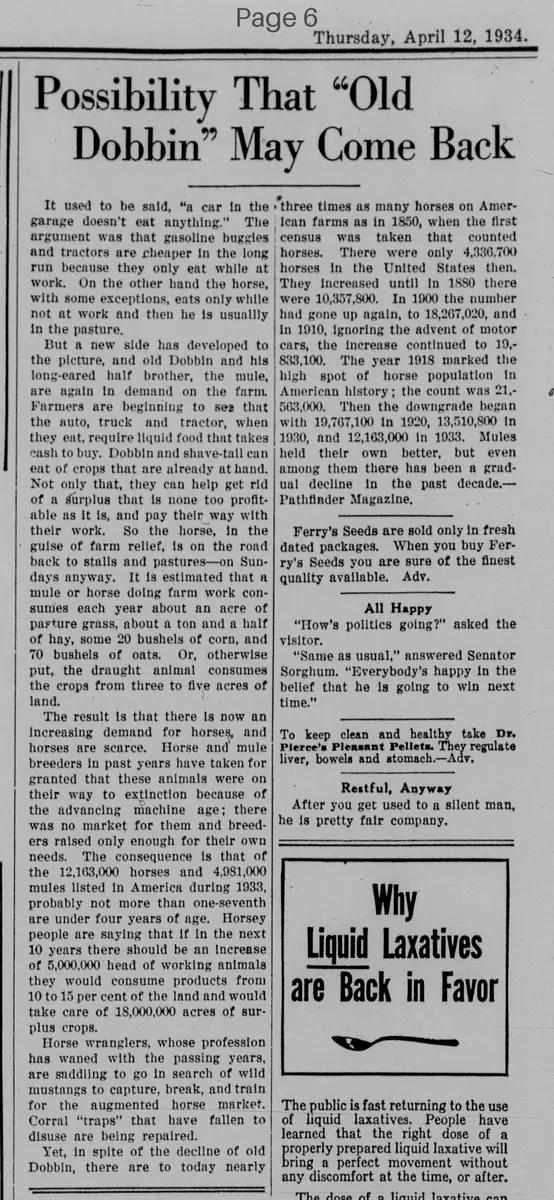
Possibility That "Old Dobbin" May Come Back
It used to be said, "a car in the garage doesn't eat anything." The argument was that gasoline buggies and tractors are cheaper in the long run because they only eat while at work. On the other hand the horse, with some exceptions, eats only while not at work and then he is usually in the pasture.
But a new side has developed to the picture, and old Dobbin and his long-eared half brother, the mule, are again in demand on the farm. Farmers are beginning to see that the auto, truck and tractor, when they eat, require liquid food that takes cash to buy. Dobbin and shave-tail can eat of crops that are already at hand. Not only that, they can help get rid of a surplus that is none too profitable as it is, and pay their way with their work. So the horse, in the guise of farm relief, is on the road back to stalls and pastures - on Sundays anyway. It is estimated that a mule or horse doing farm work consumes each year about an acre of pasture grass, about a ton and a half of hay, some 20 bushels of corn, and 70 bushels of oats. Or, otherwise put, the draught animal consumes the crops from three to five acres of land.
The result is that there is now an increasing demand for horses, and horses are scarce. Horse and mule breeders in past years have taken for granted that these animals were on their way to extinction because of the advancing machine age; there was no market for them and breeders raised only enough for their own needs. The consequence is that of the 12,163,000 horses and 4,981,000 mules listed in America during 1933, probably not more than one-seventh are under four years of age. Horse people are saying that if in the next 10 years there should be an increase of 5,000,000 head of working animals they would consume products from 10 to 15 per cent of the land and would take care of 18,000,000 acres of surplus crops.
Horse wranglers, whose profession has waned with the passing years, are saddling to go in search of wild mustangs to capture, break, and train for the augmented horse market. Corral "traps" that have fallen to disuse are being repaired.
Yet, in spite of the decline of old Dobbin, there are today nearly three times as many horses on American farms as in 1850, when the first census was taken that counted horses. There were only 4,336,700 horses in the United States then. They increased until in 1880 there were 10,357,800. In 1900 the number had gone up again, to 18,267,020, and in 1910, ignoring the advent of motor cars, the increase continued to 19,833,100. The year 1918 marked the high spot of horse population in American history: the count was 21,563,000. Then the downgrade began with 19,767,100 in 1920, 13,510,800 in 1930, and 12,163,000 in 1933. Mules held their own better, but even among them there has been a gradual decline in the past decade.
Pathfinder Magazine.
Possibility That "Old Dobbin" May Come Back
It used to be said, "a car in the garage doesn't eat anything." The argument was that gasoline buggies and tractors are cheaper in the long run because they only eat while at work. On the other hand the horse, with some exceptions, eats only while not at work and then he is usually in the pasture.
But a new side has developed to the picture, and old Dobbin and his long-eared half brother, the mule, are again in demand on the farm. Farmers are beginning to see that the auto, truck and tractor, when they eat, require liquid food that takes cash to buy. Dobbin and shave-tail can eat of crops that are already at hand. Not only that, they can help get rid of a surplus that is none too profitable as it is, and pay their way with their work. So the horse, in the guise of farm relief, is on the road back to stalls and pastures - on Sundays anyway. It is estimated that a mule or horse doing farm work consumes each year about an acre of pasture grass, about a ton and a half of hay, some 20 bushels of corn, and 70 bushels of oats. Or, otherwise put, the draught animal consumes the crops from three to five acres of land.
The result is that there is now an increasing demand for horses, and horses are scarce. Horse and mule breeders in past years have taken for granted that these animals were on their way to extinction because of the advancing machine age; there was no market for them and breeders raised only enough for their own needs. The consequence is that of the 12,163,000 horses and 4,981,000 mules listed in America during 1933, probably not more than one-seventh are under four years of age. Horse people are saying that if in the next 10 years there should be an increase of 5,000,000 head of working animals they would consume products from 10 to 15 per cent of the land and would take care of 18,000,000 acres of surplus crops.
Horse wranglers, whose profession has waned with the passing years, are saddling to go in search of wild mustangs to capture, break, and train for the augmented horse market. Corral "traps" that have fallen to disuse are being repaired.
Yet, in spite of the decline of old Dobbin, there are today nearly three times as many horses on American farms as in 1850, when the first census was taken that counted horses. There were only 4,336,700 horses in the United States then. They increased until in 1880 there were 10,357,800. In 1900 the number had gone up again, to 18,267,020, and in 1910, ignoring the advent of motor cars, the increase continued to 19,833,100. The year 1918 marked the high spot of horse population in American history: the count was 21,563,000. Then the downgrade began with 19,767,100 in 1920, 13,510,800 in 1930, and 12,163,000 in 1933. Mules held their own better, but even among them there has been a gradual decline in the past decade.
Pathfinder Magazine.
What sub-type of article is it?
Historical Event
Curiosity
What themes does it cover?
Fortune Reversal
Survival
What keywords are associated?
Horses
Mules
Farm Animals
Depression
Surplus Crops
Mechanization
Agriculture
Where did it happen?
American Farms
Story Details
Location
American Farms
Event Date
1933 1934
Story Details
Amid economic pressures and surplus crops during the Depression, farmers increase demand for horses and mules, which consume unprofitable feed and provide work, reversing the decline caused by mechanization; historical U.S. horse populations peaked at 21,563,000 in 1918 before dropping to 12,163,000 in 1933.