Thank you for visiting SNEWPapers!
Sign up free
Poem
May 5, 1860
The Cecil Whig
Elkton, Cecil County, Maryland
What is this article about?
A reflective poem titled 'If we Knew' that encourages empathy and understanding for others' hidden struggles, urging readers to avoid harsh judgment and to cherish goodness, concluding with a plea for divine judgment mirroring one's own toward fellow humans.
Clipping
OCR Quality
98%
Excellent
Full Text
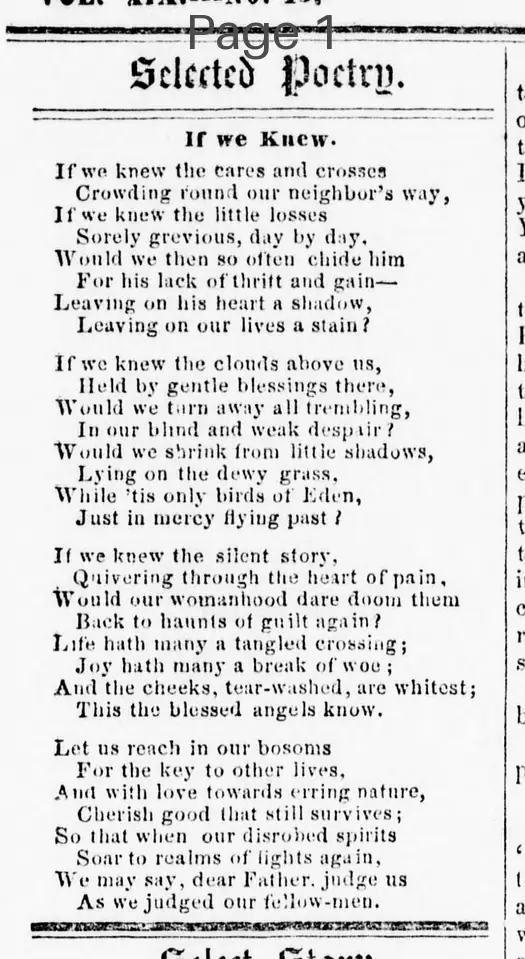
Selected Poetry.
If we Knew.
If we knew the cares and crosses
Crowding round our neighbor's way,
If we knew the little losses
Sorely grievous, day by day,
Would we then so often chide him
For his lack of thrift and gain-
Leaving on his heart a shadow,
Leaving on our lives a stain?
If we knew the clouds above us
Held by gentle blessings there,
Would we turn away all trembling
In our blind and weak despair?
Would we shrink from little shadows
Lying on the dewy grass,
While 'tis only birds of Eden
Just in mercy flying past?
If we knew the silent story
Quivering through the heart of pain,
Would our womanhood dare doom them
Back to haunts of guilt again?
Life hath many a tangled crossing;
Joy hath many a break of woe;
And the cheeks, tear-washed, are whitest;
This the blessed angels know.
Let us reach in our bosoms
For the key to other lives,
And with love towards erring nature,
Cherish good that still survives;
So that when our disrobed spirits
Soar to realms of light again,
We may say, dear Father, judge us
As we judged our fellow-men.
If we Knew.
If we knew the cares and crosses
Crowding round our neighbor's way,
If we knew the little losses
Sorely grievous, day by day,
Would we then so often chide him
For his lack of thrift and gain-
Leaving on his heart a shadow,
Leaving on our lives a stain?
If we knew the clouds above us
Held by gentle blessings there,
Would we turn away all trembling
In our blind and weak despair?
Would we shrink from little shadows
Lying on the dewy grass,
While 'tis only birds of Eden
Just in mercy flying past?
If we knew the silent story
Quivering through the heart of pain,
Would our womanhood dare doom them
Back to haunts of guilt again?
Life hath many a tangled crossing;
Joy hath many a break of woe;
And the cheeks, tear-washed, are whitest;
This the blessed angels know.
Let us reach in our bosoms
For the key to other lives,
And with love towards erring nature,
Cherish good that still survives;
So that when our disrobed spirits
Soar to realms of light again,
We may say, dear Father, judge us
As we judged our fellow-men.
What sub-type of article is it?
Ode
What themes does it cover?
Moral Virtue
Religious Faith
What keywords are associated?
Empathy
Judgment
Moral Lesson
Forgiveness
Divine Mercy
Human Struggles
Poem Details
Title
If We Knew.
Form / Style
Rhymed Quatrains
Key Lines
If We Knew The Cares And Crosses
Crowding Round Our Neighbor's Way,
If We Knew The Little Losses
Sorely Grievous, Day By Day,
Let Us Reach In Our Bosoms
For The Key To Other Lives,
And With Love Towards Erring Nature,
Cherish Good That Still Survives;
We May Say, Dear Father, Judge Us
As We Judged Our Fellow Men.