Thank you for visiting SNEWPapers!
Sign up free
Letter to Editor
October 7, 1811
Alexandria Daily Gazette, Commercial & Political
Alexandria, Virginia
What is this article about?
In a letter from Washington dated Oct. 4, 1811, Simon Pure addresses Friend Samuel's anxiety over national destiny, debunking war rumors with Britain, praising Madison's war aversion, and suggesting trade bans if needed to promote domestic industry.
Clipping
OCR Quality
98%
Excellent
Full Text
TURN-ABOUT.
WASHINGTON, Oct. 4th, 1811.
Friend Samuel,
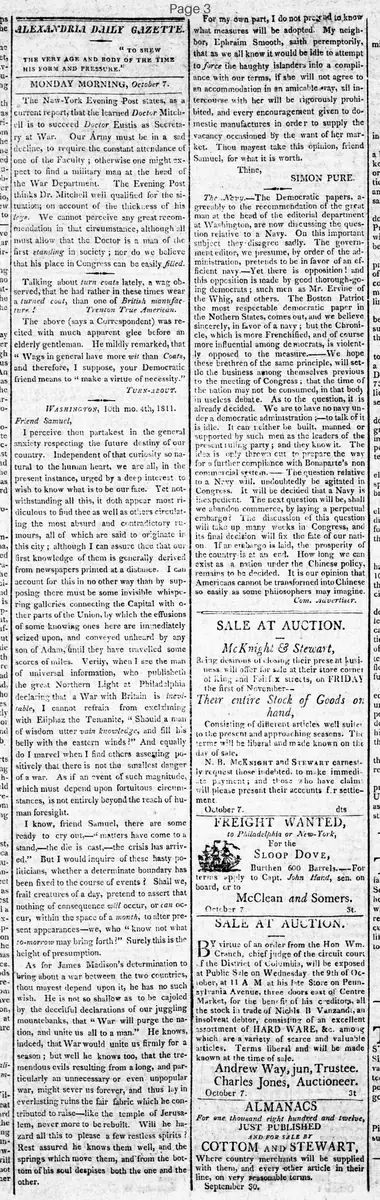
I perceive thou partakest in the general anxiety respecting the future destiny of our country. Independent of that curiosity so natural to the human heart, we are all, in the present instance, urged by a deep interest to wish to know what is to be our fate. Yet notwithstanding all this, it doth appear most ridiculous to find thee as well as others circulating the most absurd and contradictory rumours, all of which are said to originate in this city; although I can assure thee that our first knowledge of them is generally derived from newspapers printed at a distance. I can account for this in no other way than by supposing there must be some invisible whispering galleries connecting the Capital with other parts of the Union, by which the effusions of some knowing ones here are immediately seized upon, and conveyed unheard by any son of Adam, until they have travelled some scores of miles. Verily, when I see the man of universal information, who publisheth the great Northern Light at Philadelphia declaring that a War with Britain is inevitable, I cannot refrain from exclaiming with Eliphaz the Temanite, "Should a man of wisdom utter vain knowledge, and fill his belly with the east wind?" And equally do I marvel when I find others asserting positively that there is not the smallest danger of a war. As if an event of such magnitude, which must depend upon fortuitous circumstances, is not entirely beyond the reach of human foresight.
I know, friend Samuel, there are some ready to cry out,—"matters have come to a stand,—the die is cast,—the crisis has arrived." But I would inquire of these hasty politicians, whether a determinate boundary has been fixed to the course of events? Shall we, frail creatures of a day, pretend to assert that nothing of consequence will occur, or can occur, within the space of a month, to alter present appearances—we, who "know not what to-morrow may bring forth?" Surely this is the height of presumption.
As for James Madison's determination to bring about a war between the two countries, thou mayest depend upon it, he has no such wish. He is not so shallow as to be cajoled by the deceitful declarations of our juggling mountebanks, that "War will purge the nation, and unite us all to a man." He knows, indeed, that War would unite us firmly for a season; but well he knows too, that the tremendous evils resulting from a long, and particularly an unnecessary or even unpopular war, might sever us forever, and thus lay in everlasting ruins the fair fabric which he contributed to raise—like the temple of Jerusalem, never more to be rebuilt. Will he hazard all this to please a few restless spirits? Rest assured he knows them well, and the springs which move them, and from the bottom of his soul despises both the one and the other.
For my own part, I do not pretend to know what measures will be adopted. My neighbor, Ephraim Smooth, saith peremptorily, that as we all know it would be idle to attempt to force the haughty islanders into a compliance with our terms, if she will not agree to an accommodation in an amicable way, all intercourse with her will be rigorously prohibited, and every encouragement given to domestic manufactures in order to supply the vacancy occasioned by the want of her market. Thou mayest take this opinion, friend Samuel, for what it is worth.
Thine,
SIMON PURE.
WASHINGTON, Oct. 4th, 1811.
Friend Samuel,
I perceive thou partakest in the general anxiety respecting the future destiny of our country. Independent of that curiosity so natural to the human heart, we are all, in the present instance, urged by a deep interest to wish to know what is to be our fate. Yet notwithstanding all this, it doth appear most ridiculous to find thee as well as others circulating the most absurd and contradictory rumours, all of which are said to originate in this city; although I can assure thee that our first knowledge of them is generally derived from newspapers printed at a distance. I can account for this in no other way than by supposing there must be some invisible whispering galleries connecting the Capital with other parts of the Union, by which the effusions of some knowing ones here are immediately seized upon, and conveyed unheard by any son of Adam, until they have travelled some scores of miles. Verily, when I see the man of universal information, who publisheth the great Northern Light at Philadelphia declaring that a War with Britain is inevitable, I cannot refrain from exclaiming with Eliphaz the Temanite, "Should a man of wisdom utter vain knowledge, and fill his belly with the east wind?" And equally do I marvel when I find others asserting positively that there is not the smallest danger of a war. As if an event of such magnitude, which must depend upon fortuitous circumstances, is not entirely beyond the reach of human foresight.
I know, friend Samuel, there are some ready to cry out,—"matters have come to a stand,—the die is cast,—the crisis has arrived." But I would inquire of these hasty politicians, whether a determinate boundary has been fixed to the course of events? Shall we, frail creatures of a day, pretend to assert that nothing of consequence will occur, or can occur, within the space of a month, to alter present appearances—we, who "know not what to-morrow may bring forth?" Surely this is the height of presumption.
As for James Madison's determination to bring about a war between the two countries, thou mayest depend upon it, he has no such wish. He is not so shallow as to be cajoled by the deceitful declarations of our juggling mountebanks, that "War will purge the nation, and unite us all to a man." He knows, indeed, that War would unite us firmly for a season; but well he knows too, that the tremendous evils resulting from a long, and particularly an unnecessary or even unpopular war, might sever us forever, and thus lay in everlasting ruins the fair fabric which he contributed to raise—like the temple of Jerusalem, never more to be rebuilt. Will he hazard all this to please a few restless spirits? Rest assured he knows them well, and the springs which move them, and from the bottom of his soul despises both the one and the other.
For my own part, I do not pretend to know what measures will be adopted. My neighbor, Ephraim Smooth, saith peremptorily, that as we all know it would be idle to attempt to force the haughty islanders into a compliance with our terms, if she will not agree to an accommodation in an amicable way, all intercourse with her will be rigorously prohibited, and every encouragement given to domestic manufactures in order to supply the vacancy occasioned by the want of her market. Thou mayest take this opinion, friend Samuel, for what it is worth.
Thine,
SIMON PURE.
What sub-type of article is it?
Political
Reflective
Persuasive
What themes does it cover?
Politics
Military War
What keywords are associated?
War With Britain
James Madison
Rumors
Foreign Policy
Trade Prohibition
Domestic Manufactures
What entities or persons were involved?
Simon Pure
Friend Samuel
Letter to Editor Details
Author
Simon Pure
Recipient
Friend Samuel
Main Argument
the writer dismisses absurd and contradictory rumors of inevitable war with britain, defends james madison's lack of desire for war due to its potential to destroy national unity, and relays an opinion on prohibiting trade with britain while encouraging domestic manufactures if no amicable accommodation is reached.
Notable Details
References Eliphaz The Temanite From The Bible
Compares Potential War Consequences To The Destruction Of The Temple Of Jerusalem
Mentions Neighbor Ephraim Smooth's Opinion On Trade Prohibition