Thank you for visiting SNEWPapers!
Sign up free
Story
May 12, 1889
The Memphis Appeal
Memphis, Shelby County, Tennessee
What is this article about?
Publisher interviews on 20% book discounts' origins from clerical/educational favors, spread via piracy and large stores like Wanamaker's, devastating legitimate sellers; advocates international copyright for relief. (New York focus.)
Clipping
OCR Quality
98%
Excellent
Full Text
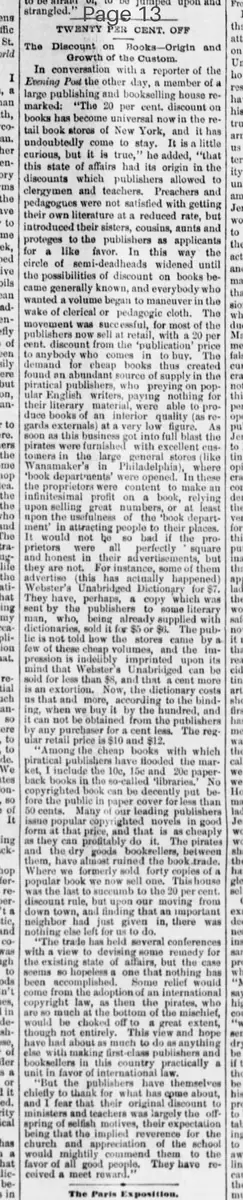
TWENTY PER CENT. OFF.
The Discount on Books—Origin and
Growth of the Custom.
In conversation with a reporter of the
Evening Post the other day, a member of a
large publishing and bookselling house re-
marked: "The 20 per cent. discount on
books has become universal now in the re-
tail book stores of New York, and it has
undoubtedly come to stay. It is a little
curious, but it is true," he added, "that
this state of affairs had its origin in the
discounts which publishers allowed to
clergymen and teachers. Preachers and
pedagogues were not satisfied with getting
their own literature at a reduced rate, but
introduced their sisters, cousins, aunts and
protégés to the publishers as applicants
for a like favor. In this way the
circle of semi-deadheads widened until
the possibilities of discount on books be-
came generally known, and everybody who
wanted a volume began to maneuver in the
wake of clerical or pedagogic cloth. The
movement was successful, for most of the
publishers now sell at retail, with a 20 per
cent. discount from the 'publication' price
to anybody who comes in to buy. 'The
demand for cheap books thus created
found an abundant source of supply in the
piratical publishers, who preying on pop-
ular English writers, paying nothing for
their literary material, were able to pro-
duce books of an inferior quality (as re-
gards externals) at a very low figure. As
soon as this business got into full blast the
pirates were furnished with excellent cus-
tomers in the large general stores (like
Wanamaker's in Philadelphia), where
'book departments' were opened.' In these
the proprietors were content to make an
infinitesimal profit on a book, relying
upon selling great numbers, or at least
upon the usefulness of the 'book depart-
ment' in attracting people to their places.
It would not be so bad if the pro-
prietors were all perfectly 'square
and honest in their advertisements, but
they are not. For instance, some of them
advertise (this has actually happened)
Webster's Unabridged Dictionary for $7.
They have, perhaps, a copy which was
sent by the publishers to some literary
man, who, being already supplied with
dictionaries, sold it for $5 or $6. "The pub-
lic is not told how the stores came by a
few of these cheap volumes, and the im-
pression is indelibly imprinted upon its
mind that Webster's Unabridged can be
sold for less than $8, and that a con cern more
is an extortion. Now, the dictionary costs
us that and more, according to the bind-
ing, when we buy it by the hundred, and
it can not be obtained from the publishers
by any purchaser for a cent less." The reg-
ular retail price is $10 and $12.
"Among the cheap books with which
piratical publishers have flooded the mar-
ket, I include the 10c, 15c and 20c paper-
back books in the so-called 'libraries.' 'No
copyrighted book can be decently put be-
fore the public in paper cover for less than
50 cents. Many of our leading publishers
issue popular copyrighted novels in good
form at that price, and that is as cheaply
as they can profitably do it. The pirates
and the dry goods booksellers, between
them, have almost ruined the book trade.
Where we formerly sold forty copies of a
popular book we now sell one. This house
was the last to succumb to the 20 per cent.
discount rule, but upon our moving from
down town, and finding that an important
neighbor had just given in, there was
nothing else left for us to do.
"The trade has held several conferences
with a view to devising some remedy for
the existing state of affairs, but the case
seems so hopeless a one that nothing has
been accomplished. Some relief would
come from the adoption of an international
copyright law, as then the pirates, who
are so much at the bottom of the mischief,
would be choked off to a great extent,
though not entirely. This view and hope
have had about as much to do as anything
else with making first-class publishers and
booksellers in this country practically a
unit in favor of international law.
"But the publishers have themselves
chiefly to thank for what has come about,
and I fear that their original discount to
ministers and teachers was largely the off-
spring of selfish motives, their expectation
being that the implied reverence for the
church and appreciation of the school
would mightily commend them to the
favor of all good people. They have re-
ceived a meet reward.
The Discount on Books—Origin and
Growth of the Custom.
In conversation with a reporter of the
Evening Post the other day, a member of a
large publishing and bookselling house re-
marked: "The 20 per cent. discount on
books has become universal now in the re-
tail book stores of New York, and it has
undoubtedly come to stay. It is a little
curious, but it is true," he added, "that
this state of affairs had its origin in the
discounts which publishers allowed to
clergymen and teachers. Preachers and
pedagogues were not satisfied with getting
their own literature at a reduced rate, but
introduced their sisters, cousins, aunts and
protégés to the publishers as applicants
for a like favor. In this way the
circle of semi-deadheads widened until
the possibilities of discount on books be-
came generally known, and everybody who
wanted a volume began to maneuver in the
wake of clerical or pedagogic cloth. The
movement was successful, for most of the
publishers now sell at retail, with a 20 per
cent. discount from the 'publication' price
to anybody who comes in to buy. 'The
demand for cheap books thus created
found an abundant source of supply in the
piratical publishers, who preying on pop-
ular English writers, paying nothing for
their literary material, were able to pro-
duce books of an inferior quality (as re-
gards externals) at a very low figure. As
soon as this business got into full blast the
pirates were furnished with excellent cus-
tomers in the large general stores (like
Wanamaker's in Philadelphia), where
'book departments' were opened.' In these
the proprietors were content to make an
infinitesimal profit on a book, relying
upon selling great numbers, or at least
upon the usefulness of the 'book depart-
ment' in attracting people to their places.
It would not be so bad if the pro-
prietors were all perfectly 'square
and honest in their advertisements, but
they are not. For instance, some of them
advertise (this has actually happened)
Webster's Unabridged Dictionary for $7.
They have, perhaps, a copy which was
sent by the publishers to some literary
man, who, being already supplied with
dictionaries, sold it for $5 or $6. "The pub-
lic is not told how the stores came by a
few of these cheap volumes, and the im-
pression is indelibly imprinted upon its
mind that Webster's Unabridged can be
sold for less than $8, and that a con cern more
is an extortion. Now, the dictionary costs
us that and more, according to the bind-
ing, when we buy it by the hundred, and
it can not be obtained from the publishers
by any purchaser for a cent less." The reg-
ular retail price is $10 and $12.
"Among the cheap books with which
piratical publishers have flooded the mar-
ket, I include the 10c, 15c and 20c paper-
back books in the so-called 'libraries.' 'No
copyrighted book can be decently put be-
fore the public in paper cover for less than
50 cents. Many of our leading publishers
issue popular copyrighted novels in good
form at that price, and that is as cheaply
as they can profitably do it. The pirates
and the dry goods booksellers, between
them, have almost ruined the book trade.
Where we formerly sold forty copies of a
popular book we now sell one. This house
was the last to succumb to the 20 per cent.
discount rule, but upon our moving from
down town, and finding that an important
neighbor had just given in, there was
nothing else left for us to do.
"The trade has held several conferences
with a view to devising some remedy for
the existing state of affairs, but the case
seems so hopeless a one that nothing has
been accomplished. Some relief would
come from the adoption of an international
copyright law, as then the pirates, who
are so much at the bottom of the mischief,
would be choked off to a great extent,
though not entirely. This view and hope
have had about as much to do as anything
else with making first-class publishers and
booksellers in this country practically a
unit in favor of international law.
"But the publishers have themselves
chiefly to thank for what has come about,
and I fear that their original discount to
ministers and teachers was largely the off-
spring of selfish motives, their expectation
being that the implied reverence for the
church and appreciation of the school
would mightily commend them to the
favor of all good people. They have re-
ceived a meet reward.
What sub-type of article is it?
Curiosity
Historical Event
What themes does it cover?
Deception
Misfortune
Justice
What keywords are associated?
Book Discounts
Publishing Trade
Book Piracy
International Copyright
What entities or persons were involved?
Clergymen
Teachers
Where did it happen?
New York, Philadelphia
Story Details
Key Persons
Clergymen
Teachers
Location
New York, Philadelphia
Story Details
A publisher explains how 20% discounts on books originated from favors to clergy and teachers, spreading widely, fueled by piratical publishers offering cheap books, leading to ruin of legitimate trade; calls for international copyright law as remedy.