Thank you for visiting SNEWPapers!
Sign up free
Story
March 18, 1824
Alexandria Gazette & Advertiser
Alexandria, Virginia
What is this article about?
An article from the Philadelphia Freeman's Journal quotes Paul Allen of the Baltimore Morning Chronicle praising the refined, educated, and multifaceted character of American naval officers, highlighting their contributions to science, agriculture, and national pride while defending the navy against retrenchment calls.
Clipping
OCR Quality
96%
Excellent
Full Text
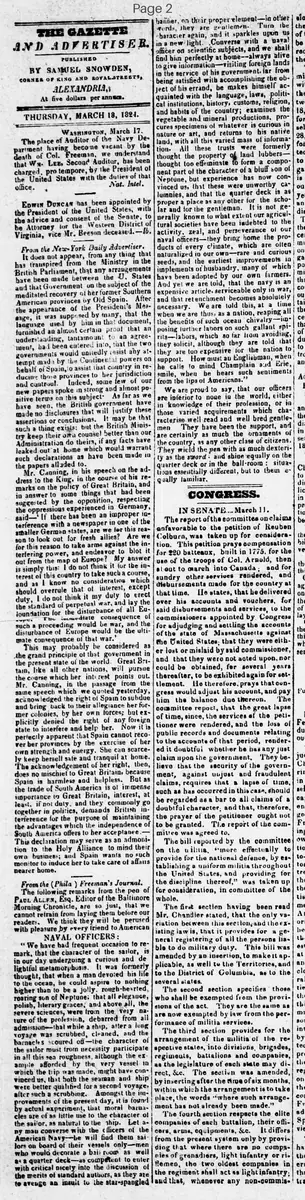
From the (Phila.) Freeman's Journal.
The following remarks from the pen of Paul Allen, Esq. Editor of the Baltimore Morning Chronicle, are so just, that we cannot refrain from laying them before our readers. We think they will be perused with pleasure by every friend to American
NAVAL OFFICERS:
"We have had frequent occasion to remark, that the character of the sailor, is in our day undergoing a curious and delightful metamorphosis. It was formerly thought, that when a man devoted his life to the ocean, he could aspire to nothing higher than to be a jolly, rough-hearted, roaring son of Neptune; that all elegance, polish, literary graces, and above all, the severe sciences, were from the very nature of the profession, debarred from all admission--that while a ship, after a long voyage was scrubbed, cleaned, and the barnacles scoured off--the character of the sailor must from necessity participate in all this sea roughness, although the example afforded by the very vessel in which the trip was made, might have convinced us, that both the seaman and ship were better qualified for a second voyage, after such a scrubbing. Amongst the improvements of the present day, it is found by actual experiment, that moral barnacles are of as little use to the character of the sailor, as natural to the ship. Let any man converse with the officers of the American Navy--he will find them sailors on board of their vessels only--men who would decorate a ball-room as well as a quarter deck--as competent to enter with critical nicety into the discussion of the merits of standard authors, as they are to avenge an insult to the star-spangled banner, on their proper element--in other words, they are gentlemen. Turn the character again, and it sparkles upon us in a new light. Converse with a naval officer on scientific subjects, and we shall find him perfectly at home--always alive to give information--visiting foreign lands in the service of his government, far from being satisfied with accomplishing the object of his errand, he makes himself acquainted with the language, laws, political institutions, history, customs, religion, and habits of the country; examines the vegetable and mineral productions, procures specimens of whatever is curious in nature or art, and returns to his native land, with all this varied mass of information. All these traits were formerly thought the property of land lubbers--thought too effeminate to form a component part of the character of a bluff son of Neptune, but experience has now convinced us, that these were unworthy calumnies, and that the quarter deck is as proper a place as any other for the scholar and for the gentleman. It is not generally known to what extent our agricultural societies have been indebted to the activity, zeal, and perseverance of our naval officers--they bring home the products of every climate, which are often naturalized in our own--rare and curious seeds, and the earliest improvements in implements of husbandry, many of which have been adopted by our own farmers. And yet we are told, that the navy is an expensive article, serviceable only in war, and that retrenchment becomes absolutely necessary. We are told this, at a time when we are thus, as a nation, reaping all the benefits of such ocean chivalry--imposing further labors on such gallant spirits--labors, which so far from avoiding, they solicit, although they are told that they are too expensive for the nation to support. How must an Englishman, when he calls to mind Champlain and Erie, smile, when he hears such sentiments from the lips of Americans."
We are proud to say, that our officers are inferior to none in the world, either in knowledge of their profession, or in those varied acquirements which characterize well read and well bred gentlemen. They have been the support, and are certainly as much the ornaments of the country, as any other class of citizens. They wield the pen with as much dexterity as the sword: and shine equally on the quarter deck or in the ball-room: situations essentially different, but to them equally familiar.
The following remarks from the pen of Paul Allen, Esq. Editor of the Baltimore Morning Chronicle, are so just, that we cannot refrain from laying them before our readers. We think they will be perused with pleasure by every friend to American
NAVAL OFFICERS:
"We have had frequent occasion to remark, that the character of the sailor, is in our day undergoing a curious and delightful metamorphosis. It was formerly thought, that when a man devoted his life to the ocean, he could aspire to nothing higher than to be a jolly, rough-hearted, roaring son of Neptune; that all elegance, polish, literary graces, and above all, the severe sciences, were from the very nature of the profession, debarred from all admission--that while a ship, after a long voyage was scrubbed, cleaned, and the barnacles scoured off--the character of the sailor must from necessity participate in all this sea roughness, although the example afforded by the very vessel in which the trip was made, might have convinced us, that both the seaman and ship were better qualified for a second voyage, after such a scrubbing. Amongst the improvements of the present day, it is found by actual experiment, that moral barnacles are of as little use to the character of the sailor, as natural to the ship. Let any man converse with the officers of the American Navy--he will find them sailors on board of their vessels only--men who would decorate a ball-room as well as a quarter deck--as competent to enter with critical nicety into the discussion of the merits of standard authors, as they are to avenge an insult to the star-spangled banner, on their proper element--in other words, they are gentlemen. Turn the character again, and it sparkles upon us in a new light. Converse with a naval officer on scientific subjects, and we shall find him perfectly at home--always alive to give information--visiting foreign lands in the service of his government, far from being satisfied with accomplishing the object of his errand, he makes himself acquainted with the language, laws, political institutions, history, customs, religion, and habits of the country; examines the vegetable and mineral productions, procures specimens of whatever is curious in nature or art, and returns to his native land, with all this varied mass of information. All these traits were formerly thought the property of land lubbers--thought too effeminate to form a component part of the character of a bluff son of Neptune, but experience has now convinced us, that these were unworthy calumnies, and that the quarter deck is as proper a place as any other for the scholar and for the gentleman. It is not generally known to what extent our agricultural societies have been indebted to the activity, zeal, and perseverance of our naval officers--they bring home the products of every climate, which are often naturalized in our own--rare and curious seeds, and the earliest improvements in implements of husbandry, many of which have been adopted by our own farmers. And yet we are told, that the navy is an expensive article, serviceable only in war, and that retrenchment becomes absolutely necessary. We are told this, at a time when we are thus, as a nation, reaping all the benefits of such ocean chivalry--imposing further labors on such gallant spirits--labors, which so far from avoiding, they solicit, although they are told that they are too expensive for the nation to support. How must an Englishman, when he calls to mind Champlain and Erie, smile, when he hears such sentiments from the lips of Americans."
We are proud to say, that our officers are inferior to none in the world, either in knowledge of their profession, or in those varied acquirements which characterize well read and well bred gentlemen. They have been the support, and are certainly as much the ornaments of the country, as any other class of citizens. They wield the pen with as much dexterity as the sword: and shine equally on the quarter deck or in the ball-room: situations essentially different, but to them equally familiar.
What sub-type of article is it?
Biography
Heroic Act
Historical Event
What themes does it cover?
Bravery Heroism
Moral Virtue
Triumph
What keywords are associated?
American Navy
Naval Officers
Character Metamorphosis
Education
Scientific Contributions
Agricultural Benefits
Retrenchment Defense
What entities or persons were involved?
Paul Allen
American Naval Officers
Where did it happen?
United States
Story Details
Key Persons
Paul Allen
American Naval Officers
Location
United States
Story Details
Paul Allen praises the transformation of American sailors into educated gentlemen who excel in literature, science, and diplomacy, contribute to agriculture, and defend the nation, countering calls for naval retrenchment by highlighting their value beyond wartime.