Thank you for visiting SNEWPapers!
Sign up free
Letter to Editor
February 13, 1816
Richmond Enquirer
Richmond, Richmond County, Virginia
What is this article about?
Extract of a satirical letter criticizing Virginia Congressman John Randolph's verbose, irrelevant three-day speech on a proposed $3 million direct tax, costing taxpayers $3,600 while he poses as a fiscal guardian. Highlights hypocrisy and historical digressions.
Clipping
OCR Quality
95%
Excellent
Full Text
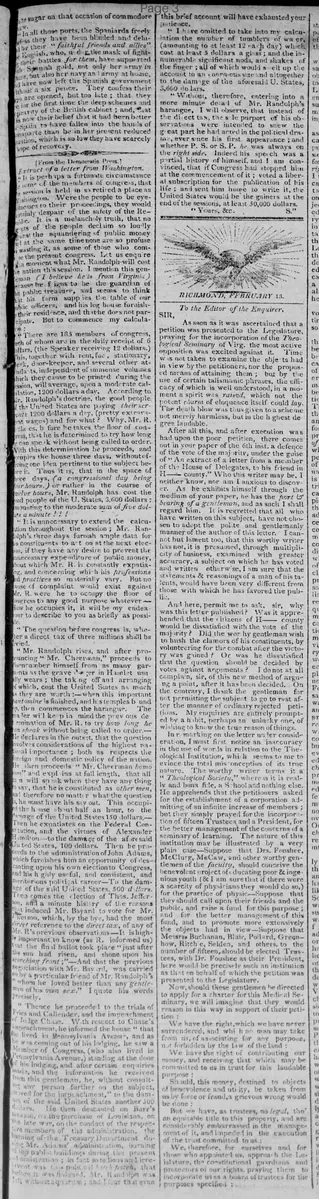
Extract of a letter from Washington.
[From the Democratic Press.]
The session is held in so retired a place as Fredericktown, that some of the members of congress, "It is perhaps a fortunate circumstance that it is so remote from Washington. Were the people to be eye-witnesses to their proceedings, they would certainly despair of the safety of the Republic."
The agents of the people declaim so loudly against the squandering of public money, and yet no one is so profuse in wasting it, as some of those who compose the present congress. Let us enquire a moment what Mr. Randolph will cost the nation this session. I mention this gentleman (I believe he is from Virginia) because he feigns to be the guardian of the public treasure, and seems to think that his farm supplies the table of our public officers, and his log house furnishes their residence, and that he does not participate. But to commence my calculation:
"There are 185 members of congress, each of whom are in the daily receipt of 6 dollars, (the Speaker receiving 12 dollars.) This, together with rent, fuel, stationery, clerk, door-keeper, and several other attendants, independent of immense volumes which they cause to be printed during the session, will average, upon a moderate calculation, 1200 dollars a day. According to Mr. Randolph's doctrine, the good people of the United States are paying their servants 1200 dollars a day, (pretty extravagant wages) and for what? Why, Mr. R. declares, before he takes the floor of congress, that he is determined to try how long he can speak without being called to order. With this determination he proceeds, and occupies the house three days, without offering one idea pertinent to the subject before it. Thus it is, that in the space of three days, (a congressional day being four hours,) or rather in the course of twelve hours, Mr. Randolph has cost the good people of the U. States, 3,600 dollars: amounting to the moderate sum of five dollars a minute!!!
"It is unnecessary to extend the calculation throughout the session; Mr. Randolph's three days furnish ample data for his constituents to act on at the next election, if they have any desire to prevent the unnecessary expenditure of public money, about which Mr. R. is constantly expatiating, and concerning which his professions and practices so materially vary. But no cause of complaint would exist against Mr. R. were he to occupy the floor of congress to any good purpose whatever. How he occupies it, it will be my endeavor to describe to you as briefly as possible.
"The question before congress is, whether a direct tax of three millions shall be levied.
"Mr. Randolph rises, and after pronouncing 'Mr. Chairman,' proceeds to disencumber himself from as many garments as the grave digger in Hamlet usually wears; the taking off and arranging of which, cost the United States as much as they are worth:--when this important pantomime is finished, and his temples bound up, then commences the harangue. The reader will keep in mind the previous determination of Mr. R. to try how long he can speak without being called to order. He declares in the outset, that the question involves considerations of the highest national importance: both as respects the foreign and domestic policy of the nation. He then proceeds 'Mr. Chairman homo sum' and explains at full length, that all men will speak when they have any thing to say, that he is constituted as other men, and therefore no matter what the question is, he must have his say out. This occupies the house about half an hour, to the damage of the United States 150 dollars.--Then he expatiates on the Federal Constitution, and the virtues of Alexander Hamilton--to the damage of the aforesaid United States. 100 dollars. Then he proceeds to the administration of John Adams, which furnishes him an opportunity of descanting upon his own election to Congress, and his highly useful, and consistent, and meritorious political career--To the damage of the said United States. 500 dollars. Then comes the election of Thos. Jefferson, and a minute history of the reasons that induced Mr. Bayard to vote for Mr. Jefferson, which, by the bye, had the most direct reference to the direct tax, of any of Mr. R's previous observations--It is highly important to know (as R. informed us) that the final ballot took place "just after the sun had risen, and shone upon his scorching front:"-- And that the previous negociation with Mr. Bayard, was carried on by a particular friend of Mr. Randolph's "whom he loved better than any gentleman of his own sex." I quote his words precisely.
"Thence he proceeded to the trials of Fries and Callender, and the impeachment of Jn. Judge Chase. With respect to Chase's impeachment, he informed the house that he lived in Pennsylvania Avenue, and as he was coming out of his lodging, he saw a Member of Congress, (who also lived in Pennsylvania Avenue, standing at the door of his lodging, and after certain enquiries made, and the information he received from this gentleman, he, without consulting any person further on the subject, moved for the impeachment," to the damage of the said United States another 100 dollars.
He then descanted on Burr's treason, on the purchase of Louisiana, on the late war, on the conduct of the respective members of the administration, the burning of the Treasury Department during Mr. Adams' administration, burning of the public buildings during the present administration: in fact so tedious and irrelevant a gasconade was poured forth, that before it was finished, Mr. Randolph was out without a quorum, and I fear that even this brief account will have exhausted your patience.
"I have omitted to take into my calculation the number of tumblers of water, (amounting to at least 12 each day) which cost at least 5 dollars a glass; and the innumerable significant nods, and shakes of the finger: all of which would swell up the account to an enormous size and altogether to the damage of the aforesaid U. States, 3,600 dollars.
"Without, therefore, entering into a more minute detail of Mr. Randolph's harangue, I will observe, that instead of the direct tax, the sole purport of his observations were intended to show the great part he had acted in the political drama, ever since his first appearance: and whether P. S. or S. P. he was always on the right side. Indeed his speech was a partial history of himself, and I am convinced, that if Congress had stopped him at the commencement of it: voted a liberal subscription for the publication of his life: and sent him home to write it, the United States would be the gainers at the end of the session, at least 50,000 dollars.
"Yours, &c.
S."
[From the Democratic Press.]
The session is held in so retired a place as Fredericktown, that some of the members of congress, "It is perhaps a fortunate circumstance that it is so remote from Washington. Were the people to be eye-witnesses to their proceedings, they would certainly despair of the safety of the Republic."
The agents of the people declaim so loudly against the squandering of public money, and yet no one is so profuse in wasting it, as some of those who compose the present congress. Let us enquire a moment what Mr. Randolph will cost the nation this session. I mention this gentleman (I believe he is from Virginia) because he feigns to be the guardian of the public treasure, and seems to think that his farm supplies the table of our public officers, and his log house furnishes their residence, and that he does not participate. But to commence my calculation:
"There are 185 members of congress, each of whom are in the daily receipt of 6 dollars, (the Speaker receiving 12 dollars.) This, together with rent, fuel, stationery, clerk, door-keeper, and several other attendants, independent of immense volumes which they cause to be printed during the session, will average, upon a moderate calculation, 1200 dollars a day. According to Mr. Randolph's doctrine, the good people of the United States are paying their servants 1200 dollars a day, (pretty extravagant wages) and for what? Why, Mr. R. declares, before he takes the floor of congress, that he is determined to try how long he can speak without being called to order. With this determination he proceeds, and occupies the house three days, without offering one idea pertinent to the subject before it. Thus it is, that in the space of three days, (a congressional day being four hours,) or rather in the course of twelve hours, Mr. Randolph has cost the good people of the U. States, 3,600 dollars: amounting to the moderate sum of five dollars a minute!!!
"It is unnecessary to extend the calculation throughout the session; Mr. Randolph's three days furnish ample data for his constituents to act on at the next election, if they have any desire to prevent the unnecessary expenditure of public money, about which Mr. R. is constantly expatiating, and concerning which his professions and practices so materially vary. But no cause of complaint would exist against Mr. R. were he to occupy the floor of congress to any good purpose whatever. How he occupies it, it will be my endeavor to describe to you as briefly as possible.
"The question before congress is, whether a direct tax of three millions shall be levied.
"Mr. Randolph rises, and after pronouncing 'Mr. Chairman,' proceeds to disencumber himself from as many garments as the grave digger in Hamlet usually wears; the taking off and arranging of which, cost the United States as much as they are worth:--when this important pantomime is finished, and his temples bound up, then commences the harangue. The reader will keep in mind the previous determination of Mr. R. to try how long he can speak without being called to order. He declares in the outset, that the question involves considerations of the highest national importance: both as respects the foreign and domestic policy of the nation. He then proceeds 'Mr. Chairman homo sum' and explains at full length, that all men will speak when they have any thing to say, that he is constituted as other men, and therefore no matter what the question is, he must have his say out. This occupies the house about half an hour, to the damage of the United States 150 dollars.--Then he expatiates on the Federal Constitution, and the virtues of Alexander Hamilton--to the damage of the aforesaid United States. 100 dollars. Then he proceeds to the administration of John Adams, which furnishes him an opportunity of descanting upon his own election to Congress, and his highly useful, and consistent, and meritorious political career--To the damage of the said United States. 500 dollars. Then comes the election of Thos. Jefferson, and a minute history of the reasons that induced Mr. Bayard to vote for Mr. Jefferson, which, by the bye, had the most direct reference to the direct tax, of any of Mr. R's previous observations--It is highly important to know (as R. informed us) that the final ballot took place "just after the sun had risen, and shone upon his scorching front:"-- And that the previous negociation with Mr. Bayard, was carried on by a particular friend of Mr. Randolph's "whom he loved better than any gentleman of his own sex." I quote his words precisely.
"Thence he proceeded to the trials of Fries and Callender, and the impeachment of Jn. Judge Chase. With respect to Chase's impeachment, he informed the house that he lived in Pennsylvania Avenue, and as he was coming out of his lodging, he saw a Member of Congress, (who also lived in Pennsylvania Avenue, standing at the door of his lodging, and after certain enquiries made, and the information he received from this gentleman, he, without consulting any person further on the subject, moved for the impeachment," to the damage of the said United States another 100 dollars.
He then descanted on Burr's treason, on the purchase of Louisiana, on the late war, on the conduct of the respective members of the administration, the burning of the Treasury Department during Mr. Adams' administration, burning of the public buildings during the present administration: in fact so tedious and irrelevant a gasconade was poured forth, that before it was finished, Mr. Randolph was out without a quorum, and I fear that even this brief account will have exhausted your patience.
"I have omitted to take into my calculation the number of tumblers of water, (amounting to at least 12 each day) which cost at least 5 dollars a glass; and the innumerable significant nods, and shakes of the finger: all of which would swell up the account to an enormous size and altogether to the damage of the aforesaid U. States, 3,600 dollars.
"Without, therefore, entering into a more minute detail of Mr. Randolph's harangue, I will observe, that instead of the direct tax, the sole purport of his observations were intended to show the great part he had acted in the political drama, ever since his first appearance: and whether P. S. or S. P. he was always on the right side. Indeed his speech was a partial history of himself, and I am convinced, that if Congress had stopped him at the commencement of it: voted a liberal subscription for the publication of his life: and sent him home to write it, the United States would be the gainers at the end of the session, at least 50,000 dollars.
"Yours, &c.
S."
What sub-type of article is it?
Satirical
Persuasive
Political
What themes does it cover?
Politics
Economic Policy
Taxation
What keywords are associated?
Congressional Waste
Randolph Speech
Direct Tax
Public Expenditure
Political Hypocrisy
Jefferson Election
Burr Treason
Louisiana Purchase
What entities or persons were involved?
S.
Letter to Editor Details
Author
S.
Main Argument
congressman randolph hypocritically wastes public money with lengthy, irrelevant speeches while claiming to guard the public treasure; his three-day speech on the direct tax cost $3,600 without advancing the discussion.
Notable Details
Calculates Speech Cost At $1,200 Per Day For Congress
References Randolph's Removal Of Garments Before Speaking
Mentions Historical Events Like Jefferson's Election, Burr's Treason, Louisiana Purchase
Suggests Publishing Randolph's Life Story To Save Money